

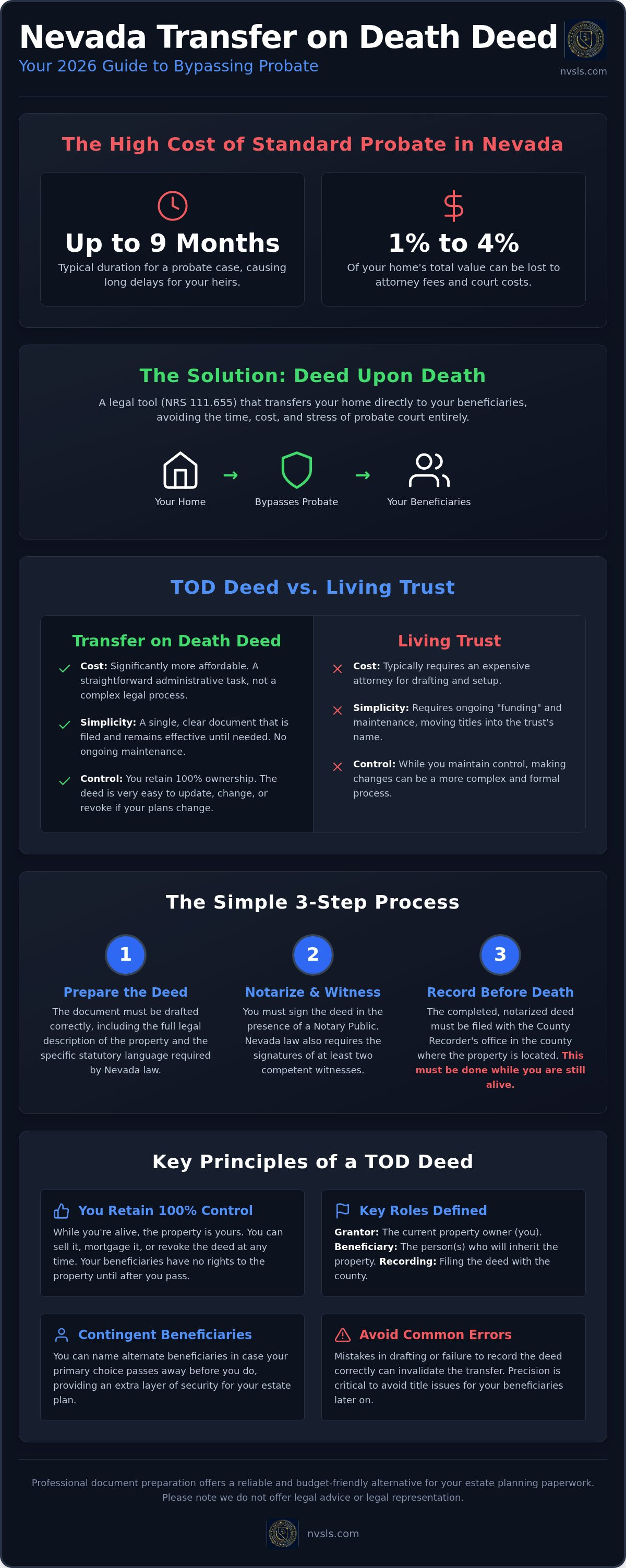
Did you know that a standard probate case in Nevada can take up to nine months and cost your family 1% to 4% of your home's total value in attorney fees? It's frustrating to think that after a lifetime of hard work, a significant portion of your equity could be swallowed by court costs and legal paperwork. You want a simple way to protect your heirs without losing control of your property today.
This 2026 guide shows you how a nevada transfer on death deed, legally known as a Deed Upon Death, allows you to bypass the probate system entirely. You can ensure your home goes directly to your beneficiaries without the need for a judge or an expensive law firm. It's a straightforward solution for homeowners who value both their time and their legacy.
We'll walk through the specific 2026 filing requirements, explain how to avoid common recording mistakes that could invalidate your transfer, and show you how to keep your home in your hands while ensuring a seamless transition for your loved ones. Please note that while we provide professional document preparation, we do not offer legal advice or legal representation. You don't need a complex trust to secure your family's future; you just need the right paperwork handled with precision.
Key Takeaways
- Learn why a nevada transfer on death deed is the most efficient way to keep your real estate out of probate court while maintaining full control during your lifetime.
- Identify the essential statutory language and recording deadlines required by the Nevada Deed Upon Death Act to protect your property transfer.
- Uncover the top drafting errors that lead to title insurance issues and how to solve them before they impact your beneficiaries.
- Get a step-by-step breakdown of how to prepare, notarize, and record your deed in Clark County or elsewhere in Nevada.
- Explore how professional document preparation offers a reliable, budget-friendly alternative to expensive law firms for your estate planning paperwork.
What is a Nevada Transfer on Death Deed? (2026 Update)
A nevada transfer on death deed is a legal document that allows you to designate exactly who will inherit your real estate after you pass away. Think of it like a beneficiary designation on a bank account, but for your home. This tool is officially authorized by the Nevada Deed Upon Death Act, which you can find in NRS 111.655 through 111.699. It provides a clear, statutory path to transfer property without the need for a judge's signature.
The most important thing to understand is that this deed does not take effect until you die. You retain 100% ownership of your home while you're alive. You can still sell the property, refinance your mortgage, or change your mind and revoke the deed at any time. When the time comes, the transfer happens automatically. This means your family avoids the stress and high costs of the Nevada probate system, which can often take nine months or longer to resolve for a typical estate.
Key Terminology for Nevada Homeowners
To use this tool correctly, you need to understand three basic roles in the process. Clarity here prevents filing mistakes that could cause delays later.
- Grantor: This is you. It's the current owner of the property who is creating and signing the deed.
- Beneficiary: This is the person, or sometimes an entity like a charity, that you choose to receive the property. You can even name contingent beneficiaries in case your first choice passes away before you do.
- Recording: This is the act of filing your completed document with the County Recorder's office. In Nevada, your nevada transfer on death deed must be recorded in the county where the property is located while you are still alive. If you forget this step, the deed is legally void.
TOD Deed vs. Living Trust: Which is Right for You?
While some homeowners look into Life Estate and Beneficiary Deeds to protect their assets, most find that a TOD deed is the most practical choice for a primary residence. Here's why many people in Southern Nevada choose this path over a complex living trust:
- Cost: Drafting a full living trust usually requires a high-priced attorney. Preparing a TOD deed is a significantly more affordable administrative task.
- Simplicity: Trusts require ongoing maintenance and "funding," which means moving titles into the name of the trust. A TOD deed is a single document that stays on file until it's needed.
- Control: Both options let you keep control of your home. However, the TOD deed is much easier to cancel or update if your family situation changes.
If your estate is relatively simple and your main goal is to keep your family home out of court, this deed is often the perfect fit. Nevada State Forms & Filing Services specializes in professional document preparation for these specific needs. We are not a law firm; we don't provide legal representation or legal advice. Our goal is to help you handle the paperwork accurately and efficiently so you can have peace of mind about 2026 and beyond.
How the Nevada Deed Upon Death Act Works
Understanding the mechanics of a nevada transfer on death deed is essential for a successful estate plan. This document operates under a specific set of rules designed to protect your property rights while you're alive. One of the most critical requirements is the recording deadline. You must record the deed in the county where the property is located before you pass away. If the document isn't part of the public record at the time of your death, the transfer won't happen, and the house will likely end up in probate court.
While the deed is recorded, your beneficiaries have no legal rights to your home. They can't use it as collateral, they can't move in without your permission, and they have no say in how you manage the property. You keep the absolute right to sell the home, take out a new mortgage, or renovate as you see fit. This flexibility is a core feature of Nevada's Uniform Real Property Transfer on Death Act. It ensures that you aren't "giving away" your house until you no longer need it.
NRS 111.655 Requirements for Validity
To be legally binding, your deed must follow the strict standards set by Nevada law. It isn't enough to just sign the paper. You must sign the document in the presence of a Notary Public and at least two witnesses. These witnesses provide an extra layer of security to prove the document was created voluntarily. Precision is your best friend during this stage. The legal description of your property must match your existing deed exactly. Even a minor typo in the "Lot and Block" description can create a title gap, which could complicate the transfer for your heirs in 2026.
The Role of the Clark County Recorder
If your property is in Las Vegas, Henderson, or North Las Vegas, you'll work with the Clark County Recorder. This office handles a massive volume of filings, so they require specific formatting. Your document must include the eleven-digit Assessor Parcel Number (APN) at the top of the first page. In 2026, the Recorder's office uses updated digital indexing rules that make these deeds much easier to track and verify. This modern system helps ensure that when the time comes, the transition to your beneficiary is as smooth as possible. We can assist you with accurate deed and contract drafting to make sure your paperwork meets these exact local standards. Please remember that we are a document preparation service; we don't provide legal representation or legal advice.
Some people worry that a nevada transfer on death deed will make it impossible for their children to sell the house later. This is a common myth. In the past, some title insurance companies were cautious because they wanted to avoid potential claims from unknown creditors. However, modern title standards have evolved significantly. According to the Legal Information Institute (LII) definition, these deeds are now recognized as reliable statutory tools. When your paperwork is prepared with precision, title companies can clearly see the chain of ownership. The real risk isn't the deed itself; it's the mistakes people make during the filing process. Common filing errors like incorrect legal descriptions, missing Assessor Parcel Numbers (APN), or forgotten witness signatures can invalidate the entire transfer. These small oversights create a "cloud" on the title that can scare off future buyers. This is why professional document preparation is so important for your 2026 planning. We ensure your paperwork is precise and ready for recording. Please remember that we are a document preparation service. We don't provide legal representation or legal advice.Protecting the Beneficiary from Creditors
In Nevada, your home isn't immediately shielded from your debts just because you used a TOD deed. Under state law, your estate remains liable for certain valid debts for an 18-month statutory period after your death. This means creditors have a specific window to file claims against the estate's assets.
- Medicaid Recovery: If you received state assistance for long-term care, the state may seek reimbursement from the equity in the home.
- Contingent Beneficiaries: It's smart to name a backup. If your primary beneficiary passes away before you, and you haven't named a secondary person, the property could fall back into probate.
- Existing Liens: Your heirs inherit the property, but they also take on any existing mortgages or tax liens attached to the title.
Solving the Title Insurance Hurdle
To ensure your beneficiary can sell the house without a hitch in 2026, the deed must be "clean." This means every detail must be perfect from the start. A major part of this is the Notary Acknowledgement. If the notary block is formatted incorrectly, the County Recorder might reject it, or a title officer might flag it years later during a sale.
Using professional deed drafting in Las Vegas helps you avoid these administrative nightmares. We focus on the tiny details that title companies look for, such as matching the exact formatting requirements of local recording offices. By getting the paperwork right the first time, you save your family from expensive legal delays down the road.
Steps to Prepare and Record Your Nevada TOD Deed
Preparing a nevada transfer on death deed is a logical, multi-step process. You don't need a law firm to handle the administrative side, but you do need to be precise. The goal is to create a document that the County Recorder will accept on the first try. Following a structured path ensures your beneficiaries won't face a rejected filing years from now.
Gathering Your Property Information
You'll need to start with your most recent deed. In Clark County, you can find this through the Recorder’s online search tool or by visiting their office in downtown Las Vegas. You are looking for the "legal description." The legal description is the specific metes and bounds or lot and block information that identifies your property's boundaries on a map. If you own your home in Joint Tenancy, remember that the TOD deed only becomes effective after the last joint tenant passes away. Both owners should sign the new deed to ensure the plan remains intact and avoids probate later.
The Notarization and Recording Process
Once your document is drafted using the 2026 Nevada statutory language, you must sign it in front of a Notary Public and two witnesses. These witnesses cannot be the beneficiaries you named in the deed. For many homeowners, scheduling a mobile notary in Las Vegas is the most efficient way to handle this. It allows everyone to sign at once in the comfort of your home, ensuring the signatures are captured correctly.
After notarization, you must record the deed. In Clark County, the recording fee for a Deed Upon Death is $42 as of 2026. You'll also need to submit a "Declaration of Value" form, though these transfers are exempt from the Real Property Transfer Tax. The Recorder’s office typically processes these documents within a few business days. However, high-volume periods can extend that timeline slightly. Once recorded, the original document is returned to you, and your probate-avoidance plan is officially in place.
Getting these steps right ensures your heirs avoid a 6 to 9 month probate battle. We provide professional estate planning documents and filing support to help you manage this process without the stress of doing it alone. Please note that we are a document preparation service and do not provide legal advice or legal representation.
Professional Document Preparation in Southern Nevada
Many homeowners assume they must hire an expensive law firm to handle their estate planning. In 2026, that's often an unnecessary expense for straightforward tasks. A nevada transfer on death deed is a powerful tool, but its success depends entirely on administrative accuracy. Nevada State Forms & Filing Services fills this gap by providing professional document preparation that focuses on precision without the high hourly rates of an attorney. We act as your "Friendly Expert Guide," taking the stress out of the paperwork so you can focus on your family.
One of the biggest advantages we offer is the integration of our mobile notary services with our document drafting. This is particularly valuable for elderly grantors or individuals with limited mobility in the Las Vegas valley. Instead of navigating traffic to reach a downtown office, we bring the signing process to your living room. This ensures that the mandatory witness and notary requirements are met in a comfortable, low-stress environment. By combining these services, we help you complete the entire process from drafting to notarization in one seamless sequence.
Affordable Peace of Mind for Las Vegas Families
Our services are designed for residents in Las Vegas, Henderson, and North Las Vegas who want a streamlined experience. We understand the specific filing nuances of the Clark County Recorder’s office. Whether you need a TOD deed or quitclaim deed preparation in Nevada, we ensure your documents are formatted correctly for 2026 standards. Our commitment is simple: we provide professional support and expert document drafting without offering legal advice or legal representation. This no-nonsense approach saves you time and keeps your hard-earned equity in your pocket.
Ready to Protect Your Home?
The best time to secure your property is before a crisis occurs. Avoiding the six to nine month probate timeline starts with a single, well-prepared document. A nevada transfer on death deed is a practical step that provides lasting peace of mind for you and your beneficiaries. It’s an efficient way to ensure your legacy remains intact without court intervention. If you are ready to take control of your property’s future, Contact Nevada State Forms & Filing Services for a consultation on your deed preparation. We are here to help you get the job done right.
Secure Your Property for 2026 and Beyond
Protecting your family's future doesn't have to be a complicated or expensive ordeal. By choosing a nevada transfer on death deed, you can bypass the stress of probate court while maintaining absolute control of your home today. This simple document ensures your heirs avoid months of legal delays and thousands of dollars in potential attorney fees. It is a practical, effective tool for anyone looking to simplify their estate plan without the high costs of a traditional law firm.
Nevada State Forms & Filing Services offers a reliable, no-nonsense alternative for your document drafting needs. We specialize in expert preparation that meets all 2026 Nevada requirements. For added convenience, our mobile notary service is available throughout Las Vegas and Henderson to help you finalize your paperwork at home. Please keep in mind that we provide document preparation and are not a law firm; we do not offer legal representation or legal advice. Take the first step toward lasting peace of mind today.
Get Started with Professional Nevada Deed Preparation Today
Frequently Asked Questions
Does a Nevada TOD deed avoid probate?
Yes, a nevada transfer on death deed effectively avoids probate for the real estate it covers. By recording this document before you pass away, the property title transfers directly to your named beneficiaries outside of the court system. This prevents your heirs from dealing with the standard 6 to 9 month probate process in Clark County. It's a highly efficient way to keep your home's equity in your family's hands rather than losing it to court costs.
Can I change my mind after recording a TOD deed?
You can absolutely change your mind at any time during your life. A Deed Upon Death is fully revocable. To cancel it, you simply record a formal revocation or a new nevada transfer on death deed with the County Recorder. The law recognizes the most recently recorded document as the valid one. This flexibility allows you to update your estate plan as your family situation or personal preferences evolve without needing a judge's permission.
Do I need a lawyer to prepare a transfer on death deed in Nevada?
You are not legally required to hire a lawyer to prepare this document. Many homeowners in Las Vegas and Henderson choose professional document preparation services like ours as a cost-effective alternative to expensive law firms. We specialize in drafting estate planning paperwork that meets all 2026 statutory requirements. While we don't provide legal representation or legal advice, we ensure your paperwork is precise and ready for recording, saving you significant money on administrative tasks.
What happens if the beneficiary dies before the grantor?
If your primary beneficiary passes away before you, the property transfer will fail unless you have named a contingent beneficiary. Without a backup person listed on the deed, the property will likely be forced into the Nevada probate process upon your death. We recommend naming at least one contingent beneficiary in your drafting to ensure the property remains outside of court even if your first choice is unable to inherit the home.
Will a TOD deed affect my property taxes in Las Vegas?
Recording this deed won't change your property taxes or your current tax assessment in Las Vegas. Since the transfer doesn't actually happen until your death, you keep your existing tax status and any exemptions you currently hold. Additionally, these deeds are exempt from the Nevada Real Property Transfer Tax at the time of recording. Your beneficiaries will only face a tax reassessment once they officially take ownership of the property after you pass away in 2026.
Does a TOD deed protect my home from Medicaid recovery?
A Transfer on Death Deed doesn't shield your home from Medicaid estate recovery in Nevada. If you receive state assistance for long-term care, the state has a statutory right to seek reimbursement from your estate assets, including property transferred via a TOD deed. The beneficiary takes the property subject to these claims. If you have concerns about long-term care costs, it's vital to understand that this specific deed is a probate-avoidance tool, not an asset-protection shield.
Can I sell my house if there is a TOD deed recorded?
You retain 100% control over your property and can sell it at any time. The recorded deed doesn't grant the beneficiary any current rights or interests in your home. You don't need their permission to sell, mortgage, or lease the property. If you sell the home, the TOD deed simply becomes void because you no longer own the asset at the time of your death. It's a "wait-and-see" document that only triggers if you still own the house.
How much does it cost to record a deed in Clark County in 2026?
As of 2026, the recording fee for a Deed Upon Death in Clark County is $42. This fee is paid directly to the County Recorder’s office at the time of filing. While this is the standard rate in Las Vegas, Henderson, and North Las Vegas, other Nevada counties may have slightly different fee structures. You'll also need to file a Declaration of Value form, although these specific transfers are exempt from the Nevada Real Property Transfer Tax.


