

Choosing the wrong document to transfer your Nevada property can lead to years of title headaches and unexpected legal bills. While many homeowners look for the simplest path, failing to understand the legal weight of a bargain and sale deed can result in costly surprises at the Clark County Recorder's office. You want a transfer process that's efficient and affordable, yet the fear of hidden liens or filing errors is enough to keep anyone up at night. It's stressful to weigh "implied covenants" against "express warranties" when your home or investment is on the line.
We understand that you just want the job done right without the stress of a DIY disaster. This guide will show you how this specific deed serves as a reliable middle ground, offering more protection than a quitclaim deed without the complexity of a full warranty deed. We'll break down exactly how these transfers function under 2026 Nevada law. You'll get a clear roadmap for drafting, notarizing, and filing your paperwork correctly so you can move forward with total confidence and peace of mind.
Key Takeaways
- A bargain and sale deed provides a reliable middle ground for Nevada property transfers by implying the grantor holds a valid interest in the title.
- Learn the crucial distinction between implied covenants and express warranties to better understand your protections against future title claims.
- Compare this deed type against quitclaim options to determine which document offers the right balance of speed and security for your specific situation.
- Identify the mandatory 2026 filing elements for Clark County, such as Assessor’s Parcel Numbers and tax statement addresses, to ensure a smooth recording process.
- Discover how professional document preparation prevents common errors found in generic forms and keeps your property transfer compliant with local standards.
What is a Bargain and Sale Deed in Nevada?
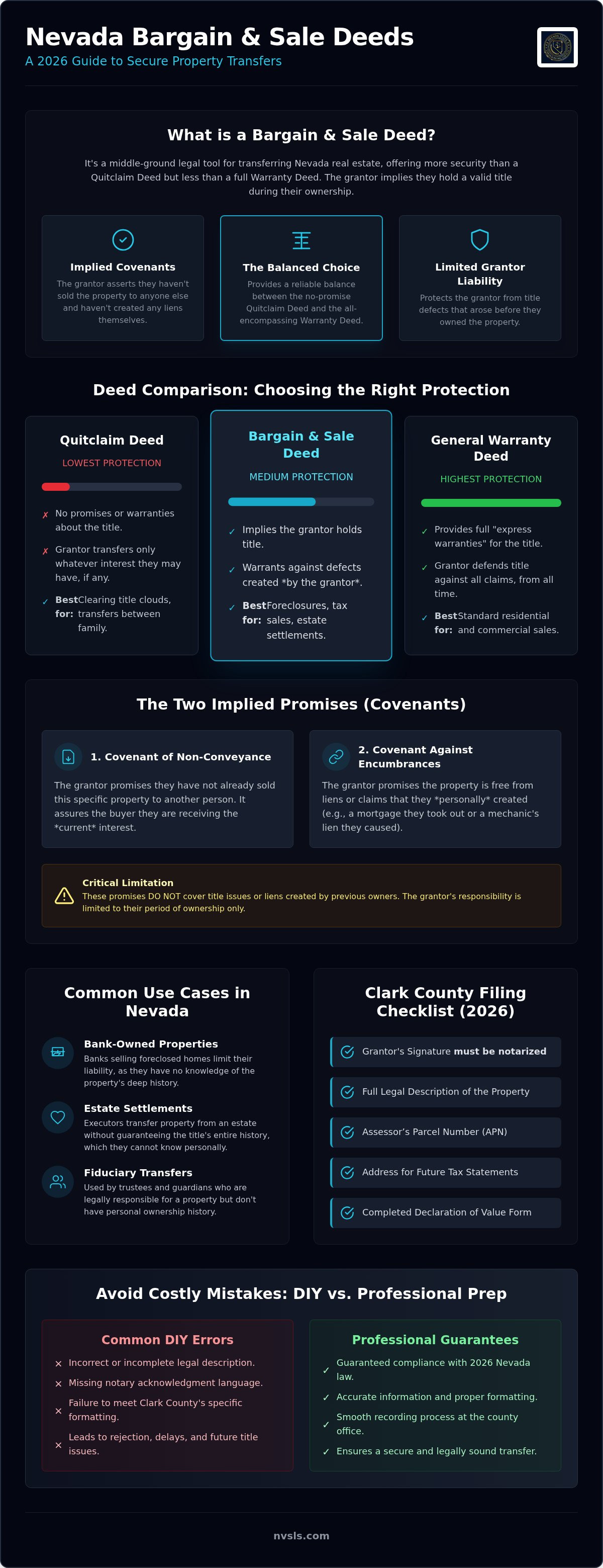
A Bargain and Sale Deed is a legal tool used to transfer Nevada real estate. It's the middle-of-the-road option for property owners. It's more secure than a quitclaim deed but less protective than a general warranty deed. The core concept is simple. The person giving the property, known as the grantor, implies they actually own an interest in it. They aren't just handing over a "maybe" interest; they're asserting they have a legal right to convey the title. Under Nevada law, this instrument implies two specific covenants: the grantor hasn't conveyed the same title to anyone else and the property is free from encumbrances they personally created.
This deed doesn't provide a 100% guarantee against every possible title defect in history. It focuses on the time the grantor actually held the property. It's a scaled-back promise. You'll frequently encounter this document in foreclosures, tax sales, and estate settlements. In these situations, the seller often doesn't have a personal history with the land. They can't swear to what happened forty years ago, so they use a bargain and sale deed to limit their future liability.
How It Differs from a General Warranty Deed
General warranty deeds are the gold standard for residential sales. They offer express warranties. This means the seller defends the title against all claims, forever. This instrument is different. It usually contains a "covenant against grantor’s acts." This specific promise only covers the period the seller owned the home. If a lien popped up from a previous owner, the seller isn't on the hook. It's about precision and limiting risk for the person signing the document. It provides enough "teeth" to satisfy title companies while protecting the grantor from unknown defects.
Common Use Cases in the Las Vegas Real Estate Market
In Las Vegas and Henderson, these deeds are common in specific scenarios where the grantor has limited knowledge of the property’s history:
- Bank-Owned Properties: If a bank sells a foreclosed home in Summerlin, they won't give a full warranty. They use this deed because they only want to be responsible for their own tenure.
- Estate Settlements: It's the standard for transferring property from a deceased person's estate. Since the executor didn't live there, they can't provide a full history of the property's title.
- Fiduciary Transfers: It bridges the gap between a complete lack of protection and an unrealistic guarantee. It's practical, efficient, and widely accepted by the Clark County Recorder’s Office.
Using this deed allows the transfer to move forward without the grantor fearing a lawsuit over a hidden boundary dispute from the 1980s. It provides the buyer with the assurance that the seller actually has something to sell, without requiring the seller to act as a permanent title insurer.
Understanding Covenants and Warranties in 2026
In Nevada real estate, the specific language in your document determines how much protection you actually receive. Most types of deeds in Nevada fall into categories based on their "covenants." These are legally binding promises. While a general warranty deed lists these promises explicitly, a bargain and sale deed operates on a system of implications. It's a subtle but vital distinction for anyone transferring property in Clark County.
You might encounter the term "seisin" during the drafting process. It simply means the grantor claims they have the legal right to possess and sell the property. Along with this, a "covenant of quiet enjoyment" is often attached. It's a promise that your ownership won't be interrupted by someone claiming a superior legal right. However, in this deed type, that promise is limited. It doesn't cover the entire history of the land; it only covers the time the current seller held the title. If you need help ensuring your paperwork reflects these promises accurately, professional deed drafting can help you avoid common language pitfalls.
Implied Covenants: What You Are Actually Promising
When you sign this document, you're making two specific legal assumptions. First, you're promising that you haven't already sold this specific property to another person. Second, you're stating that the property is free from any liens or encumbrances that you personally created. An implied covenant is a legal assumption of ownership that exists even if it isn't written word-for-word in the text. It's a "clean hands" promise. You're essentially saying that you haven't messed up the title during your tenure.
The Risk Factor for the Grantee
The biggest danger for a buyer is what happened before the current seller took over. This bargain and sale deed doesn't protect you against "hidden" liens from five or ten years ago. If a previous owner failed to pay their taxes or had a contractor lien recorded, those issues stay with the land. The current grantor isn't responsible for fixing them. This shifts the burden of due diligence entirely onto you. You can't just trust the deed to clear the path. A professional title search is mandatory to uncover the full history of the property. Even with a correctly filed deed, title insurance remains your primary shield against these legacy defects.
Bargain and Sale Deed vs. Quitclaim Deed: The Comparison
The choice between these two documents often comes down to trust. A quitclaim deed is the ultimate "as-is" transfer. It makes no promise that the person signing the document actually owns the land. They're simply releasing any interest they might have. In contrast, a bargain and sale deed implies that the grantor holds a valid title. This small distinction has massive legal consequences if a dispute arises later. Precision matters here. You don't want to find out after the fact that your deed didn't actually transfer ownership.
Quitclaim deeds are common for simple family transfers. If you're adding a spouse to a title or moving property into a trust, they're efficient. However, for "arms-length" transactions where you don't know the seller personally, this instrument is preferred. It provides a baseline level of protection that a quitclaim simply cannot match.
Key Differences at a Glance
Understanding the hierarchy of protection helps you choose the right path. While a quitclaim deed preparation Nevada process is fast, it might be insufficient for most sales. Here's how they compare:
| Feature | Bargain and Sale Deed | Quitclaim Deed |
|---|---|---|
| Warranty Level | Implied (Limited) | None |
| Ownership Claim | Implies Grantor holds title | No claim of ownership |
| Typical Use | Foreclosures, Estates | Family, Divorce, Trusts |
One major technical difference is the "after-acquired title" rule. If someone signs a bargain and sale deed before they officially own the property, but they acquire the title later, that ownership automatically passes to the buyer. A quitclaim deed doesn't do this. If the grantor didn't own the home the moment they signed the quitclaim, the buyer gets nothing, even if the grantor buys the home the next day.
Choosing the Right Deed for Your Nevada Property
Think about your specific scenario. Are you handling a divorce settlement where both parties already know the title history? A quitclaim is likely your best bet. Are you buying a foreclosure in North Las Vegas from a bank? You'll almost certainly receive this deed type. It bridges the gap between total risk and a full warranty.
If you're unsure which level of protection you need, look at the source of the property. When the seller is a fiduciary or a corporate entity, they rarely provide full warranties. They want to limit their liability to their own period of ownership. Accuracy in these documents is non-negotiable. Using professional deed drafting Las Vegas ensures that your document meets Clark County standards while reflecting the correct legal intent of your transfer.
Filing Your Deed in Nevada: Requirements and Procedures
Drafting your bargain and sale deed is only the first half of the battle. To make the transfer official, you must navigate the strict requirements of the Clark County Recorder’s Office. Every document must meet specific formatting standards to avoid immediate rejection. This includes using black ink on 8.5 x 11-inch paper and maintaining a one-inch margin on all sides. Missing the Assessor’s Parcel Number (APN), the grantee's mailing address, or the address for the tax statement is a guaranteed way to have your paperwork sent back. Accuracy at this stage prevents unnecessary delays and extra fees.
Every deed recorded in Nevada must be accompanied by a Declaration of Value (DOV) form. This document isn't just a formality. It's how the state calculates the Real Property Transfer Tax. As of September 2026, the total transfer tax in Clark County is $2.55 for every $500 of property value. If your transfer qualifies for an exemption, such as a transfer between parent and child, you must cite the specific Nevada Revised Statute (NRS) on the DOV form. Precision here is critical. Even a small clerical error can stall your property transfer for weeks.
The Notarization Step: Ensuring Validity
An unnotarized deed is just a piece of paper in the eyes of the County Recorder. Nevada law requires a formal acknowledgment to prove the signature is authentic. The notary verifies your identity and confirms the signing is a "free and voluntary act." Coordinating schedules for multiple signers can be a logistical nightmare. Utilizing a mobile notary Las Vegas service simplifies this process by bringing the signing table to your home or office. It's a fast, reliable way to ensure your bargain and sale deed is legally binding before you head to the recorder’s window.
Recording the Deed in Clark County
Nevada follows a "Race-Notice" rule for property ownership. This means the first person to record a valid deed without notice of a prior transfer usually wins the legal right to the property. Delaying your filing creates a window of risk. Once your signatures are notarized, take your deed and DOV form to the Recorder’s Office immediately. You'll need to pay the flat recording fee, which is currently $42.00 in Clark County. This step completes the public record and protects your interest in the property.
Don't let a simple formatting mistake invalidate your property transfer. If you're feeling overwhelmed by the paperwork, our team provides expert administrative filing support to ensure your documents are accepted on the first try. We handle the technical details so you can move forward with your property goals.
Professional Document Prep: Avoiding Costly Mistakes
Downloading a generic property form from a random website is a risky gamble. Many homeowners assume a one-size-fits-all bargain and sale deed will work in any state. In Nevada, this is rarely true. Our local recording offices have strict, evolving standards that generic templates simply don't address. A single clerical error can lead to a rejected filing or, even worse, a permanent cloud on your property's title. We've seen simple transfers turn into administrative nightmares because of a missing parcel number or an outdated notary block. Precision isn't just a goal; it's a requirement for a successful transfer.
Professional document preparation ensures your paperwork complies with current 2026 Nevada laws. It's about more than just filling in the blanks. It involves understanding the specific formatting rules for the Clark County Recorder and ensuring every mandatory disclosure is included. We focus on speed and accuracy so you don't have to spend your afternoon at the recorder's window only to be sent home. Our approach combines local expertise with a methodical process designed to get your deed accepted on the first attempt.
Why DIY Deed Drafting Often Fails
Incorrect legal descriptions remain the number one cause of deed failures in Southern Nevada. It's a common pitfall. People often use the street address when the recorder requires the full metes and bounds description found on the previous deed. Beyond the text of the document, improper notary acknowledgments frequently stall the process. Nevada has specific wording requirements for notary blocks; if your form uses a template from another state, it won't be recorded. Finally, many DIY attempts fail to include Nevada-specific disclosures, such as the mandatory Seller's Real Property Disclosure, which can leave the grantor vulnerable to future litigation.
How NVSLS Supports Your Property Transfer
At Nevada State Forms & Filing Services, we take the guesswork out of the process. We provide professional document preparation tailored to your specific situation. Our team understands the administrative hurdles of the local recorder's office and handles the technical details of the filing. We don't provide legal advice, but we do provide the expert drafting you need to ensure your bargain and sale deed is accurate and ready for signing. We bridge the gap between complex state requirements and the practical needs of your property transfer.
Ready to secure your transfer? Contact Nevada State Forms & Filing Services today to ensure your documents are drafted with precision and filed correctly the first time.
Securing Your Nevada Property Transfer with Confidence
Your property transfer doesn't have to be a source of constant anxiety. By choosing a bargain and sale deed, you've identified a practical path that balances legal protection with administrative efficiency. You now understand the weight of implied covenants and the critical importance of meeting 2026 Clark County recording standards. From managing the Declaration of Value form to ensuring your legal description is flawless, every detail matters for a successful filing. Precision is the key to avoiding the stress and delays of a rejected document.
Don't let technicalities or formatting errors stall your progress or create title clouds. We provide expert document preparation tailored to Nevada requirements and offer convenient mobile notary services throughout Las Vegas and Henderson. Our team is here to provide the accurate filing support you need to prevent recorder rejections and protect your investment. We handle the complex paperwork so you can focus on your next move without the headache.
Get Professional Deed Preparation in Las Vegas Today
You've done the research and have the roadmap in hand. Now, it's time to finalize your transfer with total peace of mind and move forward with your property goals.
Frequently Asked Questions
Is a bargain and sale deed the same as a warranty deed?
No, they differ in the scope of protection they provide to the buyer. A general warranty deed is the gold standard because the seller promises to defend the title against all claims throughout history. In contrast, a bargain and sale deed only implies the grantor holds the title and hasn't personally caused any encumbrances. It's a middle ground document often used when the seller hasn't owned the property long enough to offer a full warranty.
Does a bargain and sale deed clear the title of liens in Nevada?
No, this document doesn't automatically clear the title of existing liens or defects. It only carries an implied promise that the current grantor hasn't added any new liens during their period of ownership. Any legacy liens from previous owners remain attached to the property. This is why conducting a thorough title search in Clark County is vital. You shouldn't assume the deed itself acts as a guarantee against hidden financial claims from the past.
Can I use a bargain and sale deed to transfer property to a family member?
Yes, you can use this document for family transfers, though a quitclaim deed is more common for simple name changes or trust transfers. You might choose a bargain and sale deed if you want to provide a baseline level of assurance that you actually hold a valid interest in the property. It's a practical choice for transfers between relatives where some level of title accountability is preferred over the "as-is" nature of a quitclaim.
What happens if a bargain and sale deed is not recorded?
Failing to record the deed at the Clark County Recorder’s Office leaves your ownership vulnerable to outside claims. Nevada follows a "Race-Notice" rule, meaning the first person to record a valid deed usually wins a legal dispute over ownership. While the document might be valid between the two people who signed it, it doesn't provide public notice. If another claim is filed before yours, you could lose your legal right to the property entirely.
Do I need a lawyer to prepare a bargain and sale deed in Las Vegas?
You aren't legally required to hire an attorney for deed preparation in Las Vegas. Many residents choose professional document preparation services like Nevada State Forms & Filing Services to handle the drafting and administrative filing. We focus on ensuring your paperwork meets all local formatting and disclosure requirements. This approach provides a cost-effective alternative to a law firm while ensuring your documents are accurate, notarized, and ready for recording at the county office.
What information is required on a Nevada bargain and sale deed?
To be valid in Nevada, the document must include the names and addresses of both the grantor and grantee. You must also provide the Assessor’s Parcel Number (APN) and a complete legal description of the land. Additionally, the deed must list the grantee's mailing address and the specific address where future tax statements should be sent. Finally, the grantor’s signature must be properly acknowledged by a notary to be accepted by the recorder.
Can a bargain and sale deed be used for an LLC formation in Nevada?
Yes, this deed is a common tool for moving property from an individual into a newly formed Nevada LLC. It's a strategic move for asset protection and estate planning. Using a bargain and sale deed for this purpose is often preferred over a quitclaim because it asserts that the individual transferring the property actually holds a valid title. This creates a clearer ownership chain for the business entity as it begins its operations in Las Vegas.
Is title insurance necessary with a bargain and sale deed?
Yes, title insurance is strongly recommended whenever you use this type of deed. Because the warranties are only implied and limited to the grantor’s tenure, you remain exposed to risks from previous owners. A title policy protects you against hidden defects like forged documents, undisclosed heirs, or ancient liens that a standard deed won't cover. It provides the ultimate safety net for your investment, ensuring your ownership remains secure regardless of the deed type used.


