

Paying a lawyer hundreds of dollars for a simple administrative property transfer might be the most unnecessary expense you face this year. While the law requires precision, it doesn't require a courtroom advocate to move a name on a title. Most homeowners just want a document that works, yet they're paralyzed by the fear of the Clark County Recorder rejecting their filing due to a minor typo or a confusing legal description.
We understand that the bureaucracy of APN numbers and Nevada vesting options feels like a minefield. You deserve a process that's transparent, affordable, and accurate. This 2026 guide simplifies deed drafting Las Vegas by showing you how to prepare, notarize, and file your documents correctly. You'll learn how to navigate the latest Clark County requirements, avoid common errors that stall transfers, and secure your property rights without the high cost of a law firm. We'll break down the specific steps to ensure your deed is rejection-proof and ready for the recorder's office. Please note that while we provide professional document assistance, we don't offer legal representation or legal advice.
Key Takeaways
- Understand the critical distinction between a property title and the physical deed document to ensure your ownership rights are properly recorded.
- Identify which Nevada-specific instrument fits your situation, from Quitclaim Deeds for family transfers to Grant Deeds for residential sales.
- Master the technical requirements for deed drafting Las Vegas, including the precise use of Assessor’s Parcel Numbers (APN) and legal descriptions.
- Avoid common "rejection risks" at the Clark County Recorder’s office by choosing professional document preparation over generic, one-size-fits-all online forms.
- Streamline your property transfer with an integrated approach that combines accurate drafting, mobile notary services, and local filing support.
Understanding Property Deeds and Title Transfers in Las Vegas
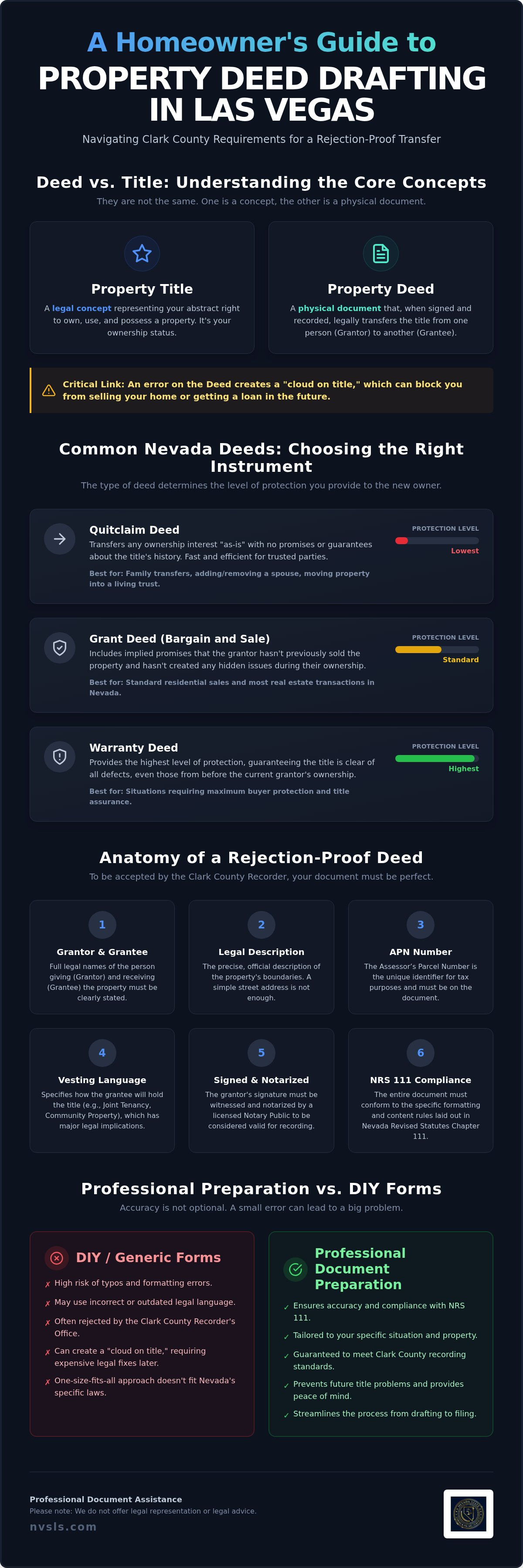
Many people use the terms "title" and "deed" as if they're the same thing. They aren't. A title is a legal concept representing your right to own and use a property. A deed is the physical, written instrument that moves that right from one person to another. Understanding What is a Property Deed? helps clarify that this document is the actual "vehicle" for ownership. In Southern Nevada, the Clark County Recorder’s Office serves as the official archive for these documents. They maintain public land records but don't verify the legal validity of what you file. If your paperwork is wrong, the record is wrong.
The Legal Framework: NRS Chapter 111
Nevada property law is strictly governed by the Nevada Revised Statutes, specifically Chapter 111. This chapter includes the Statute of Frauds, a long-standing legal principle requiring all real estate transfers to be in writing. You can't transfer a house in Las Vegas with a handshake or a simple email. Professional deed drafting Las Vegas must follow these specific state codes to be recognized as valid. In every Nevada deed, the Grantor is the party giving up the property interest, and the Grantee is the party receiving that interest. Following these statutes ensures that your transfer isn't just a private agreement, but a legally binding public record.
Deed vs. Title: Why the Document Matters
A title is abstract, but a deed is permanent. If your deed contains errors, it creates what experts call a "cloud on title." This is a technical defect that can block you from selling your home or getting a loan years later. Title companies and lenders look for a "clean" chain of title. A single typo in a legal description can break that chain. This is why "vesting" is so important. Vesting is the specific way you hold the title, such as Joint Tenancy or Community Property. It dictates whether your property goes through a long probate process or transfers automatically to a survivor. Common reasons for new deed preparation include:
- Moving a primary residence into a Living Trust.
- Transferring investment property into an LLC for asset protection.
- Adding or removing a spouse after a marriage or divorce.
- Gifting property to children or other family members.
We help you avoid these pitfalls by focusing on administrative accuracy. While we don't offer legal representation or legal advice, we ensure your documents meet the strict standards of the Clark County Recorder. This precision saves you from the high costs of fixing title errors in the future. Accurate deed drafting Las Vegas provides the peace of mind that your property transfer is handled correctly the first time.
Common Types of Deeds for Nevada Property Transfers
Selecting the right document is the first step toward a successful recording at the Clark County office. In Nevada, four main types of deeds dominate the landscape. Your choice determines the "promises" you make about the property's history and the level of protection you provide to the person receiving it. Choosing the wrong form often leads to delays or title issues that can haunt a property for years. Whether you're handling a private family matter or a standard sale, professional deed drafting Las Vegas ensures your specific intent is legally documented.
Quitclaim Deed Preparation in Nevada
Quitclaim deeds are the workhorses of simple, non-sale transfers. They are "as-is" documents that transfer whatever interest you currently have in a property without making any promises about the title's history. These are most commonly used for moving a home into a living trust, transferring property between family members, or resolving name discrepancies. If you are researching How to transfer property Nevada homeowners frequently utilize this method after a marriage or legal name change to update their public records. Because quitclaim deeds bypass the traditional title search process, they are fast and efficient for parties who already trust each other.
Choosing Between Grant and Warranty Deeds
While quitclaim deeds offer no warranties, Grant Deeds and Warranty Deeds provide layers of protection. In Nevada, the Grant Deed is the standard for most residential transactions. It carries "implied covenants," specifically promising that the grantor hasn't already sold the property to someone else and that there are no hidden encumbrances created by the grantor. Warranty Deeds go a step further, offering the highest level of protection by guaranteeing the title is clear throughout its entire history. You might also encounter "Special Warranty Deeds," which are common in newer Las Vegas developments where builders only warrant the title for the period they actually owned the land.
Other specialized instruments used in Southern Nevada include:
- Bargain and Sale Deeds: Often seen in foreclosure sales or estate settlements where the grantor has the right to sell but makes no guarantees about the title's past.
- Deeds Upon Death: A powerful estate planning tool that allows a property to transfer automatically to a beneficiary without going through probate.
Getting these details right matters. A small error in the deed type can change your legal liability or leave the recipient with a title they can't insure. If you're ready to move forward, you can explore our document preparation services to ensure your paperwork meets all local standards. Remember, we are document specialists and do not provide legal representation or legal advice. Our focus is on the precision and accuracy of your deed drafting Las Vegas to ensure a smooth, administrative transfer.
The Deed Drafting Process: From Legal Descriptions to Recording
A successful property transfer in Southern Nevada isn't just about filling out a form. It's a methodical, five-step administrative process that demands absolute precision. One misplaced digit can cause the Clark County Recorder to reject your filing, forcing you to start over and pay additional fees. Professional deed drafting Las Vegas ensures each requirement is met before you ever head to the recorder's office. The process moves through these specific stages:
- Data Collection: Locating the correct Assessor's Parcel Number and current ownership records.
- Drafting the Description: Translating property boundaries into the specific legal language required by Nevada law.
- Execution: Signing the document in the presence of a licensed official.
- Documentation: Completing the mandatory Declaration of Value (DOV) form for tax purposes.
- Recording: Submitting the final package to the Clark County Recorder for public entry.
The APN and Legal Description Requirements
Precision starts with the Assessor's Parcel Number (APN). In Clark County, this is a unique 11-digit code that acts as the "Social Security number" for your land. You can find this on your property tax bill or through the Assessor's database. Once you have the APN, you must include a full legal description. Most suburban Las Vegas homes use a "Lot and Block" description, which references a specific recorded subdivision map. Rural or larger parcels may use "Metes and Bounds," which describes the property's perimeter using distances and angles. A street address is merely a mailing location that can change over time, whereas a legal description defines the permanent, surveyed boundaries of the land itself.
Notarization and Mobile Notary Services
A deed is not recordable in Nevada without a proper notary acknowledgement. The notary's job is to verify that the person signing the deed is actually who they claim to be. This prevents fraudulent transfers and protects the integrity of public records. For many, finding time to visit a bank or office during business hours is a challenge. Using a mobile notary Las Vegas allows you to complete the signing at your kitchen table or place of work. You must provide a valid, government-issued photo ID, such as a driver's license or passport, to complete this step. We provide integrated notary support as part of our document preparation process to ensure your signatures are captured correctly the first time.
The final administrative hurdle is the Declaration of Value (DOV). This form tells the county how much the property was sold for so they can calculate the Real Property Transfer Tax. Even if the transfer is a gift between family members, you must file the DOV and claim a specific exemption code. We handle the deed drafting Las Vegas and the preparation of these supporting forms to ensure your filing is complete. Our staff strictly provides document preparation support; we do not offer legal representation or legal advice. By following this structured path, you can secure your property transfer without the stress of administrative rejection.
Why Professional Document Preparation Beats DIY
Generic templates from big-box websites often fail because they don't account for Clark County's unique administrative quirks. While a "one-size-fits-all" form might look official, it frequently lacks the specific formatting required by the local recorder's office. Using these documents creates a high "Rejection Risk," where you lose time and filing fees only to be sent back to the beginning. Professional deed drafting Las Vegas provides a localized approach that generic software simply can't match. We focus on the administrative precision needed to ensure your 'Vesting' and 'Granting' clauses align with Nevada's specific property codes.
Efficiency is another major factor. Large law firms often treat simple deed transfers as low-priority tasks, leading to weeks of waiting for a single document. Local document specialists can often turn around your paperwork in a fraction of that time. You get the same level of technical accuracy as a high-priced firm without the bureaucracy or the expensive attorney retainer. It's a faster, more agile way to handle property transfers while maintaining total confidence in the results.
Avoiding Common Nevada Deed Mistakes
Tiny errors lead to massive headaches. A misspelled name or a transposed digit in an 11-digit APN number can effectively break the chain of title. If these errors aren't caught immediately, they can lead to "Quiet Title" actions. This is a costly court process required to fix ownership records so you can eventually sell or refinance your home. Other common DIY failures include neglecting to file the mandatory Declaration of Value or failing to properly claim Real Property Transfer Tax (RPTT) exemptions. We review every detail to ensure your paperwork is complete and accurate before it ever touches the recorder's desk.
Is a Lawyer Always Necessary?
There's a clear line between "Legal Advice" and "Document Preparation." If you are involved in complex litigation, a contested divorce, or a high-stakes commercial dispute, you should consult an attorney for legal representation. However, for most uncontested property transfers, you are simply navigating an administrative process. You know what you want to do; you just need to know how to do it correctly. Document preparation services bridge this gap by providing the technical expertise to draft and file your papers without the high cost of a law firm.
We empower you to manage your property interests efficiently. Our team handles the technical heavy lifting of deed drafting Las Vegas so you don't have to guess which form or clause is correct. Please keep in mind that Nevada State Forms & Filing Services does not offer legal representation or legal advice. If you're ready to secure your property transfer with professional support, get started with our document preparation services today.
Get Your Deed Drafted and Filed with Nevada State Forms & Filing
Nevada State Forms & Filing Services provides a local alternative to expensive law firms and unreliable DIY templates. We specialize in property document preparation across Las Vegas, Henderson, and North Las Vegas. Our approach is straightforward. We handle the paperwork so you can focus on your life. By integrating our drafting expertise with mobile notary support, we remove the friction from property transfers. Whether you're moving a home into a trust or utilizing Nevada business formation services to transfer assets into a new LLC, we ensure the transition is seamless. We operate on a transparent, flat-fee model for document preparation, ensuring you never face hidden legal costs or surprise administrative fees.
Our Local Las Vegas Expertise
The Clark County Recorder has strict formatting rules that change frequently. We stay current with these requirements to ensure your filing is accepted on the first attempt. Our team has experience with high-rise condos on the Strip, suburban homes in Summerlin, and commercial parcels in North Las Vegas. We act as your "Friendly Expert Guide," translating complex county mandates into a simple, manageable process. We aren't just document preparers; we're your local partners in property administration. This local focus means we catch the small details that generic online services overlook.
How to Start Your Deed Transfer Today
Starting your transfer is simple and methodical. First, we'll collect your basic property information and the details of the grantor and grantee. We then perform a thorough administrative review to ensure the legal description and APN are accurate. Once the draft is ready, we schedule a mobile notary to meet you at a location of your choice. This integrated service is a significant time-saver. You won't have to hunt for a notary or wait in line at a bank; our mobile notary comes to your home or office. After the signing, we manage the final filing with the Clark County Recorder and deliver the recorded document back to you.
We've built our process to be fast, methodical, and highly organized. You get a professionally drafted deed ready for recording without the stress of navigating the bureaucracy alone. If you're ready to simplify your property transfer, Contact Nevada State Forms & Filing for Deed Preparation to get started. Please remember that we do not offer legal representation or legal advice. We're here to provide the precision you need for successful deed drafting Las Vegas and recording.
Secure Your Property Transfer with Precision
Navigating the administrative requirements of the Clark County Recorder doesn't have to be a source of stress. You now understand the critical role of specific legal descriptions and why choosing the right deed type is the foundation of a successful transfer. Accuracy in your paperwork today prevents expensive title clouds tomorrow. By focusing on technical precision and local standards, you can complete your property transfer efficiently and affordably.
Choosing professional deed drafting Las Vegas ensures your document meets every local requirement without the high cost of an attorney retainer. We provide the expert document preparation and mobile notary support you need to get the job done right the first time. Our team handles the technical details and filing logistics so you can move forward with total peace of mind. Please note that while we offer professional document assistance, we don't provide legal representation or legal advice.
Ready to finalize your transfer? Schedule Your Deed Preparation and Notary Service Today. With integrated mobile notary support and dedicated Clark County filing expertise, your property's future is in good hands. You've got this.
Frequently Asked Questions
Do I need a lawyer to draft a deed in Las Vegas?
You don't need a lawyer to draft a property deed in Nevada for most standard, uncontested transfers. Document preparation services provide a cost-effective alternative for administrative tasks like moving property into a trust or changing a name on a title. While we specialize in accurate deed drafting Las Vegas and filing support, we strictly don't offer legal representation or legal advice. If your situation involves complex litigation or a contested dispute, consulting an attorney is recommended.
What is the Clark County recording fee for a deed in 2026?
The flat recording fee for a deed in Clark County is $42 per document in 2026. This fee applies to the administrative act of entering the document into the public record. You should also account for the Real Property Transfer Tax (RPTT) unless your transfer qualifies for a specific exemption. RPTT in Clark County currently totals $2.55 per $500 of the property's value, which includes the statewide base rate and the local surcharge.
Can I use a quitclaim deed to add my spouse to my home's title?
A quitclaim deed is the standard tool for adding a spouse to a property title in Las Vegas. This process is common after a marriage or when moving a home into a joint tenancy. The document "quits" your sole interest and transfers it to both you and your spouse as joint owners. We ensure the vesting language is precise to reflect your intentions, whether you choose community property with right of survivorship or joint tenancy.
What is a Declaration of Value form and why is it required in Nevada?
The Declaration of Value (DOV) form is a mandatory Nevada document that accompanies every deed recording. It informs the county of the property's sale price or the value of the interest being transferred so they can calculate the Real Property Transfer Tax. Even if no money changes hands, you must file this form and cite a specific exemption code from NRS Chapter 375 to avoid unnecessary taxes on family or trust transfers.
How long does it take to record a deed in Las Vegas?
Recording a deed with the Clark County Recorder typically happens the same day if the document is submitted in person or through an electronic filing service. Once the recorder accepts the document and collects the $42 fee, the transfer is official and part of the public record. If you submit your paperwork by mail, the process can take several business days depending on the current volume at the recorder's office in downtown Las Vegas.
What happens if my deed is rejected by the Clark County Recorder?
If the Clark County Recorder rejects your deed, they'll return the document with a notification explaining the error. Common reasons for rejection include incorrect formatting, missing APN numbers, or an incomplete Declaration of Value form. You'll need to correct the mistakes, re-sign the document in front of a notary if necessary, and pay the recording fees again. Our deed drafting Las Vegas service focuses on accuracy to prevent these costly delays.
Can a mobile notary come to my house for a deed signing in Henderson?
Yes, our mobile notary services cover the entire Las Vegas Valley, including Henderson and North Las Vegas. We can meet you at your home, office, or any convenient local spot to witness the signing of your deed. This service ensures that your identification is verified and your signature is properly acknowledged according to Nevada law. It's a practical solution for busy homeowners who want to complete their property transfer without traveling across town.
What information do I need to provide for a professional deed drafting service?
To begin the drafting process, we generally need the 11-digit Assessor's Parcel Number (APN) and the full legal names of the current owners and the new recipients. It's also helpful to provide a copy of the most recently recorded deed to ensure the legal description is copied exactly. You'll also need to decide on your vesting preference, such as "Joint Tenants" or "Community Property," which determines how the title is held by the new owners.


