

What if the only thing standing between you and a successful property transfer is a single administrative error on a form you didn't even know existed? It's a common fear. You want to handle your quitclaim deed preparation Nevada accurately, but the process often feels like a confusing maze of technical requirements. You're right to be cautious. A simple mistake on the updated 2026 Declaration of Value form or an incorrect recording fee can lead to your documents being rejected by the County Recorder, wasting both your time and money.
We believe property transfers should be manageable and straightforward. This guide shows you exactly how to draft, notarize, and record a Nevada quitclaim deed while avoiding the common pitfalls that trip up most property owners. We'll cover the specific 2026 recording fees, such as the $42.00 flat fee in Clark County, explain how to claim tax exemptions under NRS 375.090, and provide a clear path to a legally valid filing. You'll learn how to navigate the system like a pro, ensuring your deed is accepted the first time without the stress of unnecessary delays.
Key Takeaways
- Master the essentials of quitclaim deed preparation Nevada to ensure your property transfer is legally valid and accepted by the County Recorder.
- Learn how to accurately source your property's legal description and party information to avoid common administrative errors that lead to document rejection.
- Understand the 2026 tax requirements, including how to calculate the Real Property Transfer Tax and properly complete the mandatory Declaration of Value form.
- Discover why a formal notary acknowledgment is critical for legal execution and how to navigate specific recording procedures in Clark and Washoe counties.
- Identify the benefits of professional document drafting to minimize stress, save time, and prevent costly filing mistakes.
What is a Nevada Quitclaim Deed and When Should You Use It?
A quitclaim deed is one of the most straightforward ways to change property ownership in the Silver State. Unlike other deeds, it doesn't offer a "warranty" of title. This means the person giving the property, known as the grantor, isn't promising that the title is clear of liens or that they even have full ownership. Instead, they're simply "quitting" any claim they have and passing it to the receiver, the grantee. To understand the broader legal context, you can look into What is a Quitclaim Deed? and how it functions as a basic transfer document.
A Nevada quitclaim deed is a tool for "simple" transfers between trusted parties. Because there are no built-in protections against prior ownership claims, it's rarely used in traditional home sales between strangers. For those situations, a Warranty Deed or a Grant, Bargain, Sale Deed is the standard. However, for internal family changes or estate planning, quitclaim deed preparation Nevada is often the most efficient path forward for residents in 2026.
Ideal Use Cases for Nevada Property Owners
Most people use this document when the relationship between the parties is already established. For instance, if you're moving property into a Nevada LLC or a family trust, a quitclaim deed is a standard choice. It's also frequently used to gift a home to children or to add a new spouse to a title after marriage. These transfers are generally friendly and don't require the intense title searches associated with market sales.
Another common scenario involves a Nevada divorce filing. In these cases, one spouse may need to remove their name from the deed to comply with a court order or settlement agreement. It’s a practical way to update the title without the complexity of a full real estate transaction. It ensures the property records reflect the current reality of ownership as quickly as possible.
The Limitations of Quitclaim Deeds
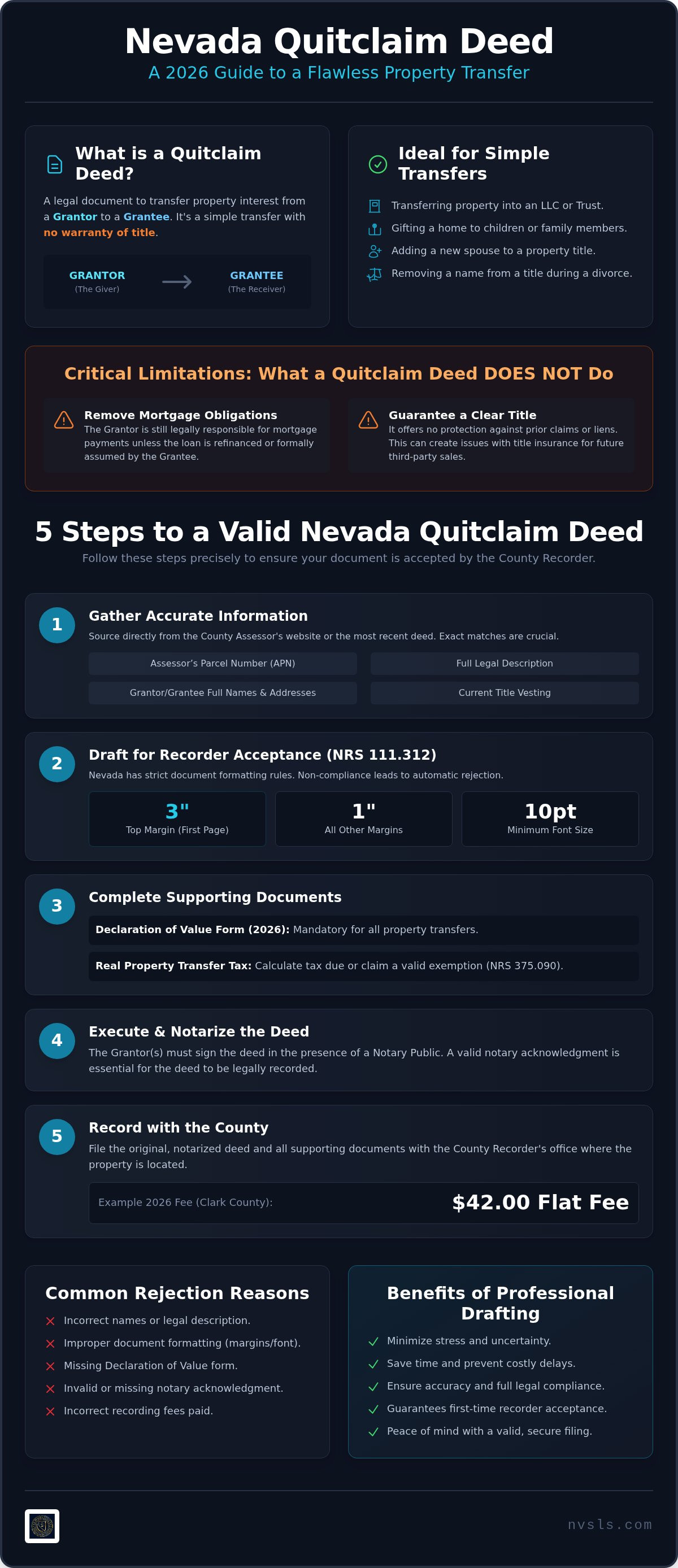
While simple, these deeds have clear boundaries. A major point of confusion for many is the mortgage. Signing a quitclaim deed does not remove your name from a mortgage obligation. Even if you're no longer on the deed, the lender still expects you to pay the loan unless you've been formally released through a refinance or a loan assumption. The deed only changes who owns the property, not who owes the bank.
Additionally, title insurance companies often scrutinize quitclaim deeds. If you plan to sell the property to a third party in the future, a "break" in the chain of title caused by a quitclaim deed might require extra steps to resolve. If you need more protection, you might consider a Grant, Bargain, Sale Deed. This is the most common deed type in Nevada for standard sales because it provides a higher level of implied ownership assurance than a quitclaim deed.
Step-by-Step Guide to Quitclaim Deed Preparation in Nevada
Successful quitclaim deed preparation Nevada starts with precision. You aren't just filling out a form; you're creating a permanent public record. If the details don't match the county's existing data, the Recorder will likely reject the document. This causes delays and may require you to pay new recording fees. Accuracy is your best defense against administrative headaches.
Gathering Your Property Information
Start by visiting the Clark County Assessor’s website or the equivalent for your specific county. You need two specific items: the Assessor’s Parcel Number (APN) and the full legal description. The APN is a unique identifier for your land and must appear at the top of your first page. Don't rely on your memory for names. They must match the most recently recorded deed exactly. If the current deed lists "John A. Doe," do not simply write "John Doe."
Identify the Grantor (the person giving the property) and the Grantee (the person receiving it) with their full legal names and current addresses. You also need to consider how the Grantee will hold the title. Common Nevada designations include Joint Tenancy or Community Property with Right of Survivorship. Reviewing the existing deed is the only way to be certain of the current vesting and ensure a smooth transition of interest.
Drafting for Recorder Acceptance
Nevada has strict formatting standards under NRS 111.312. Your document must have a 3-inch top margin on the first page. This space is reserved for the Recorder’s official stamp. All other margins on that page, and all margins on any following pages, must be at least 1-inch. Use a clear, legible font. Standard practice in 2026 is to use 10-point or larger. Even a small margin error can lead to a non-compliance fee of $25 or more, which is added to your standard recording costs.
You must also include "Return To" and "Mail Tax Statements To" blocks. These sections require complete names and addresses. The "Return To" block tells the county where to send the original deed after it is recorded. The "Mail Tax Statements To" block ensures future property tax bills reach the correct person. If you want to ensure your paperwork is recorder-ready, our professional document preparation service can help you avoid these common technical errors. As a document preparation service, we focus on providing accurate, compliant paperwork that meets all local standards.
The Mandatory Supporting Documents: Cover Sheets and Taxes
In Nevada, recording a property transfer involves more than just a signed deed. You must submit a complete recording packet to the County Recorder. The centerpiece of this packet is the Declaration of Value (DOV) form. As of January 1, 2026, a new version of this form is required for all recordings. This document tells the state exactly how much the property is worth and determines the Real Property Transfer Tax (RPTT) due at the time of filing. Even if no money changes hands, you must still complete this form and submit it alongside your deed.
Calculating the RPTT is a critical part of quitclaim deed preparation Nevada. In Clark County, the current rate is $2.55 for every $500 of value. If you're transferring a property with a high valuation, these costs can add up quickly. However, many people use quitclaim deeds for transfers that are exempt from this tax. Understanding how to navigate these exemptions is the key to a cost-effective filing. Beyond the tax forms, you must also ensure your packet includes a proper cover page. This page provides the 3-inch top margin required for the Recorder’s official stamp. If any part of your deed is difficult to read, you may also need to include a Legibility Notice to ensure the public record remains clear.
Common RPTT Exemptions Under NRS 375.090
Many residents use quitclaim deeds for family transfers or estate planning. These often qualify for specific exemptions under NRS 375.090. Exemption 1 is one of the most common, covering transfers between spouses or between parents and children. If you're moving property into a trust for your own benefit, you would typically use Exemption 7. To avoid paying the transfer tax, you must correctly cite the specific exemption code on your Declaration of Value form. Simply leaving the tax line blank isn't enough; the Recorder needs the specific legal code to process your exemption.
The Assessor’s Parcel Number (APN) Requirement
Your deed will be rejected immediately if it doesn't include the 11-digit Assessor’s Parcel Number (APN). This number is the primary way the county tracks property ownership. It's different from your property's account number, which is a common point of confusion for many owners. For Clark County filings, the APN must be formatted correctly and placed prominently at the top of the first page. Double-check this number against the Assessor’s records before you finalize your packet. A single transposed digit can cloud your title or lead to your paperwork being sent back to you for correction.
Finalizing the Deed: Notarization and Recording Procedures
Your quitclaim deed preparation Nevada isn't complete until the document is legally executed and recorded. A draft is just a piece of paper without these final steps. In Nevada, the law requires every person giving up an interest in the property (the Grantor) to sign the deed. This must happen in the presence of a Notary Public. If multiple people currently own the home, every single one must appear and sign to transfer the full interest correctly.
Nevada requires a formal Notary Acknowledgment. This is a specific block of text where the notary confirms they've verified your identity and witnessed your signature. A simple signature or a generic "witness" isn't enough for the County Recorder. If the acknowledgment language is missing or incorrect, your filing will be rejected immediately. This is one of the most common reasons for document failure in Clark County, and it often requires starting the entire drafting process over.
The Role of a Notary in Property Transfers
The notary acts as a vital gatekeeper against fraud. They verify that the person signing the deed is actually the person named in the property records. For many Las Vegas residents, finding time to visit a bank or office during traditional business hours is a challenge. Using a mobile notary in Las Vegas can simplify this process significantly. They come directly to your home or office, ensuring the signing is handled professionally on your schedule.
Make sure the notary stamp is clear and legible. It must be dark enough to scan properly but cannot overlap with any text or signatures. If the stamp obscures the legal description or the Grantor’s name, the Recorder may deem the document illegible. This requires you to print a fresh document and schedule another signing session, which wastes both time and money.
Recording Your Deed in Clark County
Once the signatures are notarized, your packet must go to the Clark County Recorder in downtown Las Vegas. You can record in person or by mail. In-person recording is faster; you often walk out with a confirmed recording number. If you choose to mail it, you must include a self-addressed stamped envelope. The Recorder will mail your original document back after it is scanned into the public record. This process usually takes one to two weeks depending on the current backlog.
Payment is the final hurdle. The Clark County Recorder currently charges a $42.00 flat fee for recording a standard document. They do not accept personal checks from out-of-state. If you're filing by mail from another state, you must use a cashier’s check or money order. The official Recording Stamp on the top of the page is your ultimate proof of ownership transfer. For local residents, we can take the guesswork out of these administrative hurdles. If you need assistance with your filing, contact our document preparation team today to ensure your deed is recorder-ready.
Professional Deed Preparation: Ensuring a Successful Filing
DIY property transfer often feels like a smart cost-saving measure until the County Recorder sends your packet back. Professional deed drafting in Las Vegas eliminates the guesswork that leads to these frustrating delays. While generic "form fillers" provide one-size-fits-all templates, a professional document preparation service understands the specific 2026 administrative requirements for Clark and Washoe counties. We aren't just filling blanks; we're ensuring every page meets the rigorous standards of Nevada law. As a dedicated document preparation service, we provide technical accuracy without the high cost of a law firm, though we don't provide legal advice or representation. We focus on the tiny details that matter, from the exact margin spacing to the correct 11-digit APN format.
Choosing a local partner like Nevada State Forms & Filing Services (NVSLS) means you're getting recorder-ready documents. We combine our expertise in quitclaim deed preparation Nevada with convenient mobile notary services to create a truly seamless solution. You won't have to spend your afternoon hunting for a notary or wondering if your signature block meets current state standards. We handle the heavy lifting of the paperwork so you can focus on the next chapter of your life. It's a faster, more reliable way to manage your property records without the stress of administrative errors.
Avoiding Costly Recorder Rejections
Rejections are expensive. If your deed is sent back for missing the Declaration of Value or using improper notary wording, you lose your initial filing fee. You also face the hidden cost of time. A delayed transfer can impact estate planning, divorce settlements, or business formations. "Free" online forms often lack the specific Nevada legibility notices or updated 2026 cover sheets required for a successful recording. NVSLS is committed to precision, ensuring your packet is complete and compliant before it ever reaches the Recorder's desk. We act as a bridge between the intimidating world of legal requirements and your practical needs.
Get Started with Your Nevada Property Transfer
Ready to finalize your transfer? The process is simple and straightforward. You provide the basic property details, and we handle the technical drafting. We ensure every grantor is identified correctly and every tax exemption is cited properly under NRS 375.090. Once the draft is ready, you can schedule a mobile notary for a convenient, on-site signing in Henderson, North Las Vegas, or Las Vegas. This eliminates the need for multiple trips to different offices and ensures the job is done right the first time.
Contact Nevada State Forms & Filing Services for expert deed preparation today. We are here to act as your friendly expert guide through the administrative maze of Nevada property records, providing the precision and reliability you deserve.
Secure Your Nevada Property Transfer Today
Transferring property in the Silver State doesn't have to be a source of anxiety. Success comes down to precision. By focusing on the technical details like 3-inch top margins, accurate 11-digit APNs, and the mandatory 2026 Declaration of Value form, you protect yourself from costly county rejections. A legally valid transfer is within your reach when you follow the proper administrative sequence. It's about getting the paperwork right the first time so you can move forward with confidence.
We're here to act as your reliable partner throughout this process. Our team specializes in quitclaim deed preparation Nevada, ensuring every document meets strict NRS 111.312 standards. We provide a recorder-ready document guarantee to give you total peace of mind. For added convenience, our mobile notary services are available throughout Las Vegas and Henderson to handle your signing on-site. Don't let administrative hurdles slow you down.
Simplify your property transfer with professional Nevada deed preparation and ensure your filing is accepted without delay. You've done the hard work; let us help you cross the finish line with ease.
Frequently Asked Questions
Can I prepare my own quitclaim deed in Nevada?
Yes, you are permitted to draft your own documents. The challenge lies in meeting the strict formatting standards required by NRS 111.312. Even a small margin error or a missing parcel number can lead to an immediate rejection by the County Recorder. Many residents choose professional quitclaim deed preparation Nevada to ensure their paperwork is recorder-ready and compliant with 2026 standards, saving time and avoiding repeated filing fees.
Do both parties have to sign a quitclaim deed in Nevada?
Generally, only the Grantor (the person giving up the interest) must sign the deed in the presence of a notary. However, Nevada is a community property state. If the property is considered community property, both spouses may need to sign the deed to legally transfer the interest. The Grantee (receiver) typically does not sign the deed itself, though they must be accurately identified with their full legal name and current mailing address.
How much does it cost to record a quitclaim deed in Clark County?
As of 2026, the flat recording fee for a standard document like a quitclaim deed in Clark County is $42.00. This fee is per document and must be paid at the time of filing. Remember that the Recorder does not accept personal checks from out-of-state. You should also be prepared for the Real Property Transfer Tax unless you qualify for a specific exemption, which must be clearly cited on your Declaration of Value form.
What is a Declaration of Value form and do I need one?
Yes, a Declaration of Value (DOV) form is mandatory for every property transfer in Nevada. The state uses this form to calculate the Real Property Transfer Tax. Even if the transfer is a gift or between family members with no money exchanged, you must still submit the 2026 version of this form. It requires you to state the property's value and provide the specific legal reason if you're claiming a tax exemption.
Does a quitclaim deed clear a mortgage from the property?
No, a quitclaim deed only transfers the ownership interest; it does not impact the underlying mortgage. If your name is on the loan, you remain financially responsible to the lender even after you've signed the deed. To remove a person from a mortgage, you usually have to refinance the loan or obtain a formal release from the bank. Changing the title does not automatically change the debt obligation associated with the property.
How do I claim a tax exemption for a family property transfer?
You claim an exemption by citing the correct code from NRS 375.090 on your Declaration of Value form. For example, transfers between parents and children or between spouses typically use Exemption 1. You must write the specific exemption number and the corresponding legal language on the form. This tells the Recorder why the standard transfer tax, which is $2.55 per $500 in Clark County, should not be applied to your filing.
Where do I file a quitclaim deed in Las Vegas?
You must file your completed packet at the Clark County Recorder’s Office in downtown Las Vegas. You can submit your documents in person at their main office or send them via mail with the appropriate fees. For residents in Henderson or North Las Vegas, recording in person provides the benefit of immediate confirmation. If you mail the packet, include a self-addressed stamped envelope so the Recorder can return your original document after scanning.
Is a quitclaim deed valid if it is not recorded?
While a signed and notarized deed may be technically valid between the parties involved, it is not effective against third parties until it is recorded. Recording provides constructive notice to the public that the ownership has changed. Without recording, the property remains in the Grantor's name in official county records. This can cause significant issues with property taxes, future sales, or claims from creditors, making prompt recording a critical final step.


