

In July 2026 alone, over 7,200 new businesses registered in Nevada, joining a community of more than 456,000 active enterprises. It's an exciting time to launch, but many owners hit a wall when they realize their LLC filing isn't the same thing as their nevada state business license. Failing to understand this distinction is a fast track to late fees and compliance headaches that no new founder needs.
We understand that staring at the SilverFlume portal feels more like a chore than a milestone. You likely feel the pressure to get everything right while worrying about the hidden costs of a simple filing error. It's a common frustration, and you shouldn't have to tackle it alone. This article provides a clear, expert-led roadmap to help you master the Nevada business licensing process from start to finish.
We'll walk you through the specific 2026 requirements for different entity types and clarify the often-confusing gap between state and local permits. By the end of this guide, you will have the tools to secure a valid license, ensure total compliance with Nevada law, and finally understand exactly how your state filings differ from your local requirements.
Key Takeaways
- Learn the critical difference between forming an LLC and obtaining your nevada state business license to ensure your company is legally authorized to operate.
- Discover how to navigate the SilverFlume portal efficiently, tailored to whether you are filing as a Title 7 corporation or a non-Title 7 entity.
- Avoid the common mistake of ignoring local requirements by understanding Nevada’s multi-tier licensing system for jurisdictions like Clark County and Las Vegas.
- Follow a clear preparation checklist, including EIN gathering and officer information, to streamline your application and prevent filing delays.
- Protect your business from entity revocation by identifying and correcting small administrative errors before they lead to state-level penalties.
What is the Nevada State Business License?
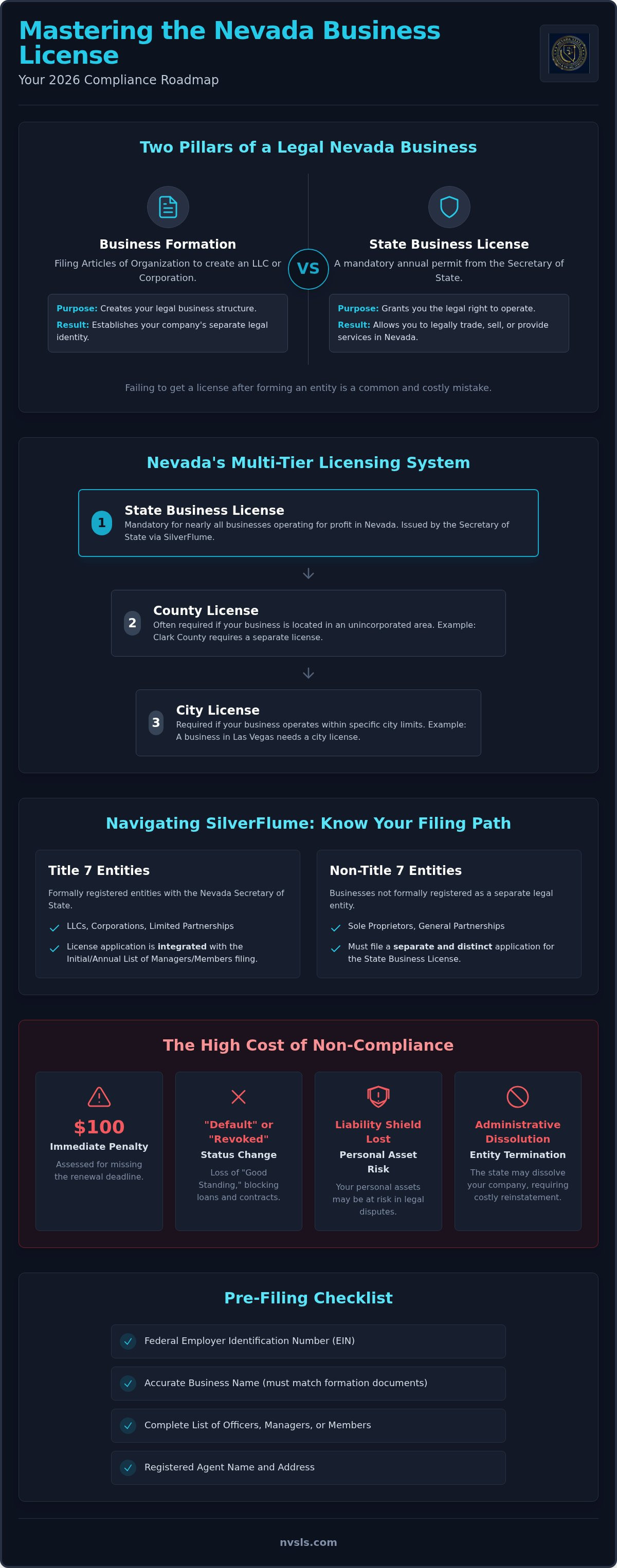
Think of your company as having two distinct identities. The first is its legal structure, like an LLC or a corporation. The second is its permission to actually operate and generate revenue. A business license is that permission. In the Silver State, this is a mandatory annual requirement. It's not a one-time task you can forget after your first year. The Nevada Secretary of State requires this for any person or entity conducting business activities for profit.
It's vital to understand the difference between your business entity and your privilege to operate. Filing your Articles of Organization creates your business. However, obtaining your nevada state business license gives you the legal right to trade, sell, or provide services. This license is the primary way the state tracks active businesses and ensures they contribute to the state's regulatory framework. Without it, your business doesn't officially exist in the eyes of state regulators.
Maintaining this license is also the only way to keep your company in "Good Standing." This status is a badge of credibility. You'll need a Certificate of Good Standing to sign major contracts, apply for business loans, or expand into other states. If your license lapses, your status changes to "Default" or "Revoked." This can bring your entire operation to a grinding halt.
Who is Required to Have One?
Most people starting a venture in Nevada will need this license. The requirement applies to:
- Title 7 Entities: This includes LLCs, Corporations, and Limited Partnerships.
- Non-Title 7 Entities: This covers sole proprietors and general partnerships.
- Statewide Operators: Even if you don't have a physical storefront, you likely need a license if you're earning money here.
There are very few exceptions. Some non-profit organizations or specific home-based businesses with low revenue might qualify for an exemption. However, you must still file for that exemption through the state portal to avoid being flagged for non-compliance.
The Consequences of Non-Compliance
Skipping your nevada state business license filing isn't just a minor oversight. It's a legal risk. If you miss your renewal deadline, the state assesses an immediate $100 penalty. This is in addition to late fees for your Annual List of Managers or Members. These costs add up quickly and aren't negotiable.
Beyond the fines, you'll face practical hurdles. Most banks won't let you maintain a business account without a current license. If your license is revoked, you lose your liability protections. This means your personal assets could be at risk. Eventually, the state may administratively dissolve your company, forcing you to pay significant reinstatement fees to get back to work.
Filing Through SilverFlume: Title 7 vs. Non-Title 7 Entities
SilverFlume is the official digital portal managed by the Nevada Secretary of State. It acts as a central hub for business registrations, renewals, and licensing. While it's designed to streamline the process, the interface can be intimidating if you don't know your business's legal classification. The portal asks you to choose between different filing paths based on whether your business is a "Title 7" or "Non-Title 7" entity. Choosing the wrong path can lead to administrative errors that are difficult to correct later.
Your filing must match your Articles of Organization exactly. If your entity name or officer list on your nevada state business license doesn't align with your formation documents, the state may reject the filing. This is why it's essential to have your original formation papers handy before you log in. Accuracy at this stage prevents delays and ensures your renewal cycle remains synchronized with your anniversary date.
Title 7 Entities: LLCs and Corporations
Title 7 is the legal term for entities that are formally registered with the state, such as LLCs, Corporations, and Limited Partnerships. For these businesses, the licensing process is integrated. When you file your Initial List of Managers or Members, you typically apply for your business license at the same time. The state automatically tracks these entities, making it easier to stay compliant. If you're currently setting up a new entity, you might find our Nevada LLC Filing Documents: The Complete 2026 Resource Guide helpful for organizing your paperwork.
Non-Title 7: Sole Proprietors and General Partnerships
Non-Title 7 refers to individuals doing business under their own name or general partnerships that haven't formed a separate legal entity. Even though you haven't "formed" a company like an LLC, you still need a state-level filing if you're earning a profit in Nevada. Some individuals may qualify for a "Notice of Exemption" if they meet very specific criteria, such as having a home-based business with minimal revenue. However, most active entrepreneurs will still need to register through SilverFlume to avoid penalties.
Keeping track of your anniversary date is your responsibility. The state doesn't always send paper reminders, so setting a digital alert for your renewal month is a smart move. If you find the technical steps of the portal frustrating, our team at Nevada State Forms & Filing Services can assist with professional document preparation to ensure your filings are accurate and timely.
State License vs. Local License: The Clark County Factor
You've successfully secured your nevada state business license through SilverFlume. You're ready to open your doors, right? Not quite. One of the most frequent hurdles new owners face is assuming the state-level paperwork is the finish line. Nevada operates on a multi-tier licensing system. This means you must satisfy the state requirements first and then clear the hurdles set by your local city or county government. If you try to apply for a local permit without a valid state license number, your application will be stalled immediately.
The sequence of events is non-negotiable. You must complete your filing with the Secretary of State before approaching local officials in Las Vegas, Henderson, or North Las Vegas. Each of these jurisdictions has its own set of rules, fees, and timelines. As outlined in the Nevada Secretary of State Business License FAQ, the state license is a prerequisite for local operation. Skipping this order only creates more stress and leads to potential application rejections.
Identifying Your Local Jurisdiction
Determining where you actually "live" in the eyes of the law is trickier than it sounds. Your mailing address might say Las Vegas, but your physical location could be in Unincorporated Clark County. This distinction is critical. If you apply to the City of Las Vegas for a business located in the county, you'll waste time and application fees. You can find jurisdiction maps on local government websites to confirm your exact zone. For a broader look at the initial setup steps required for your company, check out our Nevada Business Formation: 2026 Guide for New Entities.
Special Permits and Regulated Industries
A general business license is often just the baseline. If you run a restaurant, you'll need health department approval. If you have a physical office, the fire department may need to inspect the premises. Regulated professionals, such as doctors or accountants, must also maintain their specific board certifications alongside their nevada state business license. Even remote workers aren't exempt. Most residential areas require a Home Occupation permit to ensure your business doesn't disrupt the neighborhood. It's about ensuring every layer of your operation meets the specific safety and zoning standards of your community.
Step-by-Step Guide to Filing Your Nevada Business License
Securing your nevada state business license doesn't have to be a source of anxiety. The key lies in preparation. Before you even log into the state portal, you must gather your Employer Identification Number (EIN), your exact entity name as it appears on state records, and a complete list of officers or managers. Having these details at your fingertips prevents the portal from timing out and saves you from the frustration of starting over.
Once your data is ready, you'll need to create a profile on SilverFlume. This is your digital headquarters for all things business in Nevada. Ensure you use a reliable email address, as this is where your official correspondence and renewal reminders will go. After your account is active, you'll select the filing path that matches your entity type. The system will guide you through a series of questions designed to verify your identity and business purpose. It's a methodical process that rewards accuracy over speed.
Step 1: Verify Your Entity Status
Your license application will fail if your underlying business structure isn't sound. You must ensure your LLC or Corporation is currently active and in good standing with the Secretary of State. If you've recently moved or changed your registered agent, update that information first. This ensures all state records are synchronized. If you're still in the early stages of setting up your company, our How to Form an LLC in Nevada: The 2026 Step-by-Step Guide provides a detailed breakdown of the formation process.
Step 2: Complete the Digital Application
During the application, you'll be asked for your North American Industry Classification System (NAICS) code. This code tells the state exactly what your business does. It's also mandatory to disclose all owners and responsible parties. Nevada law is strict about transparency; leaving out a key member can lead to administrative rejection or future fines. Take a moment to double-check every entry. A simple typo in your address or EIN can trigger a "default" status that takes weeks to resolve. Accuracy in these small details is what prevents long-term delays.
The final stage is payment and confirmation. After you submit your fees, you'll typically receive your digital license immediately. Download it and keep a copy for your records. You'll need it when you move on to your local city or county applications. If the thought of navigating these digital forms still feels overwhelming, let our team handle the details. You can explore our Business Formation Services to ensure your nevada state business license paperwork is filed accurately the first time.
Avoiding Common Filing Errors with Professional Support
Small administrative errors can have outsized consequences. A simple typo or a misunderstood question on your nevada state business license application might seem minor, but the state sees it differently. Inaccurate filings often lead to a "Default" status, which eventually triggers entity revocation. This isn't just a paperwork issue. It halts your legal ability to operate and removes your liability protection. You could lose the very business you worked so hard to build over a single clerical mistake.
Managing these requirements is inherently stressful. You're balancing state filings with local city permits, and ensuring they synchronize is a challenge. Professional document preparation removes the guesswork. It provides a layer of expert oversight that identifies potential red flags before they reach the Secretary of State. Having a local partner ensures your paperwork is handled with precision. This gives you the freedom to focus on growing your business instead of managing bureaucratic hurdles.
Why DIY Filings Often Fail
Many owners choose the "Do It Yourself" route to save time, yet it often results in the opposite. One common pitfall is misunderstanding the "Exemption" criteria. Some home-based businesses assume they're exempt without verifying the specific revenue or activity limits. This leads to non-compliance notices and unnecessary fines. You shouldn't guess when it comes to state law.
Another frequent failure is missing the annual renewal deadline. SilverFlume is a powerful tool, but it requires you to be proactive. Without a dedicated tracking system, it's easy to let your anniversary month slip by. Additionally, businesses often forget to update their license when their physical address changes. If the state's records don't match your current location, you risk missing critical legal notices and losing your Good Standing status.
How Nevada State Forms & Filing Services Can Help
We specialize in making the complex feel manageable. Our team focuses on streamlined document preparation for new business formations. We ensure every piece of state-level paperwork meets the current 2026 standards. We understand the specific needs of entrepreneurs in Las Vegas, Henderson, and North Las Vegas. Our local presence in Clark County means we know exactly what the state expects from you.
By choosing professional support, you ensure your state and local filings are perfectly aligned. We help you avoid the common traps that lead to penalties and delays. Our goal is to provide you with total confidence in your compliance status. Simplify your business filing today with our expert document prep services and start your journey with a solid legal foundation.
Launch Your Business with Confidence
You now have a clear roadmap to secure your nevada state business license and manage the local permits required in Clark County. Success in the Silver State depends on more than just a great idea; it requires a commitment to administrative accuracy. As you've learned, the distinction between state filings and local requirements is where many new owners stumble. By following a methodical approach to your SilverFlume application, you can avoid the penalties that often derail new ventures.
Managing these details is easier with a reliable partner. We offer local Las Vegas expertise in administrative filings and have focused on accurate, professional document drafting since our foundation. Our team provides specialized support for Henderson and North Las Vegas entrepreneurs who need to ensure their filings meet every 2026 standard. We understand the emotional and financial weight of your new business and aim to make the process as straightforward as possible.
Start Your Nevada Business Formation with Professional Document Prep and take the stress out of your compliance journey. Your path to a successful, legally sound company is just a few steps away. We're ready to help you grow.
Frequently Asked Questions
Do I need a Nevada state business license for a home-based business?
Yes, most home-based businesses in Las Vegas or Henderson still require a license to operate legally. While some low-revenue residential operations might qualify for a specific exemption, you must still document this status through the SilverFlume portal. Operating without a clear exemption or a valid license puts your venture at risk for state-level penalties. It's always safer to file the paperwork than to assume you're exempt from the law.
How much does a Nevada state business license cost in 2026?
In 2026, the cost of your license depends on your business structure, with corporations typically paying a higher annual fee than LLCs or sole proprietors. These fees are mandatory and paid directly to the Nevada Secretary of State during your initial filing and annual renewals. Because government fees are subject to change by the legislature, we recommend checking the SilverFlume portal for the most current rates before you submit your application.
How often do I need to renew my Nevada business license?
You must renew your license every year by the last day of your business's anniversary month. For example, if you filed your Articles of Organization in March, your renewal is due by March 31st every year. The state typically processes these renewals through the SilverFlume portal. Setting a digital calendar reminder is a smart move for North Las Vegas entrepreneurs who want to avoid the automatic late penalties and administrative headaches.
What is the difference between a state business license and a city license?
A state license gives you the privilege to conduct business throughout Nevada, while a city license covers local zoning and safety regulations. If your office is in Henderson, you need a nevada state business license first, followed by a Henderson city permit. One does not replace the other. Think of the state license as your broad permission to trade and the city license as your specific permission to occupy a local space.
Can I operate my business while my license application is pending?
You should generally wait until your application is approved and your digital license is issued before you begin revenue-generating activities. Operating while a license is pending can lead to fines from both state and local authorities. In Las Vegas, having your physical license in hand is often a requirement before you can apply for necessary local permits, sign commercial leases, or open a dedicated business bank account.
What happens if I forget to renew my Nevada state business license?
Forgetting your renewal leads to an immediate late fee for the license and an additional penalty for the Annual List. If you don't resolve the delinquency quickly, the state will change your business status to "Default" and eventually "Revoked." This revocation removes your legal protections and can lead to the administrative dissolution of your company. Reinstating a revoked entity is a much more expensive and time-consuming process than filing on time.
Is a Nevada state business license the same as an LLC?
An LLC is your business's legal structure, while a license is its permission to operate and earn money. Forming an LLC protects your personal assets, but it doesn't give you the right to actually sell products or services. You must obtain a nevada state business license in addition to your formation documents. Many new owners in Clark County confuse the two, leading to unintentional non-compliance during their first year of operation.
Do sole proprietors need a state business license in Nevada?
Yes, most sole proprietors and general partnerships are required to maintain a state business license if they are conducting business for profit. This applies even if you don't have a formal entity like an LLC or a physical storefront. While the filing process is slightly different for "Non-Title 7" entities, the requirement to register and pay the annual fee remains the same for most active entrepreneurs throughout the Las Vegas valley.


