

What if the only thing standing between you and your new legal identity wasn't a judge, but a confusing stack of paperwork and a mandatory newspaper ad? You likely want your official records to reflect who you truly are, but learning how to change your name in Nevada often feels overwhelming. It's natural to feel frustrated by complex e-filing systems or anxious about public notice requirements. You deserve a process that's clear and efficient, not one that requires multiple, exhausting trips to the courthouse.
In this 2026 guide, you'll discover a professional path to navigate the state's legal requirements. We've simplified the administrative maze into a manageable sequence. As a document preparation service that does not provide legal advice, we focus on the precision needed to avoid court rejections. This article covers the $270 filing fee for Clark County, the estimated $80 to $200 publication costs, and the steps to secure your updated $23.25 driver's license. We'll preview everything from fingerprint requirements for certain petitioners to the publication waiver for gender identity transitions, ensuring you move forward with confidence.
Key Takeaways
- Identify the three distinct legal paths to ensure you use the correct forms for marriage, divorce, or a standard court petition.
- Learn exactly how to change your name in Nevada by following a structured timeline for filing, notarizing, and publishing your legal notice.
- Navigate the specific 2026 requirements for felony disclosures and fingerprint submissions to avoid immediate court rejections.
- Coordinate your post-order updates efficiently by prioritizing your Social Security record before visiting the DMV for your new ID.
- Eliminate the risk of costly delays by identifying common clerical errors and meeting strict filing deadlines.
Understanding the Three Paths to a Name Change in Nevada
Choosing the right path depends entirely on why you're making the switch. Most people assume the process is identical for everyone, but Nevada offers different administrative tracks based on your life circumstances. Understanding these options is the first step in learning how to change your name in Nevada without wasting time on unnecessary paperwork or filing the wrong forms.
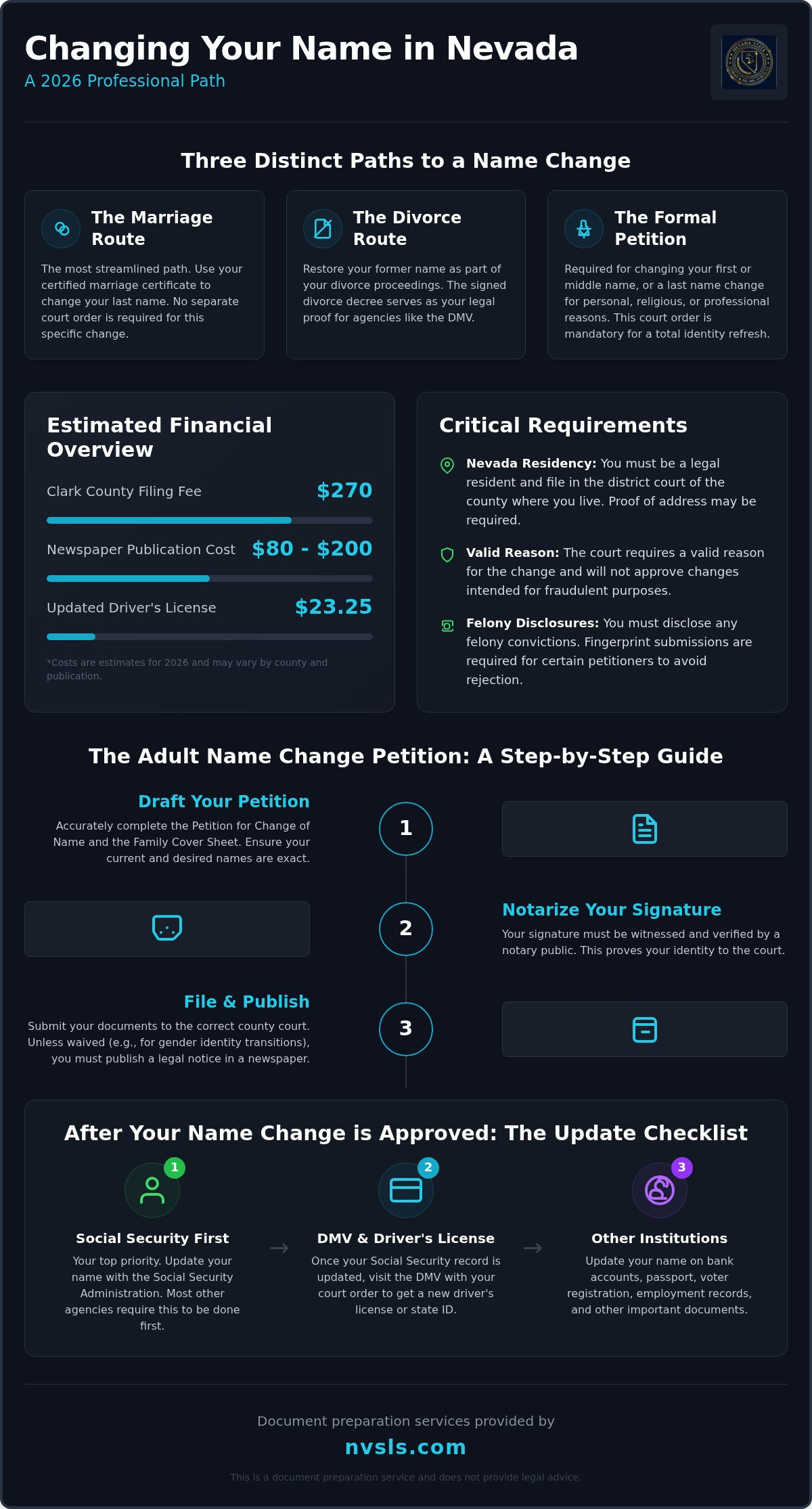
The Marriage Route is the most common and streamlined. When you get married, you can change your last name by using your certified marriage certificate. You don't need a separate court order for this specific change. Similarly, the Divorce Route allows you to restore a former name. This is typically handled within your Nevada divorce filing document. If the judge signs the decree with the name restoration included, that document serves as your legal proof for agencies like the DMV.
For those seeking a change for personal, religious, or professional reasons, the Formal Petition is the required path. While some historical traditions allowed individuals to legally change names by usage alone, modern security standards require a court order for any official identity updates. This process is more involved but ensures your new name is recognized by all federal and state institutions.
When a Court Order is Mandatory
You can't always rely on a marriage license or divorce decree. A formal court order is mandatory if you're changing your first or middle name for any reason. It's also required if you're changing your last name for reasons unrelated to a marital status change. Standard petitions involve more steps than "automatic" changes, but they provide the legal weight needed to update your Social Security card and passport. If your goal is a total identity refresh, the petition is your only option.
The Role of Residency in Your Petition
You must be a legal resident of Nevada to use the state's court system for a name change. This isn't just a suggestion; it's a jurisdictional requirement. The court needs to know it has the authority to hear your case. Here's what you need to know about residency:
- County Selection: You must file your petition in the district court of the county where you actually live. If you reside in Las Vegas or Henderson, you'll file in Clark County.
- Proving Residency: The court may require evidence of your local address. Usually, a Nevada driver's license or a utility bill in your name suffices.
- Filing Timeline: You must be a resident at the time you file. Unlike divorce cases that require six months of residency, name change petitions are generally accessible as soon as you've established your Nevada home.
Step-by-Step Guide to the Adult Name Change Petition
Navigating the court system requires a methodical approach. When you are learning how to change your name in Nevada, the process officially begins with the Petition for Change of Name. This document is the foundation of your case. It must be paired with a Family Cover Sheet, which helps the court clerk categorize your filing correctly. While the paperwork might look simple, the court's standards for clarity and disclosure are high. Missing a single field or providing vague information can stall your progress for weeks.
Drafting Your Petition for Accuracy
Accuracy is non-negotiable. You must disclose your full current legal name and your desired new name exactly as you want it to appear on your future government ID. The court also requires a valid reason for the change. While personal preference is often acceptable, the court won't approve changes intended to avoid debts, hide from criminal records, or commit fraud. Reviewing the legal requirements for adult name changes ensures your petition meets the state's standards before you submit it. Double check that your Family Cover Sheet matches your Petition exactly to avoid clerical rejections.
The Importance of Notarization
Your signature on the petition must be notarized to be valid. This step proves to the judge that you're the person requesting the change. Many petitioners find it helpful to use a mobile notary in Las Vegas to handle this requirement at their home or office. A notary acts as an official witness, verifying your identity and your willing signature. If your signature isn't witnessed properly, the court will likely reject your entire filing. Since we are a document preparation service and not a law firm, we emphasize that correct notarization is a critical administrative safeguard that prevents identity fraud within the court system.
Once your documents are notarized, you'll file them and pay the court filing fee. In Clark County, this fee is approximately $270. Most courts now offer e-filing systems, which are efficient but can be confusing for first-time users. After filing, the court will assign a case number, which you'll need for the next phase of the process.
The Publication Requirement in Nevada
Nevada law generally requires you to publish your intent in a newspaper of general circulation. This notice must run once to allow any interested parties to object to the change. You'll likely spend between $80 and $200 for this service in Las Vegas or Henderson. After the notice runs, the newspaper provides an Affidavit of Publication. You must submit this affidavit to the court to prove you've met the legal notice requirement. If you want to avoid the stress of managing these deadlines, our professional name change paperwork service can streamline the document preparation for you. Finally, you will submit the proposed Order for the judge's signature to finalize the change.
Felony Disclosures and Fingerprint Requirements
A criminal history doesn't necessarily prevent you from obtaining a new legal identity. However, Nevada maintains strict security protocols for petitioners with prior convictions. The court's primary concern is ensuring that a name change isn't being used to commit fraud, evade law enforcement, or avoid the consequences of a past crime. Understanding these extra steps is vital when you learn how to change your name in Nevada with a record on file.
If you have a felony conviction, you must submit a complete set of fingerprints to the court alongside your petition. These prints allow the state's Central Repository for Nevada Records of Criminal History to conduct a thorough background check. The court uses this data to verify that your request is made in good faith. While the process adds a layer of scrutiny, it is a standard administrative requirement designed to protect the integrity of public records.
The Fingerprinting Process for Petitioners
You can't just provide your own ink prints or a copy from a previous job application. You must visit a court-approved fingerprinting site to ensure the results are valid. In Clark County, many private fingerprinting vendors and law enforcement agencies provide this service. Here is what to expect during this stage:
- Authorized Locations: Use only Nevada-certified fingerprinting sites or local law enforcement agencies.
- Processing Fees: Expect to pay separate fees for the fingerprint capture and the state's background check.
- Submission: Results are often delivered directly to the court as required by local rules.
In 2026, petitioners should expect this background check to take several weeks to complete. It's best to handle this early in your filing timeline to avoid delays in your court date. You'll be responsible for the vendor's service fee plus the state's processing fee for the criminal history report.
Disclosing Your History Honestly
Honesty is the only path forward. When you file for an adult name change, you must disclose all prior felony convictions. Failing to do so is considered perjury; a serious offense that will lead to an immediate denial of your petition. It could also result in additional legal complications. If you're unsure how to describe your history, simply list the convictions as they appear on your official record. Even if a record has been sealed or expunged, many court forms still require disclosure for name change purposes. Being transparent from the start builds trust with the judge and ensures your petition moves through the system without suspicion. If the court determines the change is for a legitimate reason, such as personal or religious preference, a past conviction is rarely a dealbreaker.
Updating Your Identity Documents After the Order
You've finally received your signed court order. Congratulations. Now the real administrative work begins. This is where many people get stuck. Obtaining the order is only half the battle when learning how to change your name in Nevada. You need to turn that piece of paper into a new legal identity across every agency you interact with. Start by requesting at least three to five certified copies of your order from the court clerk. These usually cost about $25 each. You'll need them because most agencies won't accept a standard photocopy.
The Federal and State Document Checklist
Your first stop is always the Social Security Administration (SSA). Don't go to the DMV first. The DMV's system cross-references SSA records. If you haven't updated your Social Security card, the DMV will likely reject your application. After you visit the SSA, wait at least 24 to 48 hours. This delay allows the federal database to sync with state systems, ensuring a smoother transition when you arrive at your state appointment.
When you're ready for the Nevada DMV, bring your certified court order, your current license, and proof of residency. If you're upgrading to a Real ID, you'll also need your birth certificate or passport. In 2026, the fee for a replacement license with your new name is approximately $23.25. Don't forget your U.S. Passport. You'll need to mail in a specific update form along with a certified copy of your order and a new photo to refresh your travel documents. This process can take several weeks, so plan your travel accordingly.
Notifying Your Private Institutions
Government agencies are just the beginning. Your financial life needs an update too. Contact your bank immediately to update your debit cards and checks. You'll also need to notify your mortgage lender and credit card companies. Most will require a scanned copy or a physical mail-in of your court order to verify the change. If you have outstanding loans, ensure the names match to avoid credit reporting errors.
Tell your employer so they can update your payroll records and W-2 forms. This ensures your tax filings stay consistent with your new Social Security record. Don't overlook your insurance providers, utilities, and any professional licenses you hold. Each one has its own internal process. Managing this checklist can be exhausting, but accuracy at this stage prevents future identity headaches. If you're still in the planning phase and want to ensure your initial filing is perfect, Nevada State Forms & Filing Services provides professional document preparation to get your journey started correctly.
Avoiding Common Filing Mistakes in Nevada
Learning how to change your name in Nevada is an exercise in administrative precision. Even a small oversight can derail your entire petition. Most people assume the judge is the biggest hurdle, but the court clerk is actually your first gatekeeper. If your paperwork doesn't meet the court's strict standards, it won't even make it to the judge's desk. Understanding where others stumble will help you avoid the frustration of starting over from scratch.
Typos and inconsistencies are the #1 reason for court rejections. If your current legal name is spelled one way on your petition and another way on your Family Cover Sheet, the clerk will likely return the documents. These clerical errors are costly. If your petition is denied, you don't just lose time; you lose the approximately $270 you paid in filing fees. Nevada courts generally don't offer refunds for user error, meaning a simple spelling mistake can become an expensive lesson in document preparation.
Why Precision in Paperwork is Critical
Your "Reason for Name Change" must be legally sufficient to pass judicial review. While personal preference is common, the court needs to see that you aren't attempting to defraud creditors or hide from law enforcement. Vague or suspicious explanations are red flags that lead to immediate denials. Beyond the content of the petition, timing is everything. There is often a strict 10-day window for certain filing requirements once your case is opened. If you miss these deadlines, your case may be dismissed for lack of prosecution.
The final administrative hurdle is the proof of publication. After your notice runs in a newspaper of general circulation, you must file the Affidavit of Publication with the court. Many petitioners forget this step, assuming the newspaper handles it. Without this affidavit, the judge cannot legally sign your order. Additionally, incorrect notarization can stop your timeline before it even starts. If a notary public doesn't follow the specific Nevada statutes for verifying your identity, your document is legally void and unusable for filing.
How Nevada State Forms & Filing Services Can Help
Navigating these requirements is stressful, but you don't have to do it alone. Nevada State Forms & Filing Services provides professional name change paperwork preparation to ensure your documents are accurate and complete the first time. We understand the specific filing requirements for Clark County and the surrounding areas. Our expertise helps you avoid the common pitfalls that lead to court rejections and wasted fees.
We also offer mobile notary services to handle your affidavits anywhere in Las Vegas, Henderson, or North Las Vegas. Instead of hunting for a notary or making extra trips to a bank, we come to you to witness your signature correctly. This service is a vital part of our commitment to being a "Friendly Expert Guide" through the system. By choosing professional document preparation, you free yourself from the stress of DIY court forms. We focus on the administrative details so you can focus on your new future. If you are ready to learn more about how to change your name in Nevada without the headache, we are here to provide the support you need.
Secure Your New Legal Identity Today
Securing your new legal identity is a significant milestone. Learning how to change your name in Nevada is about following a logical sequence with absolute precision. You now understand the three distinct paths for marriage, divorce, and formal petitions. You also know that success depends on total accuracy during the initial filing and the subsequent updates at the Social Security Administration and DMV. Avoiding typos and meeting the 2026 fingerprinting and publication requirements ensures your petition moves through the court system without unnecessary delays.
Don't let the fear of complex paperwork or court rejections stall your progress. We provide professional document preparation for Clark County residents, offering a no-nonsense approach to these legal administrative tasks. Our convenient mobile notary services ensure your affidavits are signed correctly at your location, saving you time and stress. We handle the technical details so you can focus on your transition. Start your Nevada name change paperwork with the experts at NVSLS. You've done the research and have the roadmap. It's time to move forward with confidence.
Frequently Asked Questions
Do I need a lawyer to change my name in Nevada?
You aren't legally required to hire a lawyer to change your name. Many residents successfully navigate the process using professional document preparation services to ensure their paperwork is accurate and complete. While we provide the forms and mobile notary services necessary for a valid filing, we don't offer legal representation. Choosing document preparation is often a more cost-effective alternative when you are figuring out how to change your name in Nevada for straightforward, personal reasons.
How long does the name change process take in Clark County?
The process in Clark County usually takes between six and twelve weeks from the initial filing to the signed order. This timeline includes the mandatory publication period and the court's administrative review time. Delays often happen if the paperwork contains typos or if the background check for felony disclosures takes longer than expected. Ensuring your petition is perfect the first time is the best way to keep your case moving toward a quick resolution.
Can I change my name if I have a felony conviction?
Yes, you can change your name with a felony conviction, but you must follow additional security steps. Nevada law requires you to disclose all prior felonies in your petition and submit a full set of fingerprints to the court. The judge will review your criminal history to confirm the change isn't intended for fraudulent purposes. Being transparent about your past is essential to avoid perjury charges and ensure the court approves your request.
What is the newspaper publication requirement for a name change?
Most petitioners must publish a notice of their intent in a newspaper of general circulation once. This public notice allows others to object if they believe the name change is being used for fraud. The 2026 rules waive this requirement for individuals changing their name to conform to their gender identity. After the notice runs, you must file an affidavit from the newspaper with the court to prove you've met this legal obligation.
How do I change my name on my Nevada driver's license?
You must update your Social Security card before visiting the DMV for a new license. Once the federal records are updated, bring your certified court order and current ID to a Nevada DMV office. In 2026, the fee for a corrected license is approximately $23.25. This step is the final part of learning how to change your name in Nevada, ensuring your state-issued identification matches your new legal identity across all government systems.
Can I change my child's name using this same process?
The process for changing a child's name is similar but involves additional requirements regarding parental consent. You must notify the other legal parent and obtain their permission or prove that you've attempted to serve them with the petition. If both parents agree, the court usually approves the change quickly. If one parent objects, the judge will hold a hearing to determine if the name change is in the child's best interest.
What happens if someone objects to my name change petition?
If someone files a formal objection to your petition, the court will schedule a hearing. This is rare; it typically only happens if a creditor or another party believes you're changing your name to avoid legal or financial obligations. During the hearing, the judge will listen to the objection and your reasoning before making a final decision. Most objections are resolved by proving that your request is made in good faith for personal reasons.


