

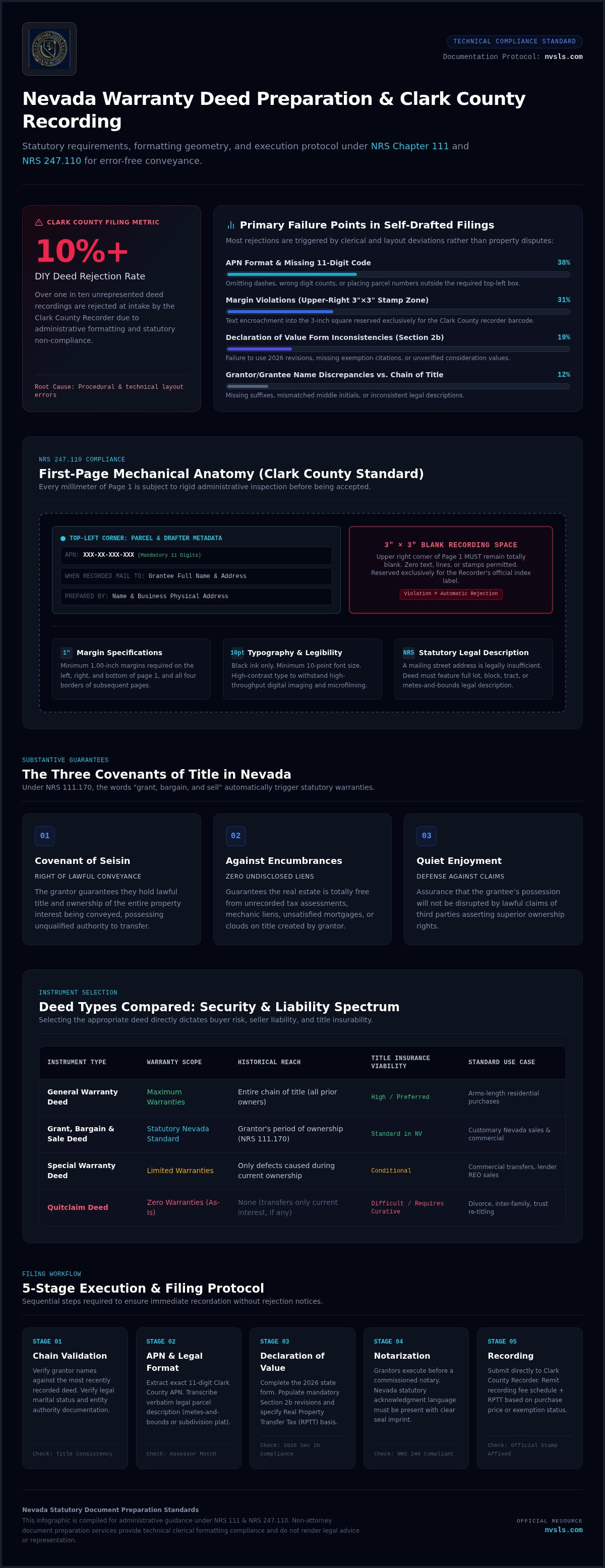
Did you know that over 10% of unrepresented DIY deed recordings in Clark County are initially rejected? Most of these failures aren't caused by major legal disputes. Instead, they happen because of minor formatting errors like a missing 11-digit APN or an incorrect margin. It's incredibly stressful to handle property transfers when you're worried about future title defects or the dense language of Nevada Revised Statutes. You deserve the security of a professional transfer without the high cost of a real estate attorney. As a document preparation service, we understand that accuracy is your top priority.
This 2026 professional guide to Nevada warranty deed preparation shows you how to draft and file your document with total confidence. You'll learn how to navigate the system to ensure a secure, error-free property transfer that stands the test of time. We'll walk you through the updated 2026 Clark County recording fees, the mandatory Section 2b updates on the Declaration of Value form, and the exact formatting standards required by NRS 247.110. By the end of this guide, you'll have a clear path to a successful recording and the peace of mind that comes with protected property ownership.
Key Takeaways
- Understand the critical differences between General and Special Warranty Deeds to ensure you select the right level of title protection for your transfer.
- Master the technical requirements of Nevada warranty deed preparation, including the mandatory 11-digit APN and strict formatting rules required for Clark County recording.
- Learn why a warranty deed provides superior security compared to a quitclaim deed, making it easier to secure title insurance and verify clear ownership.
- Follow a clear, step-by-step process for filing, including how to correctly complete the 2026 Declaration of Value form and secure a valid notary acknowledgment.
- Discover how a professional document preparation service can eliminate the risk of recording rejections while offering a cost-effective alternative to high attorney fees.
What is a Nevada Warranty Deed?
A Nevada warranty deed is the most secure way to transfer real estate. It acts as a legal bridge between a seller and a buyer, carrying a heavy guarantee that the title is clear. When you engage in Nevada warranty deed preparation, you're doing more than just filling out a form. You're creating a binding promise that the property is free from hidden debts or ownership disputes. This deed offers the highest level of protection for the buyer, known as the grantee, because it places the burden of title clarity squarely on the seller.
It's important to distinguish between the two main types used in the Silver State. A General Warranty Deed protects the buyer against title defects that occurred at any point in the property's history. A Special Warranty Deed is more limited; it only covers the period when the current seller owned the home. While both are used, Nevada's customary standard is actually the "Grant, Bargain, and Sale Deed," which functions similarly by providing statutory protections under state law. You should use a warranty deed whenever a property is being sold to an unrelated party or when title insurance is required for a mortgage.
The Covenants of Title in Nevada
The strength of a warranty deed lies in its specific legal promises. These are called covenants. The Covenant of Seisin is the seller's vow that they actually own the property and have the legal right to hand it over. Another critical layer is the guarantee against encumbrances, which promises there are no undisclosed liens or taxes owed. Finally, the promise of Quiet Enjoyment ensures the new owner won't be disturbed by third-party claims. Learning about these covenants of title and warranty deed protections shows why this document is the preferred choice for residential sales and title insurance companies.
NRS 111: The Foundation of Nevada Property Law
Nevada Revised Statutes (NRS) Chapter 111 dictates exactly how these documents must function. Specifically, NRS 111.170 explains that using the words "grant, bargain, and sell" automatically includes specific warranties by law. You don't have to list every single protection manually if the statutory language is correct. This is where professional Nevada warranty deed preparation becomes essential. Our team functions as a document preparation service to ensure your deed utilizes this precise language. We don't offer legal representation or advice; however, we do ensure your document meets the strict administrative standards that make a grantor's signature legally binding under state law.
Essential Requirements for Nevada Warranty Deed Preparation
Success in Nevada warranty deed preparation depends on absolute precision. The Clark County Recorder doesn't just check for signatures; they scan for technical compliance. If your document fails to meet the Nevada Revised Statutes Chapter 111 conveyancing requirements, it'll be rejected. This process starts with identifying the Grantor and Grantee. Their names must match existing property records exactly. Even a missing middle initial or a misspelled "Street" versus "St" can cause a chain-of-title issue that's difficult to fix later.
You must also include the 11-digit Assessor’s Parcel Number (APN) at the top-left corner of the first page. A single digit error here stops the recording process immediately. While the street address helps for mail, the Recorder relies on the APN and the "Legal Description" to identify the land. The street address isn't enough to legally transfer property in Nevada. You're transferring a specific piece of the earth, not just a mailbox.
Formatting for the Clark County Recorder
The layout of your deed is just as important as the words on it. The Clark County Recorder has strict standards to ensure documents are legible for digital scanning. If you fail to meet these, you'll likely face a non-compliance fee or a flat rejection.
- Top Margin: A blank 3-inch by 3-inch square is required in the upper right-hand corner of the first page for the recording label.
- General Margins: Maintain at least 1-inch margins on the left, right, and bottom of all pages.
- Font and Ink: Use black ink and a font size no smaller than 10-point.
- Identification: You must include a "Prepared By" statement with the drafter's name and address.
If you're feeling overwhelmed by these technicalities, our professional deed drafting services can handle the precision work for you to ensure your submission is accepted the first time.
The Role of the APN and Legal Description
The legal description is the DNA of your property. It usually appears as "Metes and Bounds" or a "Lot and Block" description. You can find this on your previous deed or through the County Assessor's office. Never guess this information. Many people make the mistake of copying descriptions from old deeds that might contain outdated references. Verify your APN through the Clark County Assessor’s portal before you finalize your paperwork. Always include the "Return to" and "Mail tax statements to" addresses clearly on the first page. This ensures your recorded deed and future tax bills reach the right person without delay.
Warranty Deed vs. Quitclaim Deed: Which Do You Need?
Choosing the wrong document during Nevada warranty deed preparation can lead to expensive title defects that haunt you for years. It's vital to understand the liability shift between these two instruments. A warranty deed is a legally binding promise that the title is clear of all liens and encumbrances. In contrast, a quitclaim deed offers zero guarantees. It simply transfers whatever interest the seller has, even if that interest is zero. If you're buying a home from a stranger, you want the protection of a warranty. If you're just moving property into a trust, a quitclaim might suffice.
One unique feature of Nevada law is the "after-acquired title" rule. When you use a warranty deed, any interest in the property that the seller acquires after the sale automatically passes to the buyer. This doesn't happen with a quitclaim. Proper Nevada warranty deed preparation ensures that the buyer receives this specific statutory protection, creating a much safer transaction for everyone involved. This rule provides a safety net that is essential for maintaining a clean chain of title in the public record.
When a Warranty Deed is Non-Negotiable
Standard residential home sales between unrelated parties require the highest level of security. Title insurance companies almost always demand a warranty deed, or the Nevada equivalent Grant, Bargain, and Sale deed, before they'll issue a policy. If you're using bank financing, your mortgage lender will also insist on these protections. This deed type safeguards the grantee from future claims by third parties, such as long-lost heirs or creditors with old liens. It places the financial responsibility for title issues on the seller, where it belongs in a market transaction.
The Quitclaim Alternative
Quitclaim deeds are generally reserved for "friendly" transfers where money isn't changing hands. This includes adding a spouse to a deed, transferring property to a personal LLC, or moving assets into an estate plan. They are also useful for clearing "clouds" on a title, such as removing an ex-spouse's name after a divorce. Even for these simpler transfers, you must adhere to the Clark County Recorder filing guidelines to avoid rejection. For a more detailed breakdown of these options, see our guide on Professional Deed Drafting in Las Vegas.
Step-by-Step Guide to Filing Your Deed in Clark County
Recording a deed in Clark County is a methodical process. It requires more than just a signature and a stamp. To ensure your property transfer is legally sound, you must follow a specific administrative path. Missing a single step often results in the County Recorder returning your documents, which delays your transfer and can lead to additional fees. Effective Nevada warranty deed preparation involves coordinating several moving parts simultaneously.
- Step 1: Drafting. Create the document using precise Nevada statutory language. You've already learned why "grant, bargain, and sell" is the standard phrase to use.
- Step 2: Notarization. The grantor must sign the deed in front of a licensed notary. This is a non-negotiable requirement for recording.
- Step 3: Declaration of Value. Complete the mandatory LGS-F049 form. This document tells the state how much the property is worth and determines your tax liability.
- Step 4: Tax Calculation. Calculate the Real Property Transfer Tax (RPTT). In Clark County, this is currently $5.10 per $1,000 of value.
- Step 5: Recording. Submit the deed, the Declaration of Value, and the $42.00 base recording fee to the Recorder’s Office at 500 S. Grand Central Parkway.
Notarization Requirements in Nevada
A Nevada notary must include their official stamp and the expiration date of their appointment. The grantor needs to provide a valid, government-issued photo ID at the time of signing. If you're managing a busy schedule, you don't have to visit an office. You can use a Mobile Notary in Las Vegas to handle the signing at your home or place of business. This ensures the "Notary Acknowledgement" section of your deed is completed correctly, preventing a common cause of document rejection.
Understanding the Declaration of Value
The Declaration of Value (DOV) is just as important as the deed itself. The state uses this form to compute the RPTT, but it also serves another purpose in 2026. Following recent legislative updates, you must use the version of the form that includes Section 2b. This section allows you to claim the 3% property tax abatement cap for primary residences immediately. If you're transferring property between parents and children or into a revocable trust, you may be eligible for one of the 14 statutory exemptions. Filing an inaccurate DOV can lead to a 10% penalty plus monthly interest, so precision is vital.
We are a document preparation service and do not provide legal advice. If you want to ensure your paperwork is handled with professional accuracy, let us prepare your Nevada deed and filing forms today.
Professional Prep Services vs. DIY: Protecting Your Property
Many Nevada residents fall into the "Form Rejection Trap." They download a generic deed online and assume the process is finished once they hit print. In reality, over 10% of unrepresented recordings in Clark County are initially rejected. Most of these fail because of the technicalities we've covered, such as margin errors, missing APNs, or outdated Declaration of Value forms. Nevada warranty deed preparation requires a level of detail that generic templates simply cannot provide. A single mistake at the recording window can delay your transfer by weeks.
Comparing your options reveals a clear choice. You could pay an attorney's high hourly rate for a simple transfer, or you can risk a rejection by doing it yourself. Professional document preparation offers a middle ground. It provides a second set of eyes on your 11-digit APN and your Metes and Bounds description. This ensures your paperwork is ready for the recording window on the first try. We bridge the gap between confusing government forms and expensive legal representation.
Why Accuracy Matters for Future Title Searches
A minor typo today often creates a "Title Cloud" ten years from now. If you misspell a name or mistype a lot number, you might not discover the error until you try to sell the property or refinance your mortgage. Correcting a recorded deed is a complicated process. It becomes even more difficult if the original grantor has moved, lost capacity, or passed away. Precision is also vital for your long-term legacy. Ensuring your Estate Planning Documents in Las Vegas are supported by clean, accurate deeds prevents major probate headaches for your heirs later.
The NVSLS Advantage
We handle the drafting so you can handle the peace of mind. Our team understands the specific nuances of Clark County, Henderson, and North Las Vegas recording requirements. We are a document preparation service, not a law firm. We don't offer legal advice or legal representation. Instead, we provide a direct, no-nonsense service with transparent pricing. We focus on administrative accuracy and efficiency. You get the benefit of local expertise and a reliable partner who values integrity. We make the complex system of property transfers work for you without the unnecessary fluff or high costs.
Secure Your Property Transfer with Confidence
Completing a property transfer in Clark County doesn't have to be a source of stress. By mastering the technical requirements of Nevada warranty deed preparation, you protect your investment and ensure a clear title for years to come. Accuracy in your 11-digit APN and adherence to the latest 2026 Declaration of Value standards are the most effective ways to avoid recording rejections. Whether you are conducting a market sale or a family transfer; choosing the right deed type is the foundation of a secure transaction.
We act as your expert guide through this complex administrative process. Our document preparation service offers the precision you need without the high cost of an attorney. We provide expert Nevada document preparation and mobile notary services available for all signings. We proudly serve clients in Las Vegas, Henderson, and North Las Vegas. Get Professional Deed Preparation in Las Vegas Today and move forward with the peace of mind that your property ownership is legally sound. You've done the hard work of owning property; let us help you handle the paperwork with ease.
Frequently Asked Questions
Can I write my own warranty deed in Nevada?
You can certainly draft your own deed, but it's a risky path for most. Nevada has strict requirements for formatting, margins, and statutory language. Over 10% of unrepresented filings are rejected by the Clark County Recorder for minor technical errors. Professional Nevada warranty deed preparation ensures your document includes the mandatory 11-digit APN and correct "Grant, Bargain, and Sell" language to avoid expensive recording delays.
How much does it cost to record a deed in Clark County in 2026?
In 2026, the base fee to record a deed in Clark County is $42.00. You must also pay the Real Property Transfer Tax, which is $5.10 per $1,000 of property value in Las Vegas and Henderson. If your document fails to meet NRS 247.110 formatting standards, you'll face an additional $25.00 non-compliance fee. Payments must be made via cash, cashier's check, or card; personal checks are not accepted.
What is the difference between a Grantor and a Grantee?
The Grantor is the person currently owning the property who is transferring the interest, while the Grantee is the person receiving it. It's vital that the Grantor’s name matches the county's current ownership records exactly. If you are transferring property in Las Vegas or North Las Vegas, even a small misspelling of a Grantee's name can lead to future ownership disputes. We verify these names against existing records to ensure your transfer is seamless.
Does a Nevada warranty deed need to be notarized?
Yes, a Nevada warranty deed must be notarized to be recordable under NRS 247.120. The document must bear an original notary acknowledgment, including the notary's stamp and commission expiration date. We provide mobile notary services throughout Las Vegas and North Las Vegas to make this step easy. Our notaries can meet you at your home or office to witness signatures and ensure your deed is ready for immediate recording at the County Recorder's office.
How do I find the legal description for my property in Las Vegas?
You shouldn't rely on your street address, as the Recorder requires a formal legal description. You can find this on your previous recorded deed or by searching the Clark County Assessor’s online portal. It's typically a "Metes and Bounds" or "Lot and Block" description. If you can't find it, we can help locate the correct text as part of our deed drafting services for properties in Henderson and Las Vegas, ensuring your filing is accurate.
What happens if I make a mistake on my deed and it's already recorded?
If a mistake is recorded, you must usually file a Correction Deed to fix the public record. This requires the original grantor to sign a new document, which is often difficult if they've moved or passed away. Minor typos can create "title clouds" that stop future sales or refinances. Using a professional service for Nevada warranty deed preparation prevents these errors by verifying your legal description and APN before the document is ever filed.
Is a warranty deed better than a quitclaim deed for family transfers?
It depends on your goals for the transfer. A quitclaim deed is often used for simple family transfers because it’s fast, but it offers no protection against title defects. A warranty deed is better if the family member plans to sell the home or get a mortgage later, as it guarantees a clear title. We can draft either document to help you protect your family’s real estate assets in Henderson or Las Vegas based on your needs.
Do I need an attorney to transfer property in Nevada?
No, you don't need a lawyer to transfer property in Nevada. You can handle the process yourself or use a document preparation service like Nevada State Forms & Filing Services. We serve Las Vegas, Henderson, and North Las Vegas by drafting accurate deeds and providing mobile notary support. While we strictly do not offer legal advice or representation, we ensure your paperwork meets all administrative standards for a fraction of an attorney's hourly rate.


