

In Nevada, a "legal separation" doesn't actually exist under that name. While most people search for how to file for legal separation in Nevada, the Silver State officially recognizes this process as "separate maintenance." It's a common point of confusion that leaves many residents feeling stuck before they even begin. You want to protect your assets and establish clear boundaries, but the thought of navigating complex court systems alone is daunting. We understand the weight of this decision and the frustration of staring at stacks of confusing paperwork.
This 2026 guide simplifies the path forward and provides the exact steps you need to take. You'll learn how to meet the mandatory six-week residency requirement and manage the administrative filings required in Clark or Washoe County. We'll walk through the essential documents, explain the current filing fees, and provide a clear roadmap to help you move forward with confidence and total clarity. You can handle these requirements accurately without the stress of complex legalese or the high cost of traditional legal counsel.
Key Takeaways
- Understand that Nevada officially calls legal separation "Separate Maintenance," which allows you to settle property and custody while remaining legally married.
- Confirm you meet the mandatory six-week residency requirement before beginning your filing in Clark County or other Nevada districts.
- Master the step-by-step process of preparing and filing your Petition and Summons with the local Family Court.
- Learn how to file for legal separation in Nevada efficiently by using professional document preparation to avoid common clerical errors and rejected filings.
- Discover cost-effective ways to manage your administrative paperwork without the high fees of traditional legal representation.
Understanding Separate Maintenance: The Nevada Version of Legal Separation
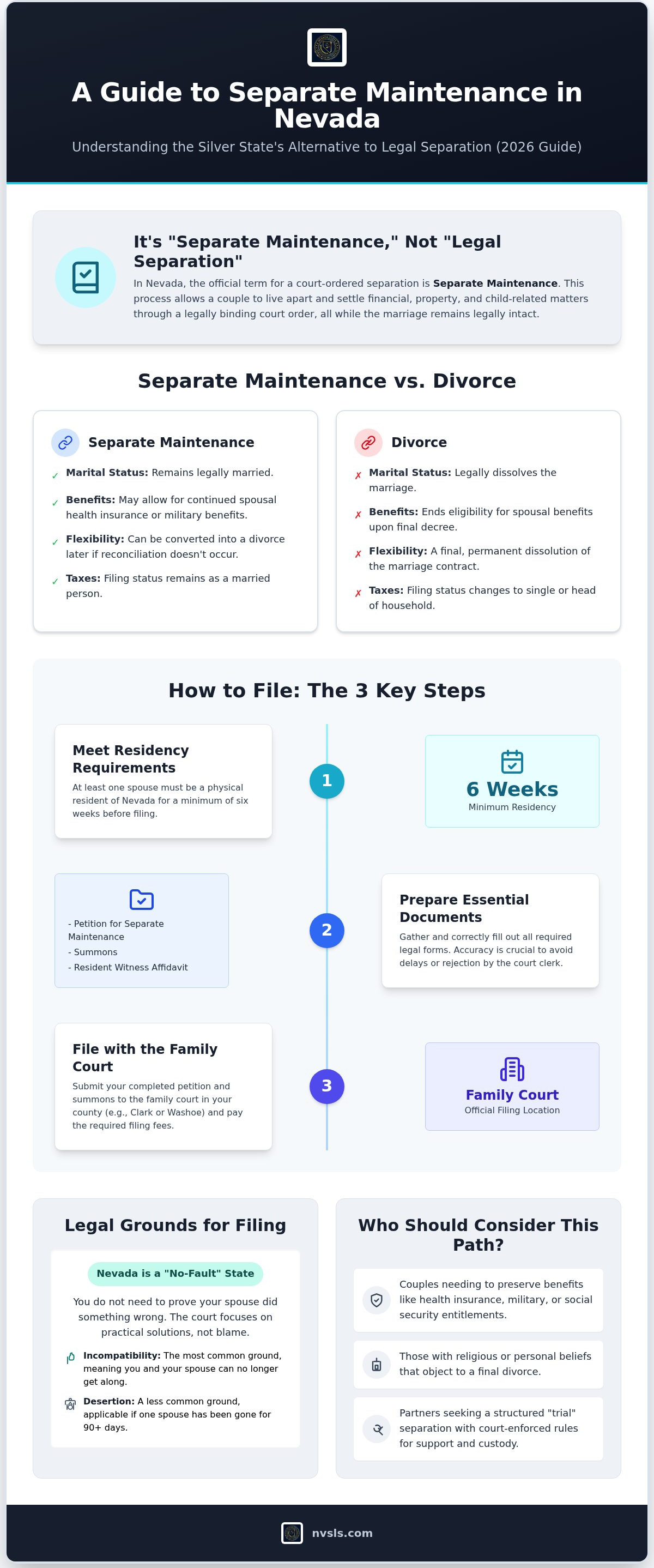
If you're looking for information on Legal separation, you won't find that exact phrase in Nevada’s legal statutes. Instead, the law uses the term "Separate Maintenance." While the names differ, the goal is often the same. You want to live apart while establishing clear rules for your finances, property, and children. Understanding this distinction is the first step in learning how to file for legal separation in Nevada. It’s about getting the right protections without actually ending the marriage contract.
A Decree of Separate Maintenance is a legally binding court order. Under Nevada Revised Statute (NRS) 125.190, the court has the same authority as it does in a divorce case. This means a judge can issue orders regarding child custody, child support, and the division of community property. However, your marital status remains "married" in the eyes of the state. This keeps the door open for reconciliation while providing an immediate, structured environment for both parties. It’s a practical solution for couples who need legal boundaries but aren't ready for a final break.
Separate Maintenance vs. Divorce in Nevada
The primary distinction lies in the marital bond. A divorce dissolves the marriage entirely. Separate maintenance keeps it legally intact. This choice often impacts your financial life in ways a divorce won't. For instance, you might maintain eligibility for a spouse's health insurance plan. Your tax filing status also remains as a married person. If your circumstances change, you can usually convert this arrangement into a divorce later. It offers a layer of flexibility that a final decree of divorce lacks. You get the legal clarity of a split without the finality of a dissolution.
Who Should Consider Filing for Separation?
This option serves specific needs. Many couples choose it due to religious objections to divorce. It allows them to live independently while honoring their faith. Others use it to preserve military benefits or social security entitlements that depend on the length of a marriage. It’s also an effective tool for those who want a structured "trial" separation. You get a court-ordered plan for child support and debt division without the permanent step of ending the marriage. If you're researching how to file for legal separation in Nevada, this path provides the legal safety net you need during a difficult transition. It's about finding the right balance for your family's unique situation.
Residency and Eligibility Requirements for Nevada Filers
Before you dive into the paperwork for how to file for legal separation in Nevada, you must establish that the state has jurisdiction over your case. Nevada law is very specific about who can access the court system for separate maintenance. You don't need to have lived here for years, but you must meet the minimum threshold. At least one spouse must have been a physical resident of Nevada for at least six weeks before the filing date. This rule is a hard requirement. If you haven't hit the 42-day mark yet, the court will likely dismiss your petition immediately.
Proving Your Nevada Residency
The court won't just take your word for it. To satisfy the residency rule, you need a "Resident Witness." This is a third party, such as a friend, neighbor, or coworker, who also lives in Nevada. They must sign a Resident Witness Affidavit swearing they have seen you living in the state for the required six-week period. It’s a simple step, but it’s non-negotiable. While the affidavit is the primary proof, it's smart to keep your Nevada ID, utility bills, or lease agreements handy. For military members stationed at Nellis or Creech Air Force Base, your presence under military orders counts as residency. If you're feeling overwhelmed by these administrative details, our team provides professional document preparation to ensure every affidavit is drafted correctly.
Legal Grounds for Filing
Nevada is a "no-fault" state, which simplifies the eligibility process significantly. You don't have to prove that your spouse committed a specific wrong to move forward. The most common ground used in these filings is "incompatibility." This essentially means you and your spouse can no longer get along and there is no hope for reconciliation. Another specific ground recognized in Nevada is desertion lasting for 90 days or more. While these grounds are listed in the statutes, the administrative process rarely requires a deep dive into marital "fault." The focus remains on the practical logistics of living apart. You can view the full list of requirements and forms at the Nevada Self-Help Center to see how these grounds are phrased in official documents.
For residents in Las Vegas, Henderson, or North Las Vegas, your case will likely be handled by the Eighth Judicial District Court. This court operates out of the Clark County Family Center. Each district has its own filing nuances and fee structures. In 2026, filing fees in Clark County were approximately $299. Knowing these local details helps you prepare your budget and your timeline. It’s about moving through the system with precision rather than guesswork.
The Step-by-Step Process: How to File for Separation
Once you've confirmed your residency, the real work begins with your paperwork. You'll start by preparing a formal Complaint for Separate Maintenance. This document tells the court exactly what you're asking for regarding assets, debts, and child custody. It’s the foundation of your entire case. Accuracy here is vital. A single mistake in your property list or a missing signature can cause delays or force you to start over. This is why many residents look for guidance on how to file for legal separation in Nevada to ensure their paperwork is professional and complete from day one.
After your documents are ready, you must submit them to the court and pay the mandatory filing fee. In 2026, the filing fee in Clark County is approximately $299. If you're facing financial hardship, don't let the cost stop you. You can file an "Application to Proceed in Forma Pauperis" to ask the court to waive these fees. The court will review your income and expenses to determine if you qualify for a waiver. Once the court accepts your filing, they'll issue a Summons, which is the official notice that begins the legal clock for your spouse to respond.
Filing Your Petition in Clark County
For those living in Las Vegas, Henderson, or North Las Vegas, your destination is the Family Court at 601 North Pecos Road. Most filings in 2026 are handled through the eFileNV electronic system. This allows you to submit documents from home, though you'll need to create an account and follow specific formatting rules. If you prefer in-person service, the Clark County Family Center provides kiosks and staff to help you navigate the submission process. You can find a complete checklist of these steps in the Nevada Courts Self-Help Center guide.
Serving the Papers Correctly
Filing the papers is only half the battle. You must legally notify your spouse through a process called "Service of Process." You cannot simply hand the papers to your spouse yourself. Nevada law requires a neutral third party, such as a professional process server or the Sheriff's office, to deliver the documents. If your spouse is cooperative, they can sign an "Acknowledgment of Service" to skip the formal delivery. However, if they cannot be found or are avoiding service, you may need to ask the court for permission to serve them by publication in a local newspaper. This adds time and cost to the process, so finding a reliable server is often the fastest path forward.
Once your spouse is served, they typically have 21 days to file a formal "Answer." If they fail to respond within this window, you can move for a default judgment. If they do respond, your case will move toward a settlement or a court hearing. The path to a final Decree of Separate Maintenance depends entirely on how much you and your spouse agree on. Staying organized and following the court’s timeline is the best way to keep the process moving without unnecessary stress.
Essential Checklists: Documents You Will Need
Success in the Nevada family court system depends on the quality of your paperwork. If your forms are incomplete or contain clerical errors, the clerk will reject your filing. This costs you both time and money. The core document you need is the Petition for Separate Maintenance. This is where you outline your specific requests for property division, debt allocation, and spousal support. It serves as the foundation for the court's eventual decree.
Along with the petition, you must prepare a Summons. This is the official notice to your spouse that a legal case has started. It establishes the 21-day deadline for their response. If you have children under the age of 18, Nevada law requires a Uniform Child Custody Jurisdiction and Enforcement Act (UCCJEA) Declaration. This form proves that Nevada is the correct state to handle your custody matters. Missing this single document can stall your case for weeks.
Joint Petition vs. Complaint
Deciding how to file for legal separation in Nevada depends largely on your relationship with your spouse. If you are both in complete agreement on every detail, you can file a Joint Petition. This is the fastest and most efficient route. It bypasses the need for a formal Summons and a professional process server. If your spouse won't sign the paperwork or disagrees on terms, you'll need to file a Complaint for Separate Maintenance instead. This starts a contested process where the court must step in to resolve disagreements. You can find the right forms for either path in our Nevada divorce filing documents section.
Financial and Property Disclosures
Transparency is mandatory in every Nevada family law case. The Financial Disclosure Form (FDF) is a comprehensive record of your income, assets, and monthly expenses. You must list everything from bank accounts to retirement funds. Accuracy is critical; hiding assets can lead to severe court penalties. During the property division process, you may need to transfer titles or remove a spouse's name from a family home. In these cases, quitclaim deed preparation Nevada services ensure your real estate transfers meet all state requirements. We provide expert document preparation to help you organize these complex financial records without the stress of doing it alone.
Each document must be signed and, in many cases, notarized. For residents in Las Vegas or Henderson, our mobile notary services can come directly to you to finalize your paperwork. This ensures every signature is verified according to Nevada state law before you submit your packet to the court clerk.
Navigating the Filing Process: Professional Prep vs. DIY
You've gathered the facts. Now you face a critical choice. You can attempt the "Do-It-Yourself" route or hire a high-priced law firm. Many residents find that professional document preparation offers the perfect middle ground. It provides the precision you need without the overwhelming cost of full legal representation. When you're learning how to file for legal separation in Nevada, the administrative hurdles are often the biggest source of stress. We bridge that gap by providing court-ready documents that reflect your specific needs.
Why Document Accuracy Matters
The family court is notoriously strict. A single missing signature or an incorrectly formatted address can lead to an immediate rejection. These clerical errors don't just cause frustration; they stall your progress and can sometimes lead to additional costs. Beyond simple typos, your child support and alimony calculations must align perfectly with Nevada’s 2026 guidelines. Professional drafting ensures your paperwork meets these specific state standards. You get peace of mind knowing your case won't be derailed by a technicality. It’s about doing it right the first time.
Choosing professional help doesn't mean you're seeking legal advice or representation. It means you're prioritizing administrative excellence. This approach is ideal for couples who want to handle their split efficiently and affordably. It keeps your costs low while ensuring your "Separate Maintenance" petition is handled with the same care a law firm would provide. You stay in control of your case while we handle the complex formatting and drafting requirements.
Finalizing with a Notary
Nevada law requires most family court forms to be officially witnessed. This means you must sign your documents in front of a licensed notary public. Without an official seal, your petition has no legal standing and the court clerk won't accept it. Finding a notary during a busy workday in Las Vegas or Henderson shouldn't be another item on your stress list. You don't have to spend your afternoon hunting for a bank or a shipping store that has a notary on staff.
You can streamline this final step by using mobile notary Las Vegas services. A professional can meet you at your home or office to witness your signatures on-site. This convenience is a game-changer for busy residents who need to finalize their filings quickly. Once the papers are signed and notarized, you're ready to submit your packet to the court. Following these steps ensures you master how to file for legal separation in Nevada without the typical headaches. You're now prepared to move forward into your new chapter with the legal protections you need.
Take the Next Step Toward Your New Chapter
You now have a clear roadmap for navigating the "separate maintenance" process. Success in the Nevada court system relies on two critical factors: meeting the six-week residency requirement and submitting flawless paperwork. Whether you're filing a joint petition or a complaint, the precision of your administrative details determines how quickly you can move forward. Understanding how to file for legal separation in Nevada is the first step toward reclaiming your independence while protecting your family's future.
We're dedicated to making this transition as smooth as possible. Start your Nevada separation paperwork today with professional document prep to ensure your filings meet all 2026 court standards. We provide expertly drafted family law documents and convenient mobile notary services throughout Las Vegas and Henderson. While we don't offer legal advice or representation, we provide the efficient, accurate support you need to avoid clerical delays. You can handle this process with total confidence. We're here to help you cross the finish line with ease and move forward with clarity.
Frequently Asked Questions
Is legal separation the same as divorce in Nevada?
No, legal separation and divorce are distinct legal actions. In Nevada, the official term is "separate maintenance." While a divorce ends the marriage entirely, separate maintenance keeps the marital bond intact while the court settles property and custody. This is often chosen for religious reasons or to maintain insurance benefits. You remain legally married but receive a binding court order that defines your financial and parental responsibilities.
How long does the legal separation process take in Clark County?
The timeline varies based on your level of agreement. If you and your spouse file a joint petition, the process is significantly faster. In contested cases where one party is served, they have 21 days to respond. In Clark County, a typical uncontested case might take several weeks to a few months to finalize. Complex cases involving property disputes in Las Vegas or Henderson generally take longer to resolve through the court system.
Do I need a lawyer to file for legal separation in Nevada?
You are not legally required to hire an attorney to file for separate maintenance. Many residents choose to handle the administrative filing themselves to avoid high legal fees. While you don't need a lawyer, you must ensure your paperwork is accurate and meets all court requirements. Professional document preparation services offer a cost-effective way to manage how to file for legal separation in Nevada without the expense of full legal representation.
Can I live in the same house while legally separated?
Yes, you can technically reside in the same home while legally separated. Nevada law focuses on the "separate maintenance" of finances and parental duties rather than your physical location. However, one of the legal grounds for separation is living apart for one year. Most couples find that living in separate residences makes it easier to comply with court orders regarding property and debt division, especially in busy areas like North Las Vegas.
What happens to our property during a legal separation?
Your assets and debts are divided according to Nevada’s community property laws. Under NRS 125.190, the court has the same authority to divide property in a separate maintenance case as it does in a divorce. This includes bank accounts, real estate, and retirement funds. It’s vital to list all community property accurately on your Financial Disclosure Form to ensure a "just and equitable" division that protects your long-term financial interests.
Can a legal separation be turned into a divorce later?
Yes, a legal separation can be converted into a divorce at a later date. If one spouse decides they want to end the marriage entirely, they can file a new complaint for divorce. In some cases, if a spouse is served with a separation complaint, they may immediately file a counterclaim for divorce. The court will typically grant the divorce request, as Nevada is a no-fault state and doesn't force couples to stay married.
How much are the filing fees for separate maintenance in Nevada?
Filing fees for separate maintenance depend on the specific county where you submit your paperwork. As of 2026, the filing fee in Clark County is approximately $299. In Washoe County, the fee is $284. These costs are mandatory unless you qualify for a fee waiver based on low income. Remember that these are court costs and don't include fees for professional document preparation or mobile notary services required to finalize your packet.
Is child support required during a legal separation?
Yes, child support is a mandatory consideration if you have minor children. Nevada uses a tiered income formula to calculate these obligations. For one child, the rate is 16% of the first $6,000 of gross monthly income. Even if a parent is currently unemployed, the law establishes a minimum support obligation of $100 per month per child. Ensuring these calculations are accurate is a key part of how to file for legal separation in Nevada.


