

Most people think a living trust is just one fancy piece of paper with a gold seal, but that's a common mistake that could land your family in probate court anyway. A valid trust isn't a single document; it's a coordinated package designed to keep your private affairs out of the public record. You likely want to protect your heirs from a 6-to-12-month legal marathon, yet the thought of deciphering archaic legalese or paying thousands in attorney fees is exhausting. It's frustrating to feel like you're choosing between future financial security and your current savings.
We understand that you need clarity, not more confusion. This 2026 guide will show you exactly which Nevada living trust documents you need to build a rock-solid plan. You'll learn how to protect your assets and ensure a smooth transition for your beneficiaries without the traditional legal price tag. We'll walk through the essential paperwork, including the trust agreement and the specific deeds required to fund your trust properly. By the end of this article, you'll have a clear, no-nonsense roadmap to securing your legacy through precise document preparation.
Key Takeaways
- Understand how a living trust functions as a legal framework to manage assets during your life and bypass probate for your heirs.
- Identify the specific Nevada living trust documents required for a complete package, including the foundational Trust Agreement and the essential Pour-Over Will.
- Learn the critical differences between revocable and irrevocable structures to choose the right level of control and protection for your family.
- Discover the two-step process for inventorying your assets and selecting successor trustees to ensure your trust is fully functional and funded.
- Explore how to secure professional-grade estate planning documents and mobile notary services without the high costs of traditional legal representation.
What Are Nevada Living Trust Documents?
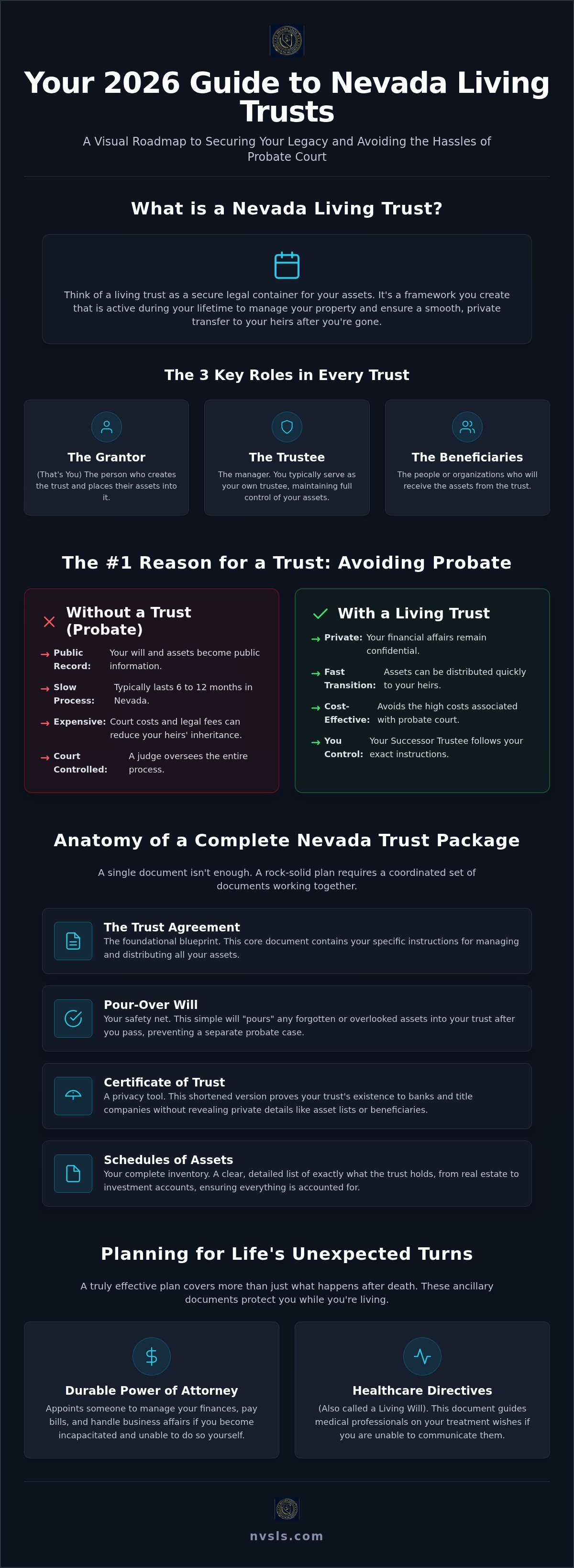
Think of a living trust as a specialized container for your assets. It's a legal framework that holds your property for your benefit while you're alive and ensures a smooth transfer to your heirs after you're gone. Unlike a Last Will and Testament, which only takes effect after death, a living trust is active the moment you sign it. This "living" quality is why it's such a powerful tool for modern estate planning. You maintain control, but the structure is already in place to protect your family.
To understand the basics, it helps to ask: What is a Trust? At its core, it's a fiduciary relationship where one party holds the title to property for another. When you prepare Nevada living trust documents through a professional document preparation service, you're defining three specific roles:
- The Grantor: That's you. You're the person creating the trust and moving your assets into it.
- The Trustee: The manager. Usually, you serve as your own trustee while you're healthy, keeping full control over your bank accounts and real estate.
- The Beneficiaries: The people or organizations who will eventually receive your assets.
The centerpiece of this package is the Trust Agreement. This document contains your specific instructions on how assets should be managed and distributed. It's the blueprint for your legacy. Because Nevada is a community property state, these documents must be drafted with precision to reflect how you and your spouse own your property. Accuracy here is vital; a small error in a legal description can cause major headaches later.
How a Living Trust Avoids Nevada Probate
Probate is a court-supervised process that can be both slow and expensive. In Nevada, a full probate typically lasts between 6 and 12 months. When your assets are held in a trust, they don't belong to "you" in the eyes of the court; they belong to the trust. This means your heirs can skip the courtroom entirely. Your financial affairs remain private because Nevada living trust documents aren't filed in public records, unlike a Will which becomes a matter of public interest during probate.
The Role of the Successor Trustee
Efficiency depends on having a backup plan. A successor trustee is the person you designate to step in if you become incapacitated or pass away. They don't have free rein; they must follow the exact instructions you laid out in your Trust Agreement. Naming a reliable alternate prevents the court from having to appoint a guardian or administrator to handle your affairs. It's a practical step that provides immediate peace of mind for your family during a stressful time.
Essential Components of a Nevada Trust Package
A living trust isn't a solo act. It's a team effort. To meet the standards of the Nevada Revised Statutes on Trusts, you need a coordinated set of paperwork. If you only have the trust agreement, you've only built half a house. A complete set of Nevada living trust documents ensures that no asset falls through the cracks and no beneficiary is left guessing.
The core of your package includes four primary elements:
- The Trust Agreement: This is the foundational blueprint. It contains your specific instructions for asset management and distribution.
- Pour-Over Will: Think of this as your safety net. Most people eventually forget to title at least one asset in their trust's name. This document "pours" those forgotten items into the trust after you pass, preventing a separate probate case.
- Certificate of Trust: Privacy is a major goal for many Nevada families. This shortened version proves your trust exists to banks and title companies without revealing your private distribution details or asset lists.
- Schedules of Assets: This is your inventory. It provides a clear, detailed list of exactly what the trust currently holds, from your primary residence to your investment accounts.
Accuracy is everything. Your Nevada living trust documents should work together like a well-oiled machine. If you're ready to organize your legacy, our team can help you prepare a complete set of estate planning documents that meet all state requirements.
Ancillary Estate Planning Documents
A truly effective plan covers more than just death; it covers life's unexpected turns. You need a Durable Power of Attorney to ensure someone can manage your bills and business affairs if you're ever unable to do so. Additionally, Healthcare Directives, often called a Living Will, guide medical professionals on your treatment preferences. You can find more details in our guide on Understanding Power of Attorney in Nevada.
Why One Document Is Never Enough
Gaps in your paperwork are invitations for probate to enter the picture. A trust without a Pour-Over Will is a common mistake that leads to unnecessary court intervention for small, overlooked accounts. Similarly, the Certificate of Trust is essential for everyday banking. Without it, you might be forced to share your entire private trust agreement with bank clerks just to open an account. Maintaining consistency across all your estate planning documents in Las Vegas is the only way to ensure your plan remains valid and functional when your family needs it most.
Revocable vs. Irrevocable Trusts in Nevada
Choosing the right structure for your Nevada living trust documents depends on one core question: Do you want flexibility or maximum protection? Most Nevada families opt for a revocable living trust because it acts like a safety deposit box you keep the key to. You can add or remove assets, change your beneficiaries, or even cancel the trust entirely at any time. It's built for life's changes. You remain the boss of your assets while you're alive and well.
Irrevocable trusts are a different beast. Once you sign these documents, the transfer is generally permanent. You're giving up direct control in exchange for specific, high-level benefits. These might include advanced creditor protection or complex tax planning. Nevada is widely considered a top-tier jurisdiction for these structures. For instance, assets in a Nevada Domestic Asset Protection Trust (DAPT) are generally protected from creditors after a 2-year statute of limitations period. Additionally, the state allows "dynasty trusts" to last for up to 365 years. This enables families to protect wealth across multiple generations. However, these benefits come with a loss of flexibility that doesn't suit the average household's needs.
When to Choose a Revocable Trust
If your main concern is avoiding the 6-to-12-month probate process, a revocable trust is usually the best fit. It's the standard choice for managing assets if you ever become incapacitated. Because you can update the terms as your family grows or your financial situation shifts, it provides a level of comfort that permanent structures can't match. It remains the most popular form of estate planning paperwork in Nevada for residents who want to keep things simple yet secure. You get the privacy you want without locking your assets away forever.
The Complexity of Irrevocable Trusts
Irrevocable structures often involve "Spendthrift" clauses. These are designed to protect an inheritance from a beneficiary's creditors or to help a loved one qualify for specific government benefits. Because these trusts are permanent, they usually require specialized legal advice to navigate federal tax implications. It's a high-stakes decision. Our professional document preparation services focus on standard revocable living trust packages. We help you create the reliable, flexible framework that most families need to stay out of court. If you have a massive estate or complex litigation concerns, an irrevocable solution might be necessary, but it requires a much higher level of ongoing administrative maintenance.
How to Create and Fund Your Living Trust
Creating your Nevada living trust documents is a methodical process. It starts with a clear inventory of what you own. You can't protect what you haven't listed. Once you've identified your real estate, bank accounts, and investments, you'll need to decide who will inherit these assets and who will manage them if you can't. This isn't just about picking names; it's about choosing people you trust to follow your instructions to the letter.
After your roles are set, the next phase is the professional preparation of the Trust Agreement and its supporting forms. In Nevada, the formal signing is a critical hurdle. Your documents must be notarized, and the state requires specific notary acknowledgments to be valid. Skipping a small detail at the notary's desk can lead to a rejected filing or a contested trust later. If you're ready to start the paperwork, we specialize in estate planning documents tailored to Nevada's precise requirements.
The Critical Step: Funding the Trust
A trust is essentially an empty box until you put something in it. This is where many DIY plans fail. You must "fund" the trust by retitling your assets into the trust's name. For bank accounts, this usually involves a trip to your local branch. For property, it requires professional deed drafting in Las Vegas. Don't forget your life insurance and retirement accounts. You'll need to update your beneficiary designations to ensure these funds flow into the trust according to your wishes.
Recording Deeds in Clark County
If you own a home in Las Vegas or Henderson, you must record a new deed with the Clark County Recorder. This transfer deed officially moves the property from your individual name to your trust. You'll also need to include a "Declaration of Value" form. While many trust transfers are exempt from real property transfer taxes, you must cite the correct Nevada Revised Statute (NRS) exemption code on the form. Errors in quitclaim deed preparation in Nevada are common and can result in costly delays or clouded titles. Current county recording fees generally range from $37 to $43, so getting the document right the first time saves you both time and unnecessary expense.
Professional Document Preparation in Las Vegas
Precision is the foundation of a functional estate plan. When you're dealing with Nevada living trust documents, there's no room for "close enough." A single typo in a legal property description or a misspelled name for a successor trustee can create significant hurdles for your heirs. It might even invalidate the trust entirely. We understand that the technical side of estate planning feels overwhelming. That's why we focus on delivering accurate, professional-grade paperwork that meets strict Nevada standards without the stress of traditional law firm billable hours.
Choosing a document preparation service is about finding a balance between value and reliability. You deserve a clear path to protecting your assets without paying for unnecessary legal overhead. Our process is designed to be efficient and transparent. We handle the administrative heavy lifting so you can focus on the big picture: your family's future. By specializing in precise form preparation, we ensure your trust is ready for the real world.
The Convenience of Mobile Notary Services
Signing your trust is just as important as drafting it. To be legally binding in Nevada, your estate documents must be notarized correctly. We know your schedule is busy, and finding a notary shouldn't be another chore on your list. Our mobile notary in Las Vegas brings the office to you. Whether you're at home in Henderson, an office in North Las Vegas, or a coffee shop in Summerlin, we provide safe, professional signing services on your terms. This ensures your Nevada living trust documents are executed with the proper acknowledgments required by state law.
Why Choose Nevada State Forms & Filing Services?
We aren't just another form provider; we're your local partner in estate administration. As a dedicated document preparation service, we provide the expertise needed to navigate Nevada's specific filing requirements. We don't offer legal advice or representation, which allows us to keep our pricing transparent and accessible. You get the benefit of our deep knowledge of local recording practices and state forms. Our goal is to act as a bridge between complex requirements and your practical needs. We offer:
- Transparent, flat-rate pricing for document packages.
- Expert knowledge of Clark County recording standards.
- Fast turnaround times to get your plan in place quickly.
- Mobile signing services for ultimate convenience.
Don't let the fear of probate keep you from acting. Starting your document preparation today is the most effective way to secure your legacy. Contact us to begin organizing your assets and building a plan that protects what matters most.
Secure Your Legacy with Confidence
Protecting your assets shouldn't be a source of stress. You now know that a successful estate plan depends on a complete package of Nevada living trust documents and the critical final step of funding your trust. By organizing your assets and retitling your property today, you ensure your family avoids the public, time-consuming probate process later. It's about taking control of your financial future and providing a clear, private path for your heirs.
We're here to make the administrative side of this process manageable and straightforward. Our team focuses on professional document preparation tailored to Nevada requirements, combined with the convenience of mobile notary services that come directly to your door. You get the precision your estate deserves with transparent, affordable pricing that respects your budget. Don't leave your family's security to chance or wait for a crisis to act. Taking this step now is the best gift you can give your beneficiaries.
Start Your Nevada Living Trust Documents Today and gain the peace of mind that comes with a professionally prepared estate plan. It's a practical, efficient way to protect what you've worked so hard to build.
Frequently Asked Questions
Do I need a lawyer to create a living trust in Nevada?
No, you aren't legally required to hire a lawyer to create your trust. Many residents in Las Vegas and Henderson use professional document preparation services to handle the administrative side of their estate plan. This is a cost-effective alternative for standard situations. While we don't provide legal advice or representation, we ensure your forms meet specific Nevada requirements. It's a practical way to get professional results without the high billable hours of a traditional law firm.
Does a living trust need to be recorded in Nevada?
The trust agreement itself is a private document and does not get recorded with any state or local agency. However, if you're transferring real estate into the trust, the specific deed for that property must be recorded with the County Recorder. For example, transferring a home in Henderson requires filing a deed in Clark County. This recording step is what officially moves the property into the trust's name and protects it from the probate process.
What is the difference between a Will and a Living Trust in Nevada?
A Will must go through probate court before assets are distributed, which typically takes 6 to 12 months in Nevada. A living trust allows your assets to pass directly to beneficiaries, skipping the court process entirely. Trusts also provide privacy because they aren't filed in public records. While a Will only takes effect after death, a trust is active while you're alive, offering management protection if you ever become incapacitated or unable to handle your affairs.
How much does it cost to set up a living trust in Las Vegas?
Costs vary significantly based on how you choose to prepare your plan. Traditional attorney-prepared plans in the Las Vegas area often range from $1,500 to $5,000. Professional document preparation offers a middle ground, providing high-quality Nevada living trust documents at a much lower cost than a law firm. You'll also need to budget for Clark County recording fees, which generally range from $37 to $43 per deed, depending on the document's page count and specific filing requirements.
Can I change my revocable living trust after it is signed?
Yes, you can update or cancel a revocable trust at any time as long as you are mentally competent. This flexibility is why most families in North Las Vegas prefer revocable structures over irrevocable ones. You might need to amend the trust if you buy new property, have more children, or want to change your successor trustee. We can help you prepare the necessary amendment paperwork to ensure your estate plan stays current with your changing life and financial situation.
What happens if I forget to fund my trust with an asset?
If you leave an asset out of your trust, it may have to go through probate court after you pass. To prevent this, your Nevada living trust documents should always include a "Pour-Over Will." This backup document acts as a safety net, instructing the court to "pour" any forgotten assets into your trust. However, it's always more efficient to fund the trust properly while you're alive. This ensures your heirs don't have to deal with the stress of a court case.
Is a Nevada living trust valid in other states?
Yes, a trust created in Nevada is generally recognized in all other states under the U.S. Constitution. If you move out of Las Vegas or own property in another state, your trust remains a valid legal entity. You won't necessarily need to create a new trust, though you should check if your new state has specific requirements for real estate transfers. Your Nevada trust will still govern how your personal assets are managed and distributed regardless of where you live.


