
You've finally finished your paperwork, but the clerk at the Henderson government office points to a blank space and tells you it's missing a certificate. You're left wondering: what is a notary acknowledgement and why is it stopping your progress? It's a small detail that carries massive legal weight. For many Nevada signers, this single page is often the only thing standing between a successful filing and a total document rejection.
Dealing with legal paperwork is rarely fun. Between the confusing jargon and the fear of making a mistake, it's easy to feel overwhelmed. You want to ensure your signature is valid without spending hours deciphering state statutes. We understand that your time is valuable and your documents are important. It's normal to feel stressed when a simple signature becomes a complex administrative hurdle.
This guide cuts through the noise to explain exactly how an acknowledgement certificate secures your documents. You'll learn what you must bring to your signing and how to meet Nevada's specific requirements. We'll also explore why these certificates are essential for filings in Las Vegas and how a mobile notary can make the entire process stress-free and straightforward.
Key Takeaways
- Learn how an acknowledgement verifies your identity and intent to prevent fraud on your most important legal documents.
- Discover what is a notary acknowledgement and why this specific certificate is mandatory for recording deeds and trusts in Nevada.
- Prepare for your signing by knowing exactly which forms of identification are accepted by Nevada notary publics.
- Understand the critical differences between an acknowledgement and a jurat so you can choose the right act for your specific paperwork.
- Find out how mobile notary services simplify the process by meeting you at your home or office in Henderson or Las Vegas.
Understanding the Notary Acknowledgement
When you're handed a stack of legal papers, the terminology can feel like a foreign language. One of the most common questions we hear from clients is: what is a notary acknowledgement? At its core, an acknowledgement is a formal declaration made before a notary public. It's a specific type of notarial act where you, the signer, declare that you've signed a document voluntarily. This act serves as a critical safeguard against forgery and coercion by ensuring the person signing the document is exactly who they claim to be. It provides a layer of security that makes the document reliable for courts, county recorders, and government agencies across Nevada.
The Role of the Notary as a Neutral Witness
It's a common misconception that a notary public "legalizes" the content of your contract or deed. In reality, the notary acts as an impartial third party representing the State of Nevada. Their job isn't to review your legal strategy or verify that the terms of your agreement are fair. Instead, they focus entirely on the signature and the individual behind it. They serve as the eyes and ears of the state, confirming that the signing event actually happened as recorded. This neutrality is what builds trust in the public record. Because the notary has no personal stake in your document, their seal carries weight with officials in Las Vegas and beyond.
Identity and Willingness: The Two Pillars
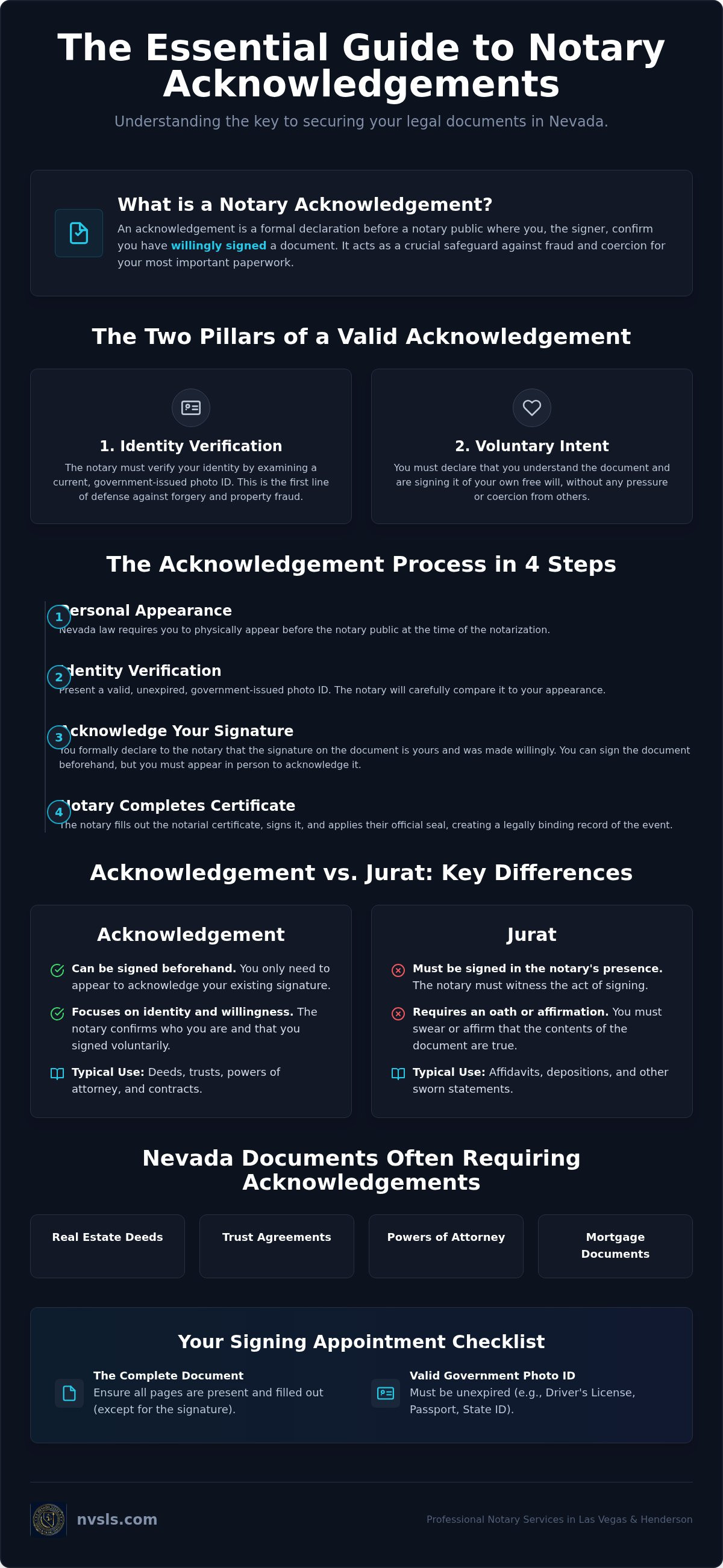
The process relies on two essential factors: identity and intent. Verifying identity is the first line of defense against property and identity fraud. By checking a government-issued photo ID, the notary ensures that a stranger isn't signing away your home or business. This fundamental concept of an Acknowledgment (law) is what gives the document its legal "teeth." Without this verification, documents could be easily disputed in court, leading to expensive legal battles and rejected filings.
The second pillar is willingness. The notary must determine that you aren't being forced to sign under duress. During the what is a notary acknowledgement process, the notary assesses your awareness through direct interaction. They'll often ask a few simple questions to confirm you understand the document's purpose and are signing of your own free will. This prevents situations where someone might take advantage of a vulnerable person. It's a simple conversation, but it's the most effective way to protect your rights.
During a standard acknowledgement, the notary confirms:
- The signer is physically present in the notary's presence.
- The signer's identity matches their unexpired government-issued ID.
- The signer understands the document they're about to sign.
- The signature is being provided voluntarily, without outside pressure.
How the Acknowledgement Process Works
Understanding what is a notary acknowledgement is the first step. Knowing how the actual appointment unfolds is the second. The process is methodical and designed to be transparent. It starts with your physical presence. Nevada law requires that every signer personally appear before the notary public at the time of the act. This ensures there's no doubt about who is participating in the transaction. If you're managing a tight schedule, our mobile notary services can meet you at your home or office to keep your day moving.
Once you're face-to-face, the notary will verify your identity. This is a strict requirement. You'll need to present a government-issued photo ID that is current and unexpired. The notary carefully compares your physical appearance and signature against the credentials provided. According to the Nevada Secretary of State Notary FAQs, this step is non-negotiable for every notarial act. After verification, you'll formally declare, or acknowledge, that the signature on the document is yours and that you signed it for the purposes stated within the text. Finally, the notary completes the certificate and applies their official seal; this creates a record that is legally binding and ready for filing.
Can You Sign the Document Before Meeting the Notary?
Yes, you can. This is a major point of difference between an acknowledgement and other notarial acts. You are permitted to sign your deed or contract before you ever step into the notary's office. However, you must still personally appear to "acknowledge" that the signature is yours. Even though it's allowed, we often suggest waiting to sign until you're with the notary. It helps avoid simple mistakes, such as signing in the wrong spot or using the wrong ink color, which could lead to your document being rejected by the Clark County Recorder.
What to Bring to Your Signing Appointment
Preparation is the best way to lower your stress. A missing document or an expired ID can stall your entire legal process. To ensure a smooth experience, please have the following items ready:
- Valid Identification: Bring a current driver’s license, state ID, or passport.
- The Full Document: The notary needs to see the entire document to ensure it's complete, not just the signature page.
- All Required Signers: If a document requires multiple people to sign, everyone must be present with their own identification.
By following these steps, you ensure your paperwork meets all state requirements. It's a quick process when handled by an expert who understands the local landscape in Las Vegas and Henderson.
Acknowledgement vs. Jurat: Key Differences
Entering a notary's office often brings up the same question: what is a notary acknowledgement and how does it differ from a jurat? It's a common source of confusion for many signers in Clark County. While an acknowledgement confirms your identity and your intent to sign, a jurat goes a step further. It confirms that the contents of the document are actually true. Because of this, Nevada divorce filing documents often require different types of notarization depending on the specific form you're submitting to the court. Choosing the wrong one can lead to your document being rejected by the court or the recorder office, causing unnecessary delays.
The "Oath" Factor in Jurats
Jurats are primarily used for evidence in court proceedings or for documents that will be recorded as sworn statements. The process involves a specific verbal ceremony that isn't required for an acknowledgement. The notary will ask you a direct question such as, "Do you swear or affirm that the contents of this document are true?" This isn't just a formality. You are making this statement under penalty of perjury. This is why jurats are the standard for affidavits and depositions. You can usually tell if you need a jurat by looking at the pre-printed language at the bottom of your form. If the text mentions "sworn to" or "affirmed," you're dealing with a jurat.
Which Notarial Act Do You Need?
One of the most important things to remember is that a notary public cannot choose the act for you. Doing so would be considered the unauthorized practice of law. We see many clients who feel frustrated when a notary asks them which certificate they need. It's not the notary being difficult; it's a legal boundary they must respect. If your document doesn't have a pre-printed certificate, you must tell the notary which one to use. If you aren't sure, check with the agency receiving the document or the professional who drafted it. Following the Nevada Secretary of State guidelines ensures your paperwork is handled correctly from the start. Look for these key phrases to help you decide:
- "Acknowledged before me": This is the standard language for an acknowledgement.
- "Subscribed and sworn to": This is the definitive signal that you need a jurat.
- "Affirmed before me": This also indicates a jurat is necessary, usually for signers who prefer not to take a religious oath.
Understanding these distinctions saves you time and prevents the headache of having to redo your paperwork because the wrong certificate was attached. It's about getting it right the first time so your legal matters can move forward without a hitch.
Common Nevada Documents Requiring Acknowledgements
In Nevada, the stakes for your paperwork are often high. Whether you're transferring property or setting up a business, you need to know exactly what is a notary acknowledgement and when it's required. Most documents that involve transferring assets or granting authority over financial affairs must have one. This is because these documents are recorded in public files or used to authorize major transactions. Accuracy isn't just a suggestion; it's a legal necessity to ensure your document is accepted by state or county officials. Mistakes here don't just cause delays; they can lead to expensive legal headaches.
Real Estate and Deed Transfers in Las Vegas
If you're dealing with property in Clark County, your deed won't get very far without a proper acknowledgement. The Clark County Recorder is notoriously strict about certificate wording. If the language doesn't match Nevada Revised Statutes (NRS) exactly, they'll reject the filing on the spot. We see this often with Quitclaim, Grant, and Warranty deeds. A tiny error in the notary block can "cloud" your property title, making it difficult to sell or refinance later. Using professional document preparation helps ensure your deed is ready for notarization before you even meet the notary.
Power of Attorney and Financial Documents
Estate planning is another area where the what is a notary acknowledgement question becomes vital. A Power of Attorney (POA) is a powerful document that gives someone else the right to manage your finances or healthcare. Because the risks of fraud are so high, banks and hospitals scrutinize these notary seals more than almost any other document. The notary must confirm you're competent and acting of your own free will during the signing. Without a clear, properly executed acknowledgement, your family might find themselves unable to use the POA during a medical or financial crisis.
Beyond deeds and estate plans, several other Nevada documents typically require this specific act to be legally binding:
- Nevada LLC Formation: Certain corporate contracts and business formation filings.
- Trust Documents: Amendments or full trust agreements designed to protect your assets.
- Name Change Paperwork: Specific supporting documents required by Nevada courts for a legal name change.
- Contractual Agreements: Long term leases or business partnership agreements.
Handling these high-stakes documents can be stressful, especially when you're balancing a busy schedule in Las Vegas or Henderson. For expert assistance at your location, consider using mobile notary Las Vegas services to ensure your signing is done correctly the first time. If you're ready to move forward with your paperwork, book our mobile notary services to handle the details for you.
Professional Support for Your Nevada Signings
Navigating legal requirements shouldn't feel like a second job. You now understand what is a notary acknowledgement and why it's so vital for your legal standing. However, the logistics of getting that stamp can still be a major source of stress. Between traffic in Las Vegas and the limited hours of traditional banks, many people find themselves rushing through important signings. This is where professional support changes the experience from a chore into a managed, straightforward process. We believe that getting your paperwork right should be the easiest part of your day.
The Benefits of a Mobile Notary in Clark County
Mobile notary services are designed with your busy schedule in mind. We bring the expertise directly to your kitchen table in Henderson or your office on the Strip. This level of convenience is a game changer for busy professionals and families who can't afford to spend their lunch break waiting in a long line at a shipping store. Beyond just saving time, a mobile service offers a level of privacy that you won't find in a public lobby. This is especially important for sensitive legal matters like estate planning or family law. You get a focused, one on one appointment in a setting where you feel comfortable. We offer flexible scheduling across North Las Vegas and the surrounding areas, ensuring your documents are handled on your own timeline without the typical administrative headaches.
Beyond the Stamp: Document Preparation Services
A notary seal is only as good as the document it is attached to. At Nevada State Forms & Filing Services, we go beyond just the signing event. We help you with the preparation of deeds, business formation contracts, and name change paperwork. Our team understands the specific standards required by the State of Nevada for 2026. We take the guesswork out of complex administrative tasks, which significantly reduces the risk that your filing will be rejected by the county recorder. By ensuring your forms are drafted correctly from the start, we save you the time and expense of multiple trips to government offices. We act as your friendly expert guide, providing the tools and support you need to handle your paperwork with confidence.
Our goal is to make the entire process feel manageable. While we do not provide legal advice or representation, we excel at making the paperwork process efficient and accurate. You can focus on your life and your family while we ensure your documents are legally binding and ready for submission. It is a no-nonsense approach to document management that prioritizes your peace of mind and your time.
Secure Your Nevada Documents Today
You now understand that a notary acknowledgement is much more than a simple stamp. It's a vital declaration of identity and intent that protects your property, business, and family legacy. Knowing exactly what is a notary acknowledgement gives you the confidence to handle high-stakes paperwork without the fear of rejection by the county recorder. By knowing what to bring and how to distinguish this act from a jurat, you're already ahead of the curve.
Don't let confusing administrative requirements slow your progress or cause unnecessary stress. We provide reliable mobile notary services and expert Nevada document preparation for family law, deeds, and business formation. Our team serves signers across Las Vegas, Henderson, and North Las Vegas with a focus on precision and convenience. Schedule your mobile notary appointment in Las Vegas today and let a friendly expert guide you through the finish line. Your documents deserve the accuracy that only a dedicated local specialist can provide. We're ready to help you move forward with total peace of mind.
Frequently Asked Questions
Does an acknowledgement expire?
A notary acknowledgement does not have an expiration date of its own. Once the notary seals the certificate, that act remains a permanent part of the document’s history. However, the document itself, such as a Power of Attorney or a business contract, may have its own internal expiration date or legal shelf life. You should always check with the receiving agency in Las Vegas to ensure they still accept the document's age.
Can a notary refuse to perform an acknowledgement?
Yes, a notary public can and should refuse to perform an acknowledgement under specific circumstances. If the notary suspects the signer is being coerced, doesn't understand the document, or appears mentally incompetent, they must decline the act. They will also refuse if you cannot provide a valid, unexpired government-issued photo ID. This refusal is a professional duty designed to protect the integrity of the Nevada public record.
Is an electronic acknowledgement legal in Nevada?
Electronic and remote online notarizations are perfectly legal in Nevada. The state has specific regulations allowing notaries to perform acts using secure audio-video technology. While the process is digital, the fundamental question of what is a notary acknowledgement remains the same. The notary must still verify your identity and ensure you are signing willingly. Many residents in Henderson prefer this method for its speed and modern convenience during busy workdays.
What happens if the acknowledgement certificate is missing from my document?
If your document is missing the pre-printed wording, the notary can attach a loose certificate. This is a separate sheet of paper containing the statutory Nevada acknowledgement language. Without this certificate, the document cannot be legally recorded at the Clark County Recorder office. It is a common issue with documents drafted out of state. We can provide the correct Nevada-compliant certificate during your mobile notary appointment to ensure your filing is successful.
Can I use a notary acknowledgement for a document in a foreign language?
You can have a foreign language document acknowledged in Nevada, but the notary certificate itself must be in English. The notary doesn't need to understand every word of your document, but they must be able to communicate with you directly to verify your identity and willingness. If you and the notary don't speak the same language, you may need a different specialized service. The focus remains on the signature event, not the text.
What is the difference between an acknowledgement and a witness signature?
A witness signature simply confirms that someone saw you sign the paper. In contrast, an acknowledgement is an official act by a state-commissioned officer who verifies your identity through formal credentials. When asking what is a notary acknowledgement, remember that it carries much higher legal weight than a standard witness. Banks and courts require the notary’s seal because it provides a verifiable trail that a neutral party confirmed the signer’s identity and intent.
Can a family member perform my notary acknowledgement in Nevada?
Nevada law strictly prohibits a notary from performing a notarial act for a direct family member if the notary has a beneficial interest in the document. This includes spouses, parents, or children who might gain financially from the contract or deed. Even if there is no direct conflict, it is always best to use an impartial third party. This ensures the document’s validity cannot be challenged later in court due to a perceived bias or conflict of interest.


