

The deed with the more reassuring name isn’t automatically the right choice. In the warranty deed vs quitclaim deed Nevada comparison, the key difference is the title protection the grantor promises, not just the document’s label.
It’s understandable to wonder whether one deed offers safer protection, changes who’s responsible for the mortgage, or clears liens. These are separate issues, and choosing a deed without sorting them out can create confusion. A warranty deed generally includes assurances about title. A quitclaim deed transfers only whatever interest the grantor has, without those guarantees.
This guide explains what each deed generally conveys, how a special warranty deed differs, and what to resolve before preparing or recording a transfer. It also covers why a deed doesn’t automatically remove mortgage obligations or liens, and which practical details matter when recording a deed in Nevada, including the property description, notarization, and Declaration of Value. Once you understand the distinction, document preparation and filing support can help organize your next steps.
Key Takeaways
- In the warranty deed vs quitclaim deed Nevada comparison, focus on the title assurances being made, not the deed’s name alone.
- Understand the difference between transferring an ownership interest and promising protection against certain title claims.
- Consider the transfer’s purpose, the parties involved, and the assurances desired before preparing a deed.
- Before recording in Clark County, check party names, the legal property description, signatures, notarization, and required supporting documents.
- Once you’ve identified your transfer goals, deed drafting and administrative filing support can help organize the preparation process.
Warranty vs. Quitclaim Deeds in Nevada: What They Do
A deed transfers an ownership interest in real property. The promises that accompany the transfer depend on the deed’s wording. That distinction is central to the warranty deed vs quitclaim deed Nevada question: both documents can transfer an interest, but they generally offer different levels of assurance about title.
A deed’s legal effect also depends on how it’s completed and signed, as well as applicable Nevada law. The document’s title alone doesn’t tell the whole story. Review its actual wording and confirm that the property and parties are identified accurately.
What a warranty deed generally promises
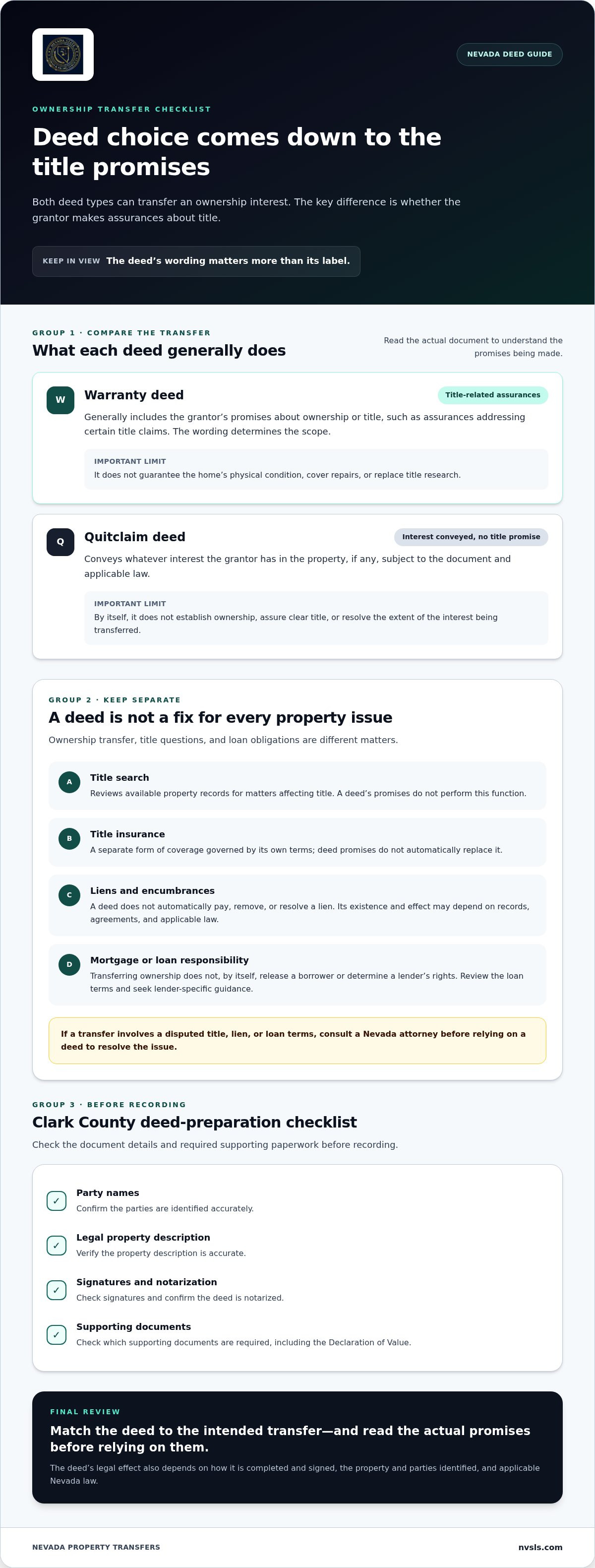
A warranty deed generally contains the grantor’s promises about ownership or title, such as assurances addressing certain title claims. The specific promises vary with the deed’s wording and form, so don’t assume every document called a warranty deed provides identical protection. These are title-related assurances, not promises that the home is free of defects or that the grantor will pay for repairs.
What a quitclaim deed transfers, and does not promise
A quitclaim deed conveys whatever interest the grantor has in the property, if any, subject to the document and applicable law. By itself, it doesn’t establish that the grantor owns the property or that title is clear. It also doesn’t resolve questions about the extent of the interest being transferred.
A quitclaim deed transfers the grantor’s interest, if any, without itself assuring that the title is clear.
Here’s the practical distinction:
| Comparison | Warranty deed | Quitclaim deed |
|---|---|---|
| Title assurances | Generally includes title-related promises; the wording determines their scope. | Generally conveys the grantor’s interest without a promise that title is clear. |
| Typical context | May be used when the transfer includes assurances about title. | May be used when transferring an interest without title assurances. |
| Important limit | Doesn’t guarantee the property’s physical condition or replace title research. | Doesn’t prove ownership, clear title, or resolve other obligations tied to the property. |
Neither deed is a home-condition warranty. Title assurances are also different from title insurance, a separate product, and a title search, which examines property records. A deed’s promises don’t perform either function. Before preparing a transfer, consider what protection the parties intend and what the deed actually says.
What Title Protection Does a Nevada Warranty Deed Actually Provide?
A warranty deed’s protection concerns title: it consists of promises the grantor makes about ownership or certain claims affecting the property. It doesn’t guarantee the home’s condition, cover repairs, or automatically resolve every issue connected to the property. The scope depends on the deed’s wording and applicable law, so the label alone isn’t enough to determine which assurances apply.
Keep three things separate. A grantor’s deed promises are statements made as part of the transfer. A title search reviews available property records for matters affecting title. Title insurance is a separate form of coverage, governed by its own terms. One doesn’t automatically replace the others.
Nevada law also includes rules relevant to real-property transactions. For example, Chapter 113 of the Nevada Revised Statutes addresses certain seller disclosures. That chapter isn’t a complete statement of the warranties in a particular deed. The document’s wording and applicable law matter.
Does a warranty deed guarantee that a property has no liens?
Not by itself. A deed warranty may address title claims, but it isn’t a search of recorded documents and doesn’t automatically pay, remove, or resolve a lien. The existence and effect of an encumbrance are separate questions that may depend on records, agreements, and applicable law. If you’re dealing with a disputed title or lien, consult a Nevada attorney for legal advice before relying on a deed transfer to resolve it.
Does transferring title change mortgage responsibility?
No deed should be assumed to change the loan. A transfer of ownership and the obligations under a mortgage or loan agreement are separate matters. Signing or recording a deed doesn’t, by itself, establish that a borrower has been released or determine a lender’s rights. If a planned ownership change involves an existing loan, review the loan terms and seek lender-specific guidance. Get legal advice if you need help understanding the legal effect.
That distinction is easy to miss in the warranty deed vs quitclaim deed Nevada comparison. Neither deed type should be treated as a mortgage payoff, lien release, title search, or title insurance policy. The right questions depend on the transfer and the documents involved.
Once you understand the assurances you want, accurate document preparation is the next practical step. Nevada deed drafting and filing support helps organize the deed paperwork and administrative filing process. Document preparation is different from legal advice, especially when title disputes, liens, or loan terms are involved.
When Might a Quitclaim Deed or Warranty Deed Fit a Nevada Transfer?
There isn’t one deed that fits every transfer. The parties’ relationship, the reason for changing ownership, the grantor’s actual interest, and the assurances the recipient expects all matter. The warranty deed vs quitclaim deed Nevada comparison can help frame those questions, but it can’t determine the right document for a particular transaction.
Family or trust-related transfers are commonly associated with quitclaim deeds, but the context alone doesn’t make one appropriate. A grantor can convey only the interest they hold, and a quitclaim deed generally provides limited title assurances to the recipient. If the recipient expects promises about title, consider the deed’s wording and the grantor’s ability to make those promises.
In a sale, a buyer may place greater importance on title assurances than someone receiving an interest through another kind of transfer. That doesn’t mean a warranty deed resolves every title concern. Its effect depends on the wording and applicable law. For general recording context, review the county’s Nevada deed recording requirements page. Recording requirements are separate from deciding which assurances suit a transaction.
| Transfer context | Potential fit to explore | Possible limitation | When legal advice matters |
|---|---|---|---|
| Family or trust-related transfer | A quitclaim deed may be considered when transferring an existing interest. | It doesn’t establish that the grantor owns the interest or provide broad title assurances. | Ownership is disputed, an estate is involved, or the trust arrangement raises legal questions. |
| Purchase from a seller | A deed with title assurances may be worth discussing as part of the transaction. | The assurances depend on the document’s wording and don’t replace a title search or insurance. | The parties disagree about title, claims, or the meaning of the promised assurances. |
| Transfer involving financing | Compare the proposed deed with the transfer purpose and loan documents. | A title transfer doesn’t, by itself, settle mortgage obligations or lender rights. | Loan terms, ownership changes, or complex financing create uncertainty. |
This table is a starting point, not a recommendation for your specific transfer. Before preparing documents, clarify what interest is being conveyed and what title promises, if any, the recipient expects. Nevada State Forms & Filing Services prepares deeds and provides administrative filing support. For questions involving ownership disputes, estates, or complex financing, consult a Nevada attorney for legal advice.
How to Prepare and Record a Deed in Clark County, Nevada
Once the transfer purpose and deed type are clear, prepare the document carefully. An error in a party’s name or the property description can cause problems during recording or create confusion later. Clark County is a useful local example, but recording procedures and fees can differ by county. Confirm current rules with the recorder where the property is located.
What to review before signing a Nevada deed
Compare the parties’ names with existing title records, then check the complete legal property description against a reliable property document. A street address alone may not identify the property adequately. Confirm the assessor’s parcel number (APN) and the address for mailing tax statements as well.
Clark County checklist: include the APN at the top left of the first page, the tax-statement mailing name and address, and the legal description; have the grantor sign and notarize the deed, and submit a Declaration of Value with it. Confirm current requirements and any Declaration of Value exemption before signing or filing, since rules can change and exemptions depend on the transfer.
Arrange notarized signing through mobile notary services. The notary’s role is separate from reviewing whether the deed’s terms fit your legal situation.
What happens when a deed is submitted to the county recorder?
The recorder processes a document for filing under the county’s administrative requirements. Recording isn’t a legal review of whether the transfer is appropriate, whether the deed’s promises match the parties’ intentions, or whether the grantor has authority to convey the interest. Acceptance for recording doesn’t settle those questions.
For Clark County, the standard recording fee is $42 as of 2026. The real property transfer tax rate is $2.55 per $500 of value, subject to applicable exemptions and how the transfer is valued. Confirm the current fee, tax calculation, required forms, and submission options with the Clark County Recorder before sending documents. These figures and steps apply to this local example, not as a statewide recording rule.
The warranty deed vs quitclaim deed Nevada choice affects the transfer’s title assurances, but it doesn’t replace accurate paperwork. Nevada State Forms & Filing Services prepares deeds and provides administrative filing support. Get help preparing and filing a deed to organize the document and recording steps.
Get Nevada Deed Preparation Support After Comparing Your Options
Before preparing a deed, get clear on three things: the purpose of the transfer, the title assurances the parties expect, and the recording requirements for the county where the property is located. These steps help organize the process, but they don’t determine which deed is legally right for your circumstances.
In the warranty deed vs quitclaim deed Nevada comparison, the right questions depend on the specific transfer. Document preparation support can turn the parties’ agreed-upon information into a deed and organize administrative filing steps. It doesn’t promise that a recorder will accept or record the document.
What document preparation support can help with
Deed drafting support helps prepare the document using the transfer details provided, including the parties’ names and property description. Administrative filing support helps organize paperwork for submission. Mobile notary services assist with notarized signing when appropriate for the document. These services address preparation and process, not whether a particular deed or set of title assurances is legally suitable.
Have the transfer goal, relevant property information, and any county instructions ready. Keep the deed’s purpose and the choice of assurances clear. A document preparer can help with the paperwork, but can’t choose the legally correct deed for you or interpret your legal rights.
When to seek legal advice before transferring property
Pause for legal guidance if ownership is disputed, creditor concerns may affect the transfer, an estate is involved, or loan obligations are uncertain. These situations can raise questions that go beyond completing a form. Nevada State Forms & Filing Services provides deed preparation and administrative filing support, but does not provide legal advice or legal representation.
Once you’ve clarified the transfer plan and addressed legal questions, prepare the paperwork carefully and follow the county’s current recording process. For deed drafting or administrative filing support, discuss your Nevada deed preparation needs with Nevada State Forms & Filing Services.
Prepare Your Nevada Property Transfer With Clarity
The key to the warranty deed vs quitclaim deed Nevada decision is understanding the title assurances in the document and matching them to the transfer’s purpose. A deed transfers an interest in property, but it doesn’t automatically clear liens or change mortgage obligations. Accurate names, property details, signatures, notarization, and current county recording requirements also matter.
Nevada State Forms & Filing Services offers deed and contract drafting, administrative filing support, and mobile notary services in Las Vegas, Henderson, and North Las Vegas. These services support document preparation and filing steps, but aren’t legal advice or legal representation. If your transfer involves a title dispute, estate issue, creditor concern, or uncertain loan terms, seek legal guidance before proceeding.
Ready to organize your deed paperwork? Explore Nevada deed drafting and document preparation support. With the right questions answered and the details handled carefully, you can move forward with greater confidence.
Frequently Asked Questions
What is the main difference between a warranty deed and a quitclaim deed in Nevada?
A warranty deed generally includes the grantor’s promises about ownership or certain title claims, while a quitclaim deed transfers whatever interest the grantor has without itself assuring that title is clear. The scope of any warranty depends on the deed’s wording and applicable law. In the warranty deed vs quitclaim deed Nevada comparison, focus on the title assurances stated in the document, not just its name.
Does a quitclaim deed give the new owner clear title in Nevada?
No. A quitclaim deed doesn’t establish that the grantor owns the property or that the title is clear. It conveys the grantor’s interest, if any, subject to the document and applicable law. It also doesn’t, by itself, identify or resolve title claims or recorded liens. If you’re concerned about ownership or a title dispute, get advice from a Nevada attorney before relying on a deed transfer.
Can a quitclaim deed remove someone from a mortgage in Nevada?
No, a quitclaim deed doesn’t by itself remove someone from a mortgage or release them from loan obligations. A deed transfers an interest in property; the loan agreement is a separate matter. Changing title also doesn’t, by itself, determine a lender’s rights. If an ownership transfer involves an existing loan, review the loan terms and seek lender-specific guidance. Consult a Nevada attorney if the legal effect is unclear.
Does a warranty deed guarantee that a Nevada property has no liens?
No. A warranty deed may contain title-related promises, but it isn’t a title search and doesn’t automatically pay, remove, or resolve liens. The deed’s wording and the circumstances matter. A recorded encumbrance is a separate issue that may need its own review. If you’ve found a lien or have a disputed title question, seek legal advice from a Nevada attorney rather than assuming the deed resolves it.
When might someone use a quitclaim deed to transfer Nevada property?
A quitclaim deed is commonly associated with transfers between family members or certain trust-related transfers, but those examples aren’t recommendations. The grantor’s actual ownership interest matters because the deed can convey only the interest the grantor holds, if any. A recipient should also understand that a quitclaim deed generally provides limited title assurances. Consider the transfer’s purpose and the assurances expected before preparing a deed.
Does a Nevada deed need to be notarized and recorded?
For a deed submitted for recording in Nevada, the grantor’s signature must be notarized under the stated recording requirements. Recording places the document in the county’s public records, but it isn’t a legal review of the transfer or its merits. Required forms and submission procedures can vary by county. Confirm current requirements with the county recorder where the property is located before submitting the document.
How do I prepare a deed for recording in Clark County, Nevada?
Start with accurate party names and the property’s complete legal description. Clark County recording requirements include the assessor’s parcel number at the top left of the first page, the name and address for mailing tax statements, the grantor’s notarized signature, and a Declaration of Value filed with the deed. Check current submission procedures and any applicable Declaration of Value exemptions with the recorder. This applies to local properties in Las Vegas, Henderson, and North Las Vegas.


