

Downloading the wrong legal paperwork won't just waste your afternoon. It can instantly delay school enrollment or leave a vulnerable child without essential medical coverage. When you need to step in quickly, sorting through the temporary guardianship forms Nevada requires can feel completely overwhelming. You are likely caught between a private parental consent agreement and an emergency petition for Clark County Family Court, worried that a single clerical mistake will derail your filing. That anxiety is entirely normal when a child's daily stability is on the line.
You don't have to guess your way through confusing state requirements. In this preparation guide, you will learn how to accurately prepare and file temporary guardianship forms in Nevada to protect a minor child quickly. We will break down the critical differences between short-term parental agreements and court-ordered emergency petitions, clarify strict notarization rules under Nevada law, and outline the exact filing steps needed to establish legal authority without unnecessary delays.
Key Takeaways
- Learn how to choose between an informal six-month agreement and a formal court petition when selecting the temporary guardianship forms Nevada requires for minor care.
- Identify the core document packet required by Clark County Family Court to prevent immediate clerical rejection before a judge ever sees your case.
- Understand statutory execution rules, including mandatory signature protocols for children aged 14 or older and strict Nevada notarization standards.
- Spot common jurisdictional and notice mistakes that trigger administrative dismissals, especially if the family recently relocated across state lines.
- Navigate Eighth Judicial District Court logistics with confidence, from in-person filing on North Pecos to the Clark County Odyssey electronic filing system.
Understanding Nevada Temporary Guardianship: Informal Agreements vs. Court Orders
Choosing the right legal instrument is your first critical decision under Nevada Revised Statutes Chapter 159A. Temporary guardianship grants a caregiver the legal authority of a legal guardian to manage a minor's physical safety, education, and healthcare. Families often face these situations during sudden crises: military deployment, extended medical rehabilitation, or acute personal illness. However, selecting the wrong temporary guardianship forms Nevada clerk offices accept will stall the entire process. Before preparing a single page, you must determine whether your situation calls for a private, non-court agreement or a formal judicial petition.
The Six-Month Informal Temporary Guardianship Agreement
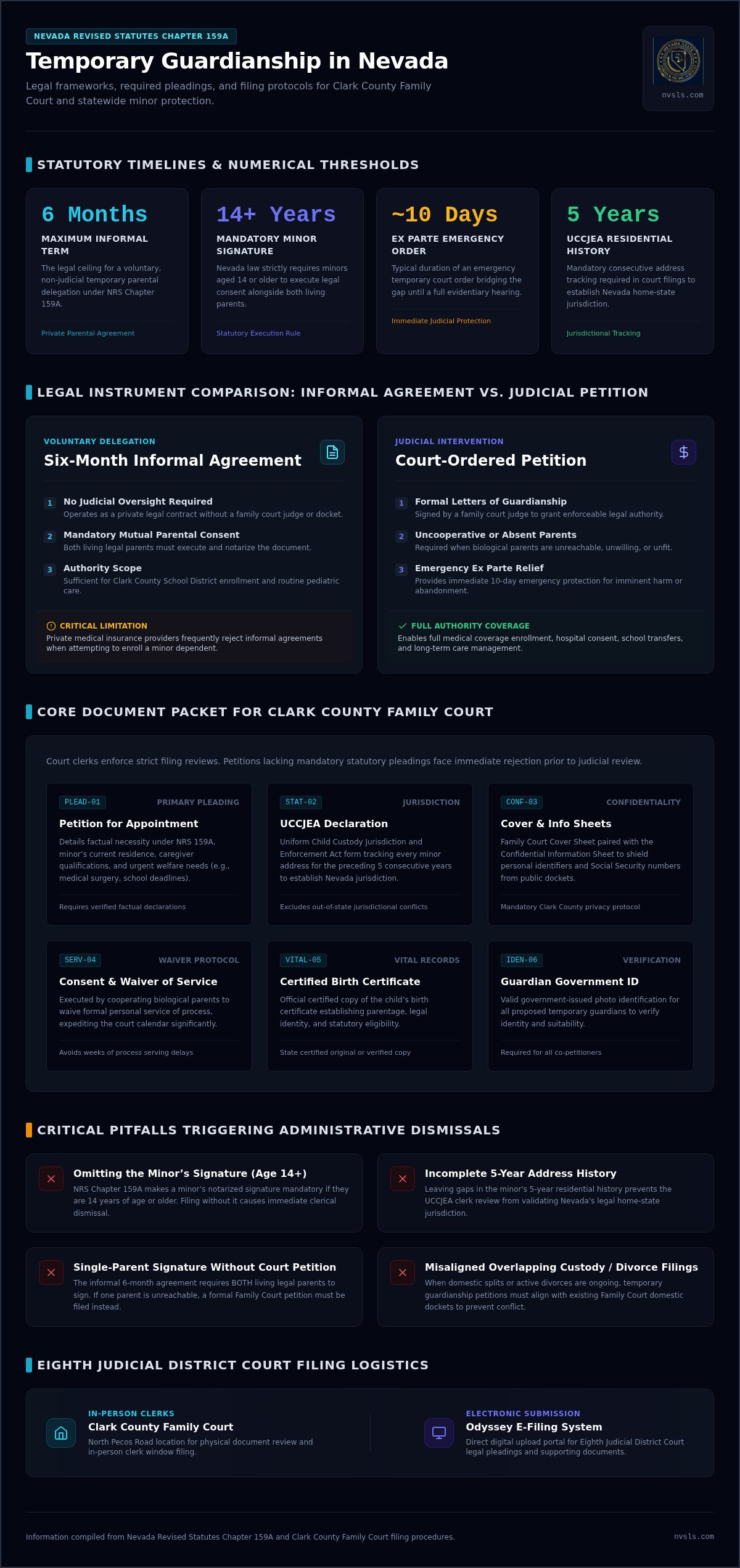
Under NRS 159A, biological parents can voluntarily delegate parental authority for up to six months without judicial oversight. This route uses the Six-Month Temporary Guardianship Agreement. Mutual parental consent is mandatory; both living legal parents must sign the document before a notary. Additionally, if the youth is 14 years of age or older, Nevada law requires the minor to sign as well. This private document suffices for Clark County School District enrollment and standard pediatric care. However, private health insurance carriers frequently reject informal agreements, making a court order necessary if you need to add the child to your health policy.
Court-Ordered Temporary and Emergency Guardianship Petitions
When biological parents are unreachable, unfit, or unwilling to sign voluntary paperwork, you must file a formal petition in family court. A judge must issue temporary letters of guardianship to grant legal authority. In severe scenarios involving imminent physical harm, severe neglect, or sudden abandonment, petitioners can request an emergency ex parte order. These emergency orders typically provide short-term protection, often lasting around 10 days, serving as a legal bridge until a full evidentiary hearing occurs. In cases where domestic disputes overlap with active splits, parties drafting Nevada divorce filing documents must align their filings with ongoing custody actions. Filing the wrong petition creates administrative delays that leave minors unprotected.
Essential Temporary Guardianship Forms Nevada Residents Must Prepare
Filing for legal authority over a child involves far more than printing a single form from a website. Court clerks review filings strictly. Incomplete packets face instant rejection before a family court judge ever reads your petition. To establish temporary guardianship forms Nevada courts will formally accept, you must submit a unified collection of mandatory pleadings and verified supporting documents. This includes certified copies of the minor's birth certificate and valid government-issued identification for all proposed guardians. Omitting a single cover sheet or statutory declaration halts the entire process.
The Petition for Appointment of Temporary Guardian
Your primary pleading is the Petition for Appointment of Temporary Guardian. This document lays out the factual basis required under NRS Chapter 159A, proving why immediate legal intervention is necessary. You must state the minor's exact residential history, current living arrangements, and the specific qualifications of the proposed caregiver. Factual claims must demonstrate urgent welfare needs, such as an upcoming surgical procedure, pending school enrollment deadlines, or an acute parental crisis that prevents routine daily care.
UCCJEA Declaration and Child Information Worksheets
Nevada courts must establish legal authority under the Uniform Child Custody Jurisdiction and Enforcement Act (UCCJEA). Your packet must include a comprehensive UCCJEA Declaration detailing every address where the minor has resided during the past five consecutive years. This five-year historical tracking confirms Nevada holds proper home-state jurisdiction over out-of-state claims. In Clark County, you must also file a Family Court Cover Sheet and a Confidential Information Sheet to shield personal identifiers like Social Security numbers from public dockets.
Consent and Waiver of Service Forms
Whenever biological parents cooperate, filing written parental consent forms accelerates the court calendar dramatically. A fully executed consent waives formal personal service of process, eliminating weeks of waiting for process server affidavits. If the minor is 14 years of age or older, Nevada law requires a separate signed nomination form confirming their agreement with the proposed placement. If you need assistance assembling these complex pleadings, using a reputable document preparation service helps ensure your forms comply with statutory court formatting standards before filing.
How to File for Temporary Guardianship in Nevada
Filing temporary guardianship forms Nevada family courts require involves a rigid three-step administrative sequence. If you miss a deadline or botch service, the court will dismiss your case. In emergency situations where an ex parte petition is filed to stop immediate harm, hearings can occur within days. Meeting local standards established by the Eighth Judicial District Court requires rigorous attention to procedural detail before your papers ever reach a judge's desk.
Step 1: Drafting and Accurate Document Preparation
Every petition begins with exacting data entry. Spell legal names exactly as they appear on state birth certificates and photo IDs. Any discrepancy between a child's school records and your court captions can prompt a clerk notice of rejection. Working with professional document preparers eliminates these common technical pitfalls. Keep in mind that document preparers are not attorneys and cannot provide legal representation, but they ensure your pleadings meet exact local formatting requirements for initiating a court-ordered guardianship.
Step 2: Execution and Mandatory Notarization
Nevada statutes require formal verification under penalty of perjury. That means petitions, affidavits, and parental consent waivers must be signed before a commissioned notary public. In situations involving hospitalized parents or tight schedules, traveling across town to find an open office creates needless stress. Scheduling a mobile notary Las Vegas service brings state-licensed notarization straight to your home or hospital bedside, ensuring every signature complies fully with Nevada notarial standards.
Step 3: Filing and Serving Interested Parties
Once properly executed, submit your packet electronically or in person at the family division. Clark County charges a $0 filing fee if the minor's estate is valued at $2,500 or less, or a modest $5 fee if assets exceed that threshold. Fee waivers are also accessible for qualifying low-income filers. After the clerk stamps your documents, you must legally serve copies on all interested parties:
- Non-consenting biological parents
- Legal custodians or current physical caregivers
- Minors aged 14 or older
- The Guardianship Compliance Division when applicable
Service must be completed by an uninterested adult or licensed process server. Complete and file a Proof of Service certificate immediately. Without verified proof of service on file, the court commissioner cannot issue binding temporary letters of guardianship.
Common Mistakes When Preparing Nevada Guardianship Paperwork
Clerical mistakes derail well-intentioned petitions every week. Judges follow statutory rules strictly, and family court commissioners will not bend requirements simply because a family is stressed. When drafting temporary guardianship forms Nevada filers often overlook jurisdictional hurdles or service rules. Avoiding these basic pitfalls protects the child's daily routine from disruptive court delays.
Jurisdictional Pitfalls and the Six-Month Residency Rule
Under Nevada's UCCJEA standards, a child must live in Nevada for at least six consecutive months before local courts claim home-state jurisdiction. Families relocating to Las Vegas often petition too soon. If the child moved here three months ago, the prior home state still holds authority. Filing before meeting this timeline triggers prompt judicial dismissal. The only exception involves emergent jurisdiction for extreme domestic violence threats or physical abandonment. If that exception applies, your initial petition must outline verifiable emergency facts rather than broad claims.
Defective Notice and Service Failures
Skipping formal service to required family members halts the calendar instantly. Nevada law mandates notifying specific individuals:
- Both legal parents, even if non-custodial or absent
- Living grandparents on both maternal and paternal sides
- Any adult siblings currently residing with the child
You cannot simply decide someone does not need to know. If a parent's location is unknown, you must perform a certified diligent search and submit proof before asking to waive service. Ambiguous statements regarding parental unfitness also backfire. Stating that a parent is "unstable" carries no weight; you must provide dates, police reports, or specific factual incidents.
Temporary orders serve as a stopgap measure, not a permanent plan. To secure a minor's long-term future against unexpected life events, savvy caregivers pair immediate protective custody with comprehensive estate planning documents Las Vegas families use for lasting peace of mind. If you want to avoid administrative dismissals, get your Nevada guardianship forms prepared accurately to ensure every petition complies with Eighth Judicial District standards from day one.
Filing Temporary Guardianship in Clark County: Local Court Logistics
Submitting your initial petition requires understanding local courthouse mechanics. In Clark County, all minor guardianship matters funnel through the Family Courts and Services Center located at 601 N. Pecos Road in Las Vegas. While statewide statutes dictate what paperwork looks like, local court rules govern how clerks receive and docket your materials. Getting the temporary guardianship forms Nevada requires properly filed means navigating either the electronic portal or the courthouse clerk windows efficiently.
Family Courts and Services Center Procedures
Most self-represented filers manage their actions through the Clark County Odyssey e-filing system. If you prefer filing in person, the Pecos facility provides walk-up public service counters and electronic self-help kiosks. Arrive early to clear building security. For emergency motions, check in directly with the guardianship clerk on the first floor. If court costs present a severe hardship, you can submit an Application to Proceed in Forma Pauperis alongside your initial packet. This fee waiver request halts payment requirements until a judicial officer reviews your household income and expenses.
Professional Document Preparation Support
Handling family court filings on your own can feel intimidating, especially when you are balancing an urgent caregiving transition. Partnering with a registered Nevada document preparation service offers a stress-reducing pathway. Document preparers specialize in format accuracy, ensuring captions, UCCJEA disclosures, and verification sheets adhere strictly to Clark County standards. These specialists provide professional document drafting and administrative filings; they are not attorneys and do not provide legal representation or legal advice. That distinction keeps services accessible and straightforward. Relying on an experienced local team across Las Vegas, Henderson, and North Las Vegas ensures your temporary guardianship forms Nevada clerks examine are clean, compliant, and ready for immediate judicial processing.
Establish Legal Authority Without Costly Delays
Protecting a child during an unexpected life transition requires swift, deliberate action. Whether an informal six-month agreement meets your current school and medical needs or an urgent crisis demands an emergency petition, selecting the proper temporary guardianship forms Nevada judges require ensures uninterrupted care. Valid notarization, exact residential disclosures, and proper party notices keep your case moving forward smoothly.
You don't have to tackle Clark County's complex court procedures alone. Specializing in family document preparation and local filing protocols, our team drafts accurate, compliant packets designed to prevent clerk rejections. Plus, with convenient mobile notary services across Las Vegas, Henderson, and North Las Vegas, completing sworn verifications at home or the hospital is fast and easy. Get your Nevada temporary guardianship forms professionally prepared today and give your family the legal certainty they deserve.
Frequently Asked Questions
How long does a temporary guardianship last in Nevada?
An informal parental agreement lasts up to six months under NRS Chapter 159A. When that term ends, parents must execute a new agreement or pursue court action. Court-ordered emergency temporary orders typically last only 10 days, functioning as a bridge until a full evidentiary hearing. Standard court temporary guardianships remain active until the hearing date or until the court terminates the order upon parental recovery.
Can a parent cancel a temporary guardianship agreement in Nevada?
Yes, a parent can revoke an informal six-month agreement at any time by providing written notice. Because this arrangement rests entirely on voluntary consent, delivering a signed, notarized revocation to the caregiver and school immediately ends the arrangement. If the guardianship was granted by a Clark County family judge, however, parents cannot unilaterally cancel it; they must file a formal petition to terminate guardianship with the court.
Do both parents have to agree to temporary guardianship in Nevada?
Both legal parents must sign an informal six-month agreement unless one parent has died, lost parental rights, or holds sole legal custody. If one parent contests or is unavailable, you cannot use informal temporary guardianship forms Nevada provides for mutual consent. You must instead file a petition in family court, where a judge evaluates the child's welfare and determines whether to grant guardianship over parental objection.
What is the difference between temporary custody and temporary guardianship?
Temporary custody is determined strictly between legal parents, usually during an ongoing divorce or separation under NRS Chapter 125. Temporary guardianship applies when a third-party non-parent, such as a grandparent, relative, or family friend, assumes legal authority over the minor under NRS Chapter 159A. Custody divides parental responsibilities, whereas guardianship delegates parental rights to an outside caregiver when parents cannot provide care.
Can a temporary guardian enroll a child in Clark County public schools?
Yes, the Clark County School District accepts valid temporary guardianship documents for student registration. If you use a six-month agreement, submit the notarized document signed by the biological parents along with the child's birth certificate and your local proof of address in Las Vegas, Henderson, or North Las Vegas. If your authority comes from the court, provide the certified Letters of Temporary Guardianship issued by the clerk.
How fast can I get an emergency guardianship order in Las Vegas?
A judge can grant an emergency ex parte order within 24 to 48 hours if you prove immediate physical danger or critical medical necessity. You must submit emergency pleadings at the Family Courts and Services Center on North Pecos. A family court commissioner reviews the petition without requiring prior notice to opposing parties. If granted, this emergency order provides temporary authority for roughly 10 days until a hearing.
Does a temporary guardianship form need to be notarized in Nevada?
Yes, all temporary guardianship paperwork requires notarization under Nevada law. Private six-month agreements have no legal validity without sworn signatures witnessed by a licensed notary public. Similarly, formal court petitions, jurisdictional UCCJEA declarations, and voluntary parental waivers filed in district court require verified signatures under penalty of perjury. Scheduling an on-site mobile notary ensures all signatures meet statutory standards without travel delays.


