

Your child’s financial future shouldn't depend on whether you’re a math whiz or a legal expert. Filling out the child support worksheet Nevada requires for your case is often the most stressful part of the entire filing process. One small mistake in your income calculation can lead to a rejected document or a monthly figure that doesn't reflect your actual situation. It's a technical task that carries heavy emotional and financial weight.
It's completely normal to feel overwhelmed by tiered percentages and the complex math behind joint custody offsets. You shouldn't have to guess if you're doing it right or worry about a clerk sending your paperwork back. This guide simplifies those complexities. It provides the clarity you need to ensure your 2026 court filings are accurate, professional, and compliant with current state standards.
We'll break down the specific definitions of Gross Monthly Income, explain the 40 percent custody threshold, and walk through the exact steps to prepare your documents with total confidence.
Key Takeaways
- Understand why the child support worksheet Nevada courts require is the essential foundation for every divorce and custody filing.
- Learn the precise definition of Gross Monthly Income to ensure your calculations include all necessary 2026 income sources.
- Avoid common filing errors by correctly accounting for mandatory adjustments like health insurance premiums and work-related child care.
- Follow a clear roadmap for gathering financial records and preparing professional, court-ready documents that meet strict state requirements.
- Discover how professional document preparation and mobile notary services can streamline your final filing steps in Las Vegas and Henderson.
What is the Nevada Child Support Worksheet?
The child support worksheet Nevada courts use is a standardized document designed to remove the guesswork from financial obligations. It isn't just a piece of paper; it's a legal calculator that ensures both parents contribute fairly based on their actual earnings. While federal law sets the broad child support guidelines in the United States, Nevada uses a specific tiered model to arrive at a final dollar amount. This document translates your financial life into a court-ordered monthly payment.
You might confuse this with the General Financial Disclosure Form (FDF). They are different. The FDF is where you list every asset, debt, and monthly expense to prove your financial standing. The worksheet is the final calculation based on that data. Think of the FDF as the evidence and the worksheet as the verdict. Nevada Revised Statutes (NRS) Chapter 125B provides the legal authority for these rules, ensuring every child in the state receives support that scales with their parents' income.
Mandatory Filing Requirements in 2026
You must submit a child support worksheet Nevada form in almost every family law case involving children. This includes divorce, legal separation, and any motion to modify an existing custody order. In Clark County, the court is strict about these filings. If your data is missing or clearly inaccurate, the judge may reject your entire submission. This causes expensive delays and unnecessary stress. An accurate worksheet leads to a clear Decree of Divorce, preventing future disputes over who owes what. It's a foundational document that the court uses to protect the child's best interests.
The 2026 Percentage Tiers for Child Support
Nevada uses a regressive tiered model. As your income increases, the percentage you pay on higher earnings decreases. This balances the needs of the child with the financial reality of the parent. The math is calculated using Gross Monthly Income (GMI), which is your pay before taxes and deductions.
Here are the 2026 tiers for GMI:
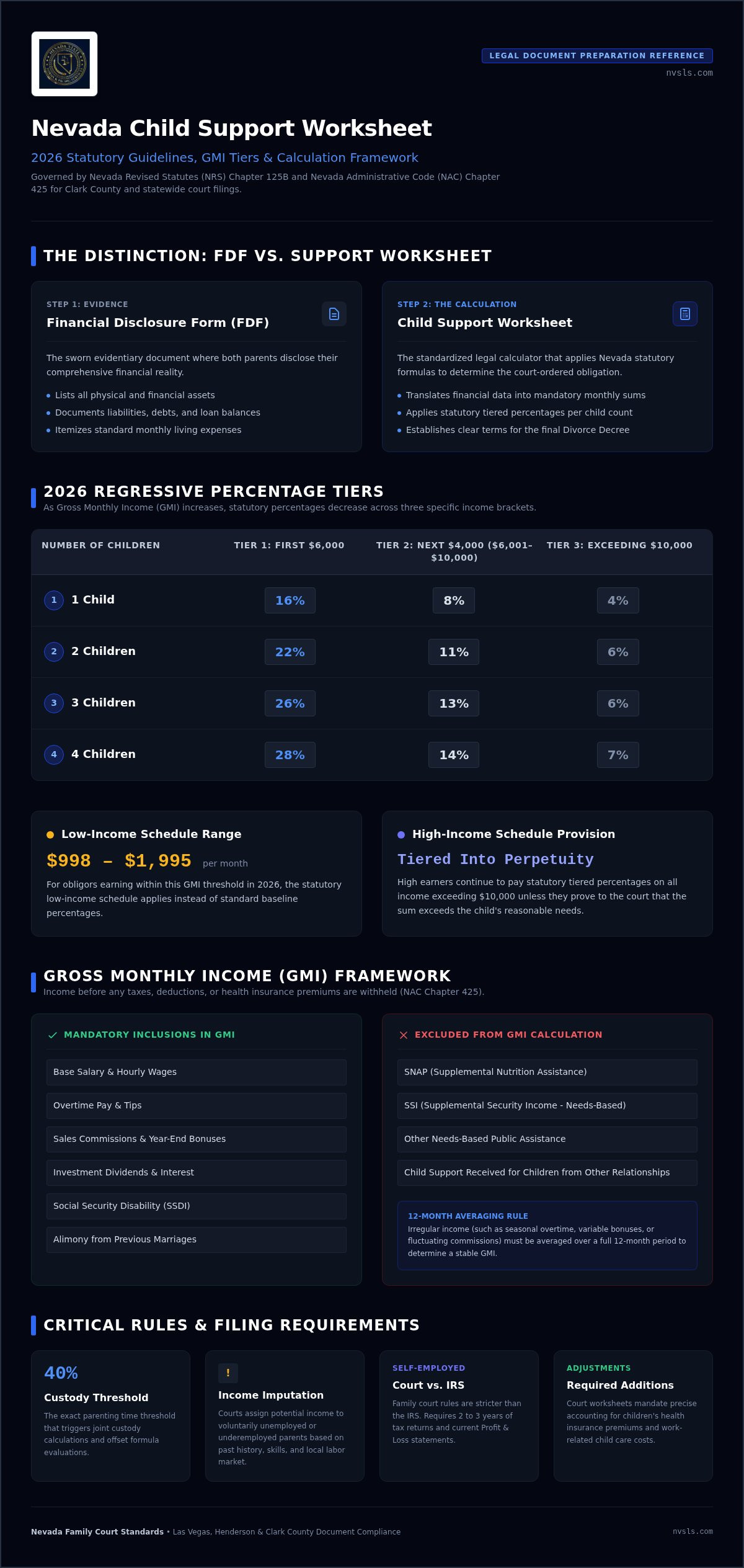
- 1 Child: 16% of the first $6,000; 8% of the next $4,000; 4% of any amount exceeding $10,000.
- 2 Children: 22% of the first $6,000; 11% of the next $4,000; 6% of any amount exceeding $10,000.
- 3 Children: 26% of the first $6,000; 13% of the next $4,000; 6% of any amount exceeding $10,000.
- 4 Children: 28% of the first $6,000; 14% of the next $4,000; 7% of any amount exceeding $10,000.
For 2026, the low-income schedule applies to those earning between $998 and $1,995 per month, while high-income earners pay tiered percentages into perpetuity unless they demonstrate the amount exceeds the child's reasonable needs.
Calculating Gross Monthly Income (GMI) for Nevada
Accuracy starts with your Gross Monthly Income (GMI). In Nevada, GMI is your total income before taxes or health insurance deductions are taken out. Getting this number right on your child support worksheet Nevada filing is critical. If you use your "take-home" pay instead of your gross pay, your calculations will be wrong, and the court will likely reject your documents.
According to Nevada Administrative Code Chapter 425, GMI includes almost every form of money you receive. This covers your base salary, overtime, tips, and commissions. It also includes investment dividends, social security disability, and alimony from a previous marriage. If you receive irregular income, such as a year-end bonus or seasonal overtime, you should generally average these amounts over a 12 month period to find a stable monthly figure. Some income is excluded, however. You don't include needs-based public assistance like SNAP or SSI, nor do you include child support payments you receive for children from other relationships.
Be aware of the "Income Imputation" rule. If a parent is voluntarily unemployed or working significantly below their earning potential without a valid reason, the court can assign them an income. This is often based on their work history, skills, and the local job market. You can’t simply quit a job to avoid a support obligation.
Self-Employed and Business Owner Calculations
Calculating income for business owners is more complex. You can deduct legitimate business expenses, but Nevada guidelines are stricter than the IRS. Just because an expense is tax-deductible doesn't mean the family court will allow it to reduce your child support obligation. You'll need to provide clear documentation, such as the last two or three years of tax returns and recent profit and loss statements. Accurate document preparation is essential here to ensure your business deductions are presented correctly to the court.
The Joint Custody Offset Formula
Nevada uses the Wright v. Osburn formula for shared parenting. This applies if both parents have the children at least 40 percent of the time. In Nevada, this threshold is exactly 146 overnights per year. If you meet this 146-day rule, the math changes significantly. Instead of one parent paying the full amount, the court calculates what each parent would owe the other based on their respective GMI. The parent with the higher obligation then pays the net difference to the parent with the lower obligation. This ensures the child enjoys a similar standard of living in both households.
Common Pitfalls in Child Support Document Prep
Preparing your child support worksheet Nevada filing involves more than just basic math. Small administrative oversights are the leading cause of document rejection in Clark County family court. One of the most common mistakes is using outdated forms. Legal standards shift annually. A template from 2024 or 2025 might lack the updated 2026 low-income thresholds or the specific regressive tier formatting required today. Always verify you are using the official Nevada Child Support Worksheet and custody forms to ensure your submission is valid.
Another frequent pitfall is the math involved in the "Wright v. Osburn" offset. If you share parenting time, you must calculate the base obligation for both parents before subtracting the smaller number from the larger one. Parents often skip a step or miscalculate the net difference. This leads to an incorrect support order that can take months of legal motions to fix. Similarly, the "Child Care" cost adjustment is often misunderstood. Under NAC 425.130, work-related child care costs must be equitably divided. Failing to list these as a separate line item on the worksheet can result in you paying more than your fair share. Accuracy isn't just about following rules; it's about protecting your financial stability.
Health Insurance and Extraordinary Expenses
NAC 425.135 requires judges to account for health insurance premiums. The parent who actually pays the monthly premium for the child's coverage should receive a credit on the worksheet. It's a common error to forget this deduction, which effectively overcharges the paying parent. Don't forget that "out-of-pocket" costs, such as co-pays, dental work, or specific educational fees, are typically split equally between parents. It is vital that these figures align perfectly with your other Nevada divorce filing documents. Inconsistency creates doubt in the judge's mind about your financial transparency and can stall your case for weeks.
The "Financial Disclosure Form" Discrepancy
The court doesn't look at your child support worksheet Nevada in a vacuum. It cross-references every dollar with your General Financial Disclosure Form (FDF). If your worksheet says your GMI is $5,000 but your FDF lists it as $4,850, you have a procedural problem. This discrepancy often happens because parents forget to include bonuses, tips, or overtime on one form but not the other. Administrative consistency is your best defense against court delays. You must ensure every form in your packet tells the exact same financial story. Double-check your pay stubs against both documents before you finalize your filing. This simple step prevents the court from questioning your credibility during a financial hearing.
Step-by-Step: Preparing Your Worksheet for Filing
Completing your child support worksheet Nevada filing is a methodical process. It requires organization and attention to detail. You shouldn't rush this stage. A single misplaced digit can alter your monthly obligation by hundreds of dollars. By following a structured workflow, you ensure your paperwork is court-ready and reflects your actual financial situation in the Las Vegas valley.
The process begins with downloading the official 2026 version of the worksheet. Once you have the form, you'll input the Gross Monthly Income (GMI) for both Parent A and Parent B. After establishing the income, you apply the specific state percentage based on the number of children involved. Finally, you adjust for health insurance premiums and any custody offsets, such as the joint custody math we discussed earlier. This sequence ensures every legal factor is accounted for before you sign the document.
Gathering Your Financial Evidence
Precision depends on your source documents. Before you type a single number, gather the following records for both parents to ensure your data entry is accurate:
- Your three most recent paystubs showing year-to-date earnings.
- The most recent W-2 or 1099 forms filed with the IRS.
- Documentation of monthly health insurance premiums paid specifically for the children.
- Verification of work-related child care expenses.
If you're dealing with a reluctant co-parent, remember that Nevada law requires both parties to file a Financial Disclosure Form. This mandate is your tool for transparency. Always verify that you are using the "Gross" figure on your paystub. Using the "Net" or take-home pay is the fastest way to get your filing rejected by the clerk in Clark County.
Final Review and Verification
Run your numbers at least twice. Clerical errors are common but easily avoidable with a second look. Check if the Eighth Judicial District Court in Las Vegas requires any supplemental local forms to accompany your child support worksheet Nevada submission. While the logic behind Nevada business formation services focuses on entity structure and liability, family law math is strictly about the immediate welfare and standardized support of the child. Once your figures are verified, you are ready for the final step of notarization.
If you want to ensure your forms are drafted with professional precision, you can start your professional document preparation today to avoid common filing delays.
Finalizing Your Documents: Notary and Filing in Las Vegas
Completing the math is a major milestone. Now you must ensure your documents meet the court's strict administrative standards. The child support worksheet Nevada requires is often part of a larger filing packet that includes affidavits and financial disclosures. Many of these forms require a verified signature. This isn't just a formality. It's a security measure that tells the court your financial claims are authentic and sworn under penalty of perjury. Without proper verification, the clerk will likely reject your entire submission.
Once your documents are signed and verified, you'll submit them to the Eighth Judicial District Court. In Clark County, most filers use the Odyssey eFileNV platform. If you prefer a physical visit, the Family Courts and Services Center is located at 601 N. Pecos Rd. in Las Vegas. Filing is the act that moves your case from a stack of paperwork to an active court matter. After the judge reviews your worksheet and confirms the math follows state guidelines, those figures become a binding part of your final court order.
Using a Mobile Notary for Family Court Forms
Finding time to visit a bank or a shipping store during business hours is difficult for most parents. Using a mobile notary Las Vegas professional simplifies this final step. A mobile notary comes directly to your home or office in Las Vegas, Henderson, or North Las Vegas. They verify your identity and witness your signature on-site. This convenience ensures your 2026 filings stay on track without requiring you to take time off work. Professional document preparation combined with a mobile signing service creates a seamless path to the courthouse clerk.
Document Preparation vs. Legal Advice
It is vital to understand the difference between clerical support and legal strategy. A professional document preparation service focuses on the precision of your forms. They ensure your child support worksheet Nevada is drafted correctly and follows all 2026 state requirements. They don't provide legal advice or represent you in front of a judge. This distinction allows you to stay in complete control of your case while delegating the tedious administrative work to a seasoned expert. You get the benefit of professional-grade documents without the high cost of a law firm. delegating the paperwork lets you focus on your family while we handle the technical details.
Get professional document preparation for your Nevada child support worksheet today.
File Your Nevada Documents with Confidence
Mastering the child support worksheet Nevada requires is about more than just numbers. It is about providing financial stability for your family. You now understand how to define Gross Monthly Income and navigate the 146 day custody rule. These details ensure your paperwork moves through the Clark County court system without unnecessary delays or rejections.
You don't have to handle the technical drafting alone. We provide accurate, professional document preparation at affordable rates for self-litigants. Whether you need help with complex tiered calculations or require a mobile notary in Las Vegas or Henderson for your final signatures, our team is ready to assist. We focus on precision so you can focus on your children. It's a straightforward way to manage a complex process.
Start Your Nevada Document Preparation Today and take the stress out of your family law filing. You've done the hard work of gathering the facts. Now, let's make sure your documents are court-ready and professional. You're one step closer to a finalized agreement and a fresh start.
Frequently Asked Questions
How is child support calculated in Nevada if we have 50/50 custody?
The child support worksheet Nevada uses for joint custody follows the Wright v. Osburn formula. This applies when each parent has at least 146 overnights per year. You calculate the base obligation for both parents using their Gross Monthly Income. The higher earner then pays the net difference to the lower earner. This ensures the child enjoys a similar standard of living in both Las Vegas homes.
Does child support in Nevada include health insurance costs?
Yes, Nevada law requires health insurance costs to be factored into the final support amount. The parent paying the monthly premium for the child's coverage typically receives a credit on the worksheet. Out-of-pocket medical expenses are usually split equally between both parents. Judges must explicitly separate base support from these add-ons in the final order to ensure the child's needs are met.
What is the maximum amount of child support a parent has to pay in Nevada?
Nevada no longer uses presumptive statutory dollar caps for child support. Instead, support is calculated using regressive tiered percentages based on income. For one child, it is 16 percent of the first $6,000 of GMI, 8 percent of the next $4,000, and 4 percent of anything above that. High earners pay these percentages unless they prove the amount exceeds the child's reasonable needs.
Can I change my child support amount without a lawyer in Las Vegas?
You can modify child support without a lawyer by filing a motion in the Eighth Judicial District Court. You must submit a new child support worksheet Nevada requires along with a General Financial Disclosure Form. Professional document preparation services can help you draft these forms to ensure they meet strict 2026 court standards in Las Vegas and Henderson. This helps avoid common filing errors that cause delays.
What counts as "Gross Monthly Income" for Nevada child support?
Gross Monthly Income includes almost all pre-tax income you receive. This covers your base salary, overtime, tips, bonuses, and commissions. It also includes alimony received, social security disability, and investment income. You must average any irregular income over a 12 month period to find a stable monthly figure. Needs-based assistance like SNAP or SSI is excluded from these calculations under Nevada Administrative Code 425.025.
Do I need to notarize my child support worksheet before filing?
While the worksheet itself is a calculation tool, the accompanying Financial Disclosure Form and final affidavits usually require a notarized signature. In Clark County, these documents are sworn under penalty of perjury. Using a mobile notary service in North Las Vegas or Henderson makes it easy to finalize your paperwork at your convenience. This ensures your identity is verified before the documents reach the court clerk.
What happens if I can’t afford the calculated child support amount?
Parents with limited income may qualify for the 2026 Low-Income Child Support Schedule. This applies to those earning between $998 and $1,995 per month. The obligation is scaled significantly lower than the standard percentages to ensure the paying parent maintains a basic self-support reserve. Courts will review your Financial Disclosure Form and pay stubs to verify your actual ability to pay before setting the amount.
How often can child support be reviewed in Nevada?
Child support orders can be reviewed every three years without proving a change in circumstances. However, you can seek a modification sooner if there is a substantial change. In Nevada, a 20 percent or greater change in either parent’s gross monthly income qualifies as a substantial change that justifies an immediate review. This ensures the support amount stays accurate as your financial situation evolves in Las Vegas.


