

A summary divorce isn't just a faster way to end a marriage. It's a precision-based administrative process where a single missing document or a small clerical error can restart your timeline from scratch. If you're feeling overwhelmed by the technical differences between a "Summary Proceeding" and a "Joint Petition," you aren't alone. Most people find the paperwork intimidating. They worry about residency proof. They fear meeting strict asset limits. Understanding the specific summary divorce Nevada requirements is the first step toward reclaiming your peace of mind and moving forward without unnecessary delays.
You deserve a clear "yes" or "no" on whether you qualify for this streamlined path. This guide provides exactly that. We've compiled the 2026 eligibility checklist and a complete list of the documents you need to file correctly the first time. We'll walk through the current asset and debt limits, the specific forms required by Nevada courts, and how to ensure your residency proof is bulletproof. By the end of this article, you'll have a simplified roadmap to your final decree.
Key Takeaways
- Understand why a Summary Proceeding is the fastest legal path to dissolution in Nevada and how it bypasses lengthy court hearings.
- Confirm your eligibility by verifying the 6-week residency rule and the specific financial limits governing summary divorce Nevada requirements for 2026.
- Identify the critical documents needed for a successful filing, including the Joint Petition and the mandatory Affidavit of Resident Witness.
- Learn the step-by-step filing sequence from notarizing signatures to managing county-specific court fees.
- Discover how professional document preparation prevents common clerical errors that lead to rejected filings or long delays.
What is a Summary Divorce in Nevada?
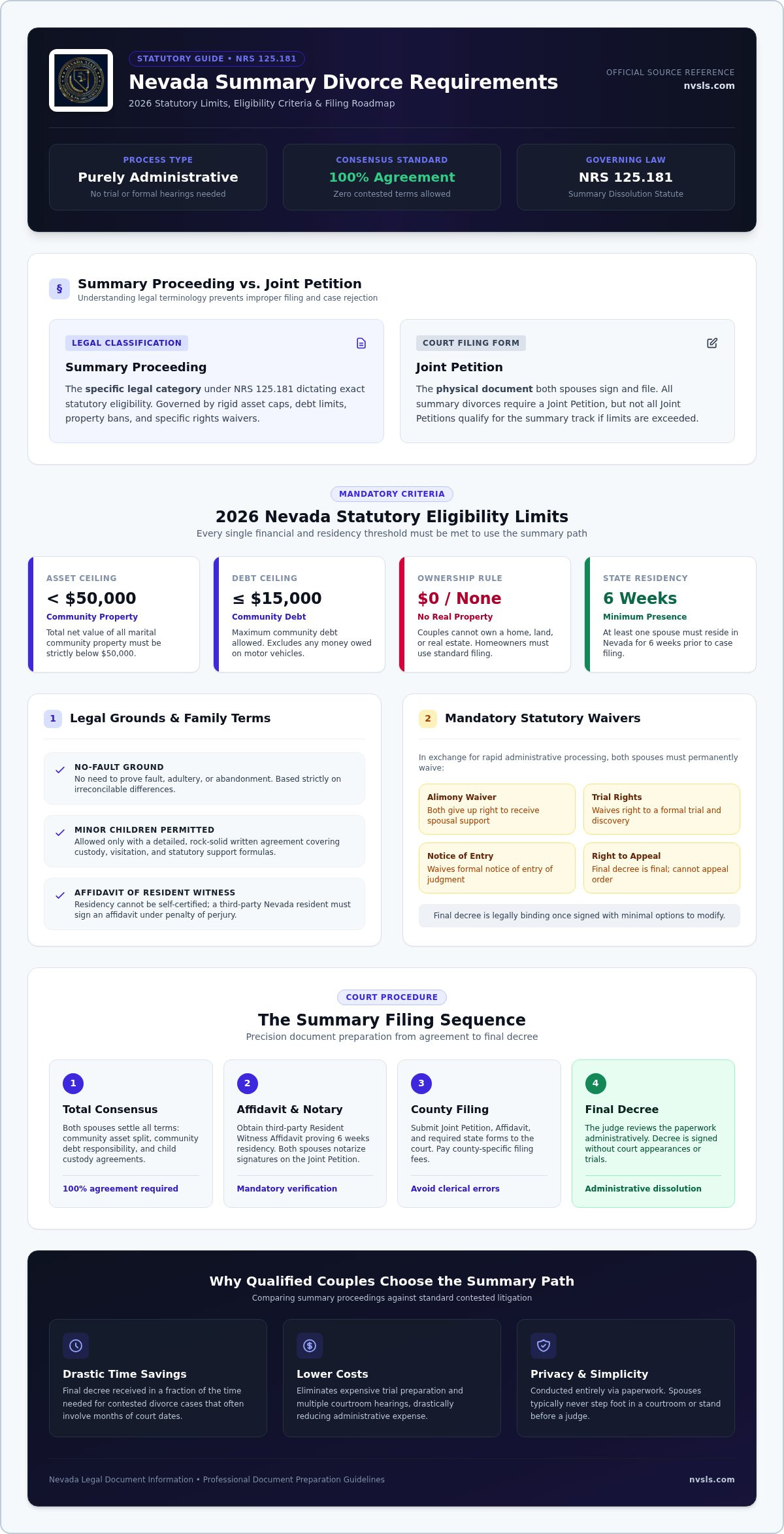
A "Summary Proceeding for Dissolution of Marriage" is a specialized legal track defined by Nevada Revised Statute (NRS) 125.181. It serves as the state’s most efficient method for ending a marriage. Unlike traditional divorce procedures in the United States that often involve litigation and discovery, the summary path is purely administrative. It's designed for couples who have already settled every detail of their separation. No fighting over assets. No arguments over the house. Just a clear, mutual path forward.
This process is significantly faster than a contested divorce. In a contested case, one spouse sues the other, leading to months of court dates. A summary divorce bypasses this entirely. To use this track, you must meet all summary divorce Nevada requirements, including total agreement on asset division, debt responsibility, and child custody. If there is even one point of disagreement, the court will not grant a summary decree. It requires 100% consensus from start to finish.
Summary Proceeding vs. Joint Petition
Many people use these terms interchangeably, but they aren't identical. A "Joint Petition" is the actual document both spouses sign. A "Summary Proceeding" is the specific legal category that dictates which rules apply to your case. While all summary divorces use a Joint Petition, not all Joint Petitions qualify for the summary track. If your marital estate is complex or exceeds certain financial thresholds, you might file a Joint Petition under standard rules rather than the summary statute. Understanding these summary divorce Nevada requirements ensures you don't file under the wrong category and face a rejection.
The Benefits of Choosing the Summary Path
Choosing this route offers several practical advantages for couples ready to move forward. It's about efficiency and clarity.
- Drastic Time Savings: You can often receive a final decree in a fraction of the time required for a standard filing.
- Lower Costs: By avoiding trial prep and multiple hearings, you save on administrative costs and filing fees.
- Privacy and Simplicity: Most cases are resolved through paperwork alone. You typically won't need to step into a courtroom or stand before a judge.
This path reduces the emotional weight of the process. It allows you to focus on your future rather than dwelling on a long, drawn-out legal battle. We act as your guide to ensure your paperwork aligns with these strict standards, helping you avoid the clerical errors that often stall these cases.
Eligibility Criteria: Do You Qualify for a Summary Proceeding?
Meeting the summary divorce Nevada requirements is about fitting into a very specific legal box. It isn't just about agreeing to split. You must meet strict statutory thresholds defined by state law. The most fundamental requirement is residency. At least one spouse must have lived in Nevada for a minimum of six weeks before the case is filed. This isn't just a claim you make; it requires a third-party resident witness to sign an affidavit under penalty of perjury.
Nevada is a no-fault state. This means you don't need to prove "grounds" like adultery or abandonment. You only need to state that the marriage is broken due to irreconcilable differences. However, the financial boundaries are rigid. For 2026, the total net value of your community property must be less than $50,000. Additionally, your community debt cannot exceed $15,000, excluding any money owed on vehicles. If your financial situation exceeds these caps, you'll need to explore a standard Joint Petition instead.
Children and Property Restrictions
The summary track is designed for simplicity. You cannot own "real property," such as a house or land, and use this specific process. If you own a home together, you must use the standard filing track to ensure the deed transfer is handled correctly. Regarding children, you can still use a summary proceeding if you have minor children, but only if you have a rock-solid, written agreement. This agreement must cover every detail of custody, visitation, and child support according to Nevada's statutory formulas. If you're unsure if your assets fit these limits, professional document preparation can help clarify your standing before you pay court fees.
The Waiver Requirements
Speed comes with a trade-off. To qualify for a summary decree, both spouses must voluntarily waive several significant legal rights. You must waive the right to receive alimony from the other person. You also waive the right to a trial, the right to notice of entry of judgment, and the right to appeal the final decree. Once the judge signs the order, it's final. There are very few ways to modify a summary decree after the fact. This is why a written property settlement agreement is mandatory. It acts as the final word on who keeps which bank accounts, furniture, and debts, leaving no room for future disputes.
Essential Documentation Checklist for Your Nevada Summary Divorce
Filing for a summary divorce requires more than just a single form. It's a package of specific documents that must align perfectly with the court's expectations. If one detail on your Joint Petition contradicts a detail on your Decree, the clerk will likely reject your entire filing. Precision is your best friend here. Beyond the primary petition, you'll need confidential information sheets and civil cover sheets. These forms keep your personal data, like Social Security numbers, out of the public record while providing the court with the administrative data it needs to open your case.
The Decree of Divorce is the final hurdle in the paperwork stack. You actually draft this document yourself for the judge to sign. It's a common misconception that the court creates this for you. It must be a mirror image of your Joint Petition. If the petition says you keep the 2022 Ford, but the decree says you keep the 2023 Ford, the judge will stop the process. This document is what officially ends the marriage, restores your former name if requested, and sets the legal rules for your post-divorce life. Getting it right isn't optional; it's the entire point of the process.
The Critical Role of the Resident Witness
The Affidavit of Resident Witness is where many people stumble when trying to meet summary divorce Nevada requirements. Nevada law requires proof that at least one spouse has lived in the state for at least six weeks. You cannot prove this yourself. You need a third party who lives in Nevada to sign an affidavit swearing they've seen you living here for that period. In 2026, the witness must still be a Nevada resident for at least six weeks. This document must be notarized to be legally valid. A simple signature isn't enough; the notary's seal is the court's assurance that the witness is who they claim to be.
Drafting the Property Settlement Agreement
Your property settlement agreement is the heart of your filing. It acts as the contract that governs your financial life after the divorce. To meet summary divorce Nevada requirements, this document must be incredibly specific. You can't just say you're "splitting the bank accounts." You must list account numbers, specific dollar amounts, and clear deadlines for debt payments. Integrating this level of detail into your Nevada divorce filing documents ensures that the Decree of Divorce is enforceable and clear. Without a precise agreement, you risk future legal headaches that a summary proceeding is supposed to prevent.
The Filing Process: Moving Your Case Through the Courts
Once your documents are drafted, the physical filing process begins. It's a methodical sequence that requires absolute attention to detail. Every signature on your Joint Petition and the proposed Decree must be notarized to be accepted by the court clerk. If you're in the Las Vegas valley, coordinating schedules for both spouses and a notary can be difficult. Our mobile notary services bring the expert to your location, ensuring every seal is placed correctly the first time. This step is non-negotiable; without a valid notary stamp, your case won't even make it past the intake desk.
After notarization, the next phase is electronic submission. Most Nevada counties require the use of an e-filing system rather than over-the-counter paper filings. You'll upload your documents as separate PDF files: the Joint Petition, the Affidavit of Resident Witness, and the Decree of Divorce. Once submitted, the court clerk reviews the package for clerical errors. If the paperwork passes this initial check, it's forwarded to a judge for final review. If you've met all summary divorce Nevada requirements perfectly, the judge signs the order without requiring a hearing.
Filing in Clark County: Las Vegas and Henderson
In Clark County, the Eighth Judicial District Court handles these cases through its Family Division. The local rules here are strict regarding document formatting and cover sheets. You must use the specific e-FileNV portal and ensure your confidential information sheets are filed separately to protect your privacy. In 2026, processing times for summary decrees typically range from one to three weeks. This speed depends entirely on the court's current backlog and the accuracy of your filing. A single typo in a social security number or a misspelled name can push you back to the start of the line.
Handling Filing Fees and Waivers
Court costs are a mandatory part of the administrative process. Filing fees for a summary proceeding in Nevada usually fall between $280 and $300, depending on the county and specific technology surcharges. If the cost is a significant financial barrier, you can apply for a fee waiver known as "In Forma Pauperis." This requires submitting a detailed financial affidavit for the court to review. Once your decree is signed and filed, don't just save a digital copy. Always obtain at least two certified copies from the clerk's office. You'll need these for official name changes, social security updates, or future deed transfers.
Professional Document Preparation: Ensuring Accuracy and Efficiency
You've done the hard work of reaching an agreement with your spouse. Now comes the technical work. One typo in a child's birth date or a mismatched bank account number can trigger an immediate court rejection. Professional divorce document preparation in Nevada eliminates this guesswork. We ensure every form aligns with current court standards, so you don't waste time or filing fees on a flawed submission. Precision is the difference between a decree signed in weeks and a case dismissed in days.
It's important to understand our role in your journey. Nevada State Forms & Filing Services is a professional document preparation service. We don't provide legal advice or legal representation in court. Instead, we act as your expert administrative guide. This middle-ground approach is ideal for couples who have already settled their affairs and simply need the paperwork handled with professional precision. It's about reducing the administrative burden so you can focus on your new beginning.
The Convenience of Mobile Notary Services
Even perfect paperwork is useless without a valid notary seal. Finding a time when both spouses and a resident witness can visit a bank or office is often a logistical nightmare. Using a mobile notary in Las Vegas solves this problem entirely. We come to your home, office, or a local coffee shop to verify all signatures simultaneously. This ensures your summary divorce Nevada requirements for notarization are met without the stress of coordinating multiple trips across Clark County.
Next Steps: Starting Your Summary Divorce
Your path to a final decree starts with a final review of your eligibility. Confirm you meet the residency rules and financial caps discussed in the previous sections. Once you've gathered your financial records and identified your resident witness, you're ready to move forward. Contact Nevada State Forms & Filing Services today for professional support in drafting your documents. We help you navigate the summary divorce Nevada requirements with confidence, ensuring your paperwork is ready for a smooth filing process.
Secure Your Fresh Start with Confidence
Navigating the summary divorce Nevada requirements doesn't have to be a source of constant stress. By now, you know if you meet the residency rules and financial caps required for this streamlined process. Success depends on the absolute precision of your Joint Petition and Decree. It's an administrative task. It's a matter of getting the right words in the right boxes. You've already done the hard work of reaching an agreement. Now, let's make sure the state accepts it.
You don't have to tackle this paperwork alone or pay the high cost of traditional legal fees. We provide a practical, efficient alternative that prioritizes your time. Our team delivers expertly drafted forms that match 2026 Nevada standards perfectly. Plus, our convenient mobile notary services in Las Vegas and Henderson ensure your signatures are verified without the hassle of a cross-town trip. We are here to act as your friendly expert guide.
Ready to move forward? Get Started with Professional Nevada Divorce Document Preparation today. We'll handle the administrative heavy lifting so you can focus on building your future. You've made the difficult decisions; now let's ensure the paperwork is the easiest part of your transition.
Frequently Asked Questions
Can I get a summary divorce if my spouse doesn't agree to sign?
No. A summary proceeding requires a "Joint Petition," meaning both spouses must sign the documents under oath. If one spouse refuses, you must file a standard contested divorce instead. This track is strictly for couples in 100% agreement on all terms, including asset division and custody. If your spouse is uncooperative, you cannot meet the summary divorce Nevada requirements. You'll need to pursue a different legal path to end the marriage.
How long do I have to live in Nevada before I can file for a summary divorce?
You must reside in the state for at least six weeks before filing. This residency must be verified by a third-party resident witness who signs a notarized affidavit. This is a core part of the summary divorce Nevada requirements. At least one spouse must meet this duration to establish jurisdiction in Las Vegas or Henderson courts. We help ensure your witness affidavit is formatted correctly to prevent common residency-based rejections during the intake process.
What is the maximum amount of debt allowed for a summary proceeding in 2026?
For 2026, the community debt limit for a summary proceeding is $15,000. This calculation excludes any money owed on vehicles. If your combined marital debt exceeds this amount, you are ineligible for the summary track and must file a standard Joint Petition. Professional document preparation helps you organize these figures to ensure your filing meets these strict financial caps. Accuracy here is vital because the court reviews these totals before granting a final decree.
Do I have to go to court for a summary divorce in Las Vegas?
Typically, no court appearance is required for a summary divorce in Las Vegas. Because both parties have already agreed to all terms in writing, the judge usually reviews the paperwork in chambers. If the documents are accurate and meet all legal standards, the judge signs the decree without a hearing. This administrative approach is the fastest way to finalize your case. It removes the stress of standing before a judge in a formal courtroom setting.
Can I change my name back to a previous name during the summary divorce process?
Yes, you can request a name restoration within the Joint Petition. The final Decree of Divorce will include a provision that legally restores your former or maiden name. This avoids the need for a separate name change filing later. It's a standard part of our document preparation service for clients in Henderson and North Las Vegas. You just need to specify the exact name you wish to use on the initial paperwork we draft for you.
What happens if we realize we have community property after we file?
If you discover omitted assets after filing, you may need to amend your petition or file a separate action to divide the property. A summary decree is final and waives your right to appeal, making it difficult to modify. It's vital to list every bank account, retirement fund, and vehicle in your initial property settlement agreement. We guide you through gathering this information to ensure your filing is comprehensive and protects your financial future.
Is a resident witness required for every summary divorce in Nevada?
Yes, a resident witness is a mandatory requirement for every divorce filed in Nevada. This person must be a Nevada resident who can swear under oath that they have seen you living in the state for at least six weeks. Without a notarized Affidavit of Resident Witness, the Clark County clerk will reject your filing. This is true regardless of how well the other forms are prepared. We offer mobile notary services to make this step easier.
How much does it cost to file for divorce in Clark County without a lawyer?
Filing fees in Clark County generally range between $280 and $300 for a summary proceeding. These are mandatory court costs paid directly to the clerk. While you save significantly by avoiding high-cost legal fees, you still benefit from professional document preparation. This ensures your filing isn't rejected due to clerical errors. If your filing is dismissed because of mistakes, you might have to pay these fees again to restart the process in Las Vegas.


