

A single typo on your Nevada name change filing can turn a simple administrative task into a frustrating court rejection. You might think you need to spend thousands on a lawyer or wait months for a hearing, but for most people in Clark County, the reality is much simpler. It's a precise process. It's also entirely manageable when you have the right information and the right documents in hand.
It's natural to feel stressed while staring at confusing court forms. You might worry about checking the wrong box or feel anxious about the newspaper publication rule. You want this done right the first time without multiple trips to the courthouse or high legal fees. We're here to help you discover the truth behind Nevada name change requirements so you can navigate the filing process without costly delays or legal confusion.
We're debunking five major myths about the 2026 filing process, from the current rules on newspaper ads to the specific documents a judge requires before signing your final order. You'll learn how to handle mandatory verifications and exactly what it takes to get your paperwork approved the first time.
Key Takeaways
- A verbal name change isn't legally binding. You must obtain a court order to update your status with the DMV and Social Security.
- Avoid court rejection by submitting a full document packet for your Nevada name change filing instead of just a single form.
- Newspaper publication is still a legal necessity in Nevada. Social media posts do not satisfy the court's requirements for public notice.
- You can navigate this administrative process without an expensive lawyer. The Nevada court system is designed for individuals to represent themselves.
- Your work isn't done once the judge signs. You’ll need certified physical copies of the order to update your government IDs.
The "Common Law" Myth: Can You Legally Change Your Name Just by Using It?
You might have heard that if you use a name long enough, it legally becomes yours. This concept of Common Law Name Changes is a persistent myth that can lead to significant headaches at the DMV or the airport. In Nevada, simply asking friends to call you something new doesn't change your legal status. You can use a "social name" for your coffee orders or your social media profile, but it carries zero weight with government agencies. To update your official identity, you must follow the specific administrative steps required by the state.
A formal Nevada name change filing is the only way to ensure your passport, professional licenses, and tax records all match. While we provide the professional document preparation to help you get started, it's important to remember that the judge makes the final decision on your petition. Without that court order, your new name isn't legally recognized for official business.
Marriage vs. Petition: Knowing the Difference
There are a few times when you don't need a separate court petition. Marriage certificates act as a legal bridge for last name changes. If you're getting married or divorced, the decree itself usually serves as the authorization for the name change. However, there's a strict limit. If you want to change your first or middle name, a marriage license won't work. Those changes always require a formal Nevada name change filing through the district court. Once you have your order, the Social Security Administration (SSA) must validate your new identity before you can update your driver's license or bank accounts.
The Risks of "Informal" Name Changes
Trying to live under an unofficial name creates unnecessary red flags. You might face issues with tax filings or fail an employment background check because your records don't align. Nevada Revised Statutes (NRS) 41.270 through 41.290 outline the only recognized path for a name change; they don't recognize common law usage for official purposes. A legal name change is a court-decreed modification of a birth record or current identity. Relying on an informal name leaves you vulnerable to identity confusion and administrative delays that can take months to resolve. We focus on getting your paperwork right the first time so you can avoid these complications.
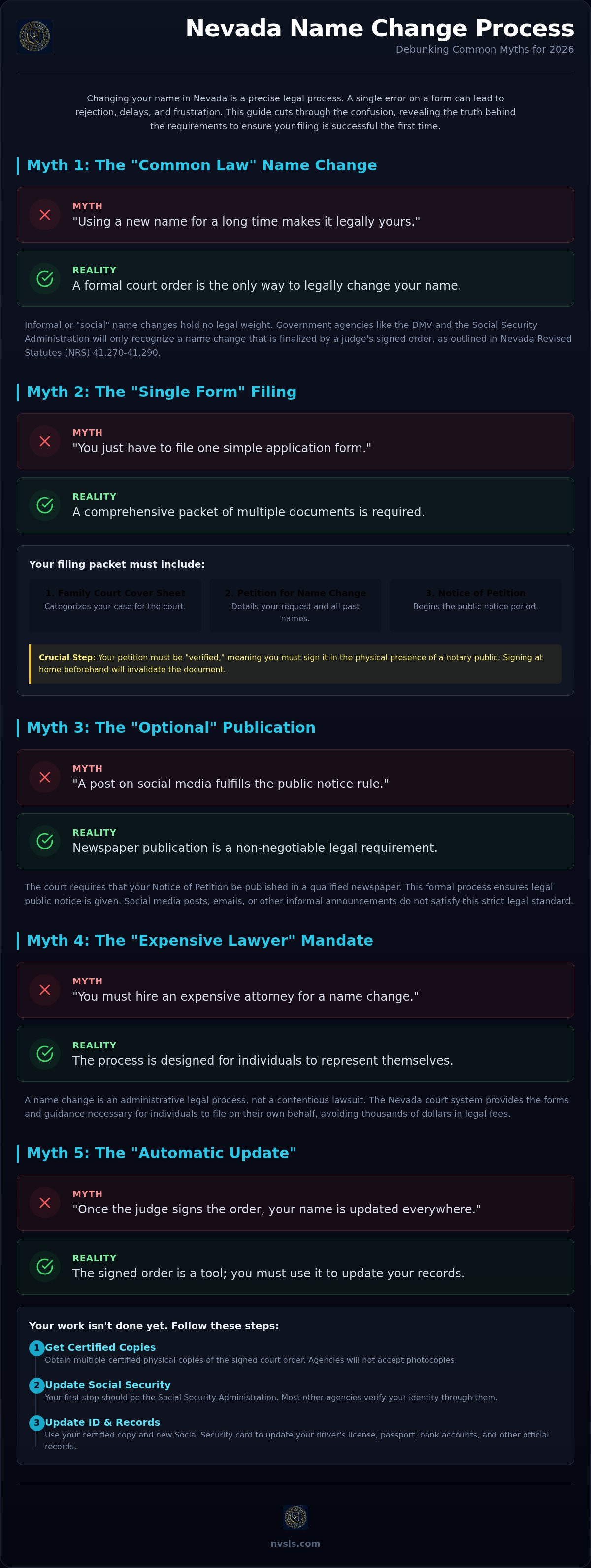
Myth: Nevada Name Change Filing Only Requires a Single Form
Many people walk into the courthouse expecting a simple, one-page application. In reality, a successful Nevada name change filing requires a comprehensive "Form Packet." Submitting just one sheet of paper is a guaranteed way to have your case rejected by the clerk before it ever reaches a judge's desk. You aren't just filling out a request; you're initiating a formal civil case that requires specific administrative categorization.
The Family Court Cover Sheet acts as the gatekeeper of your case. It tells the court exactly what kind of petition you're filing so they can assign it to the correct department. Next is the Petition for Name Change. This is a detailed document where you must disclose every alias or name you've used in the past. Transparency is vital. If the court discovers an undisclosed name later, it could stall your entire process or lead to a summary denial. Finally, you must include the Notice of Petition, which is the document that starts the public clock required by Nevada law. Understanding these Nevada Name Change Legal Requirements is the first step toward a valid filing.
The Verification Requirement
Your signature isn't enough on its own. The court requires a "verified" petition, which means your signature must be notarized to be accepted. A common mistake is signing the documents at home before meeting a notary. If you do this, the notary cannot legally verify the signature; they must actually witness you signing the page. Our mobile notary Las Vegas services simplify this step by meeting you at a convenient location, ensuring your documents are court-ready without you having to hunt down a notary office.
Drafting the Final Order
You might assume the court provides the final paperwork once the judge approves your request. However, you must prepare the "Order for Name Change" yourself before the judge even sees your case. This is the document the judge actually signs to make your name change official. Common drafting errors, like typos in the "New Name" field, can't be easily fixed once the ink is dry. Precise legal document preparation ensures the judge can sign off immediately without sending you back to the beginning. If the paperwork feels overwhelming, using professional name change document services can provide the accuracy you need to avoid costly delays.
The Publication Requirement: Debunking the "Optional" Misconception
You might think that in the digital age, a post on your Facebook wall or a personal blog would satisfy the court's notice requirements. Unfortunately, that isn't the case. Nevada Revised Statute (NRS) 41.280 remains the law of the land. It mandates that you provide public notice through a traditional newspaper of general circulation. While it feels like an outdated hurdle, skipping this step will bring your Nevada name change filing to a grinding halt. The court requires this to ensure you aren't changing your name to avoid debts or legal obligations.
One major update for 2026 is the timing of this requirement. While older versions of the law required publication for three successive weeks, current Nevada name change requirements now only mandate that the notice be published at least one time. This change significantly reduces the time you have to wait, but it doesn't make the requirement optional. There are two primary exceptions to this rule. You don't have to publish if you're changing your name to conform to your gender identity or if you can prove that publication would put your personal safety at risk. In all other cases, the newspaper ad is a non-negotiable part of the process.
Choosing an Approved Newspaper in Clark County
Not every local circular or neighborhood newsletter qualifies as a "legal newspaper" for court purposes. In Clark County, the court maintains a specific list of approved publications. Choosing an unapproved paper means your notice won't be legally valid, and you'll have to pay to publish it all over again. The cost of publication is an out-of-pocket expense paid directly to the newspaper, so it's a critical item to include in your name change budget. Once the notice runs, the publisher will provide you with an "Affidavit of Publication," which is the physical proof the court requires.
Filing Your Proof of Publication
The biggest mistake people make is assuming the newspaper sends the proof to the court for them. They don't. You must personally file the original Affidavit of Publication with the court clerk to move your case forward. If you miss the deadline to file this proof, the court may dismiss your petition, forcing you to start the entire process over from scratch. The court cannot grant the name change until the 10-day waiting period after publication expires. This delay is mandatory to allow anyone with a valid legal objection to come forward before the judge signs the final order.
Misconception: You Need an Expensive Attorney for a Name Change
Many people assume that any interaction with the court system requires a high-priced attorney. They fear that without a lawyer, their Nevada name change filing will be ignored or rejected. The truth is that name change petitions in Nevada are considered "pro se" friendly. This means the court system is designed for individuals to represent themselves in these specific administrative matters. Unless your case is contested by another party, you don't need a four-figure retainer to get a judge's signature.
Hiring a full-service law firm for a standard name change often leads to unnecessary "hidden costs." You're paying for legal strategy and advocacy that an uncontested petition simply doesn't require. Instead, many residents choose a "Middle Path." This involves using professional legal name change documents Las Vegas preparation services to handle the technical heavy lifting without the attorney price tag. Accuracy matters more than advocacy in these cases.
Document Preparation vs. Legal Advice
It's vital to understand the difference between legal advice and document preparation. A preparation service focuses on accuracy, proper formatting, and filing support. We ensure your paperwork meets the exact standards of the Clark County courts so you don't face a "typo rejection" from the clerk. While we don't provide legal representation or advice, our local expertise in Nevada's administrative procedures provides a bridge between confusing government forms and a finished, valid filing. Professional drafting eliminates the guesswork that often leads to multiple, frustrating trips to the courthouse.
Cost Comparison: DIY vs. Prep Service vs. Attorney
When budgeting for your name change, you'll face a few fixed and variable costs. Regardless of which path you choose, the court filing fee remains the same. In Clark County, the filing fee for a Petition for a Change of Name is currently $270. If you choose the DIY route, your biggest cost is time. You'll spend hours researching NRS codes and court rules, with no guarantee that your self-drafted forms will pass the clerk's inspection. Professional document preparation ensures your Nevada name change filing is accurate and ready for the court's review. It provides peace of mind at a fraction of the cost of a law firm.
There are rare instances where you should consider hiring a lawyer. If you have a complex criminal history, such as a felony conviction, or if you expect someone to legally contest your name change, an attorney's advice is beneficial. However, for the vast majority of residents, the process is purely administrative. You can secure your new identity by focusing on accurate paperwork rather than expensive litigation. If you're ready to start your journey with professional support, we can help you prepare your Nevada name change paperwork today.
The "Final Order" Myth: Does Your Name Change Automatically Update Everything?
You might think that once the judge signs the order, your job is finished. It isn't. Many people mistakenly believe their driver's license or social security record updates automatically. In reality, the court order is simply your permission slip to begin the administrative "after-party" of your name change. While we help with the paperwork, the judge makes the final decision; once that order is signed, you are responsible for notifying every local, state, and federal agency of your new identity.
The most critical tool in your arsenal is the "Certified Copy." A digital scan or a standard photocopy won't work for the DMV or the Social Security Administration. These agencies require a physical document with the court's original embossed seal or colored ink stamp. When you finalize your Nevada name change filing, we recommend ordering at least three certified copies immediately. This ensures you can update multiple accounts at once without waiting for documents to be mailed back to you.
If you are dealing with a name change after divorce Nevada and missed the chance to include it in your decree, the process is the same as any other petition. You'll need that new court order to move forward with updating your records.
Your Post-Order Checklist
There is a specific hierarchy to these updates. You must visit the Social Security Administration (SSA) first. They manage the master identity file for the United States. If you try to go to the DMV before the SSA has processed your change, the DMV system will flag a mismatch and reject your application. Updating your card is free of charge, but you must present your original court order.
Next, head to the Nevada DMV. Be prepared for a full update; they require a new photo, a new signature, and a processing fee for the replacement license. While amending your birth certificate is optional, it's recommended to prevent future discrepancies with vital records or passport renewals. Passports require a specific amendment form and the submission of your original order, which the Department of State will eventually mail back to you.
Notifying Private Institutions
Government agencies are only the first half of the battle. You must also establish a paper trail with your bank, credit card companies, and mortgage lenders. Most financial institutions require you to present a certified copy of the order in person or via secure mail. Don't forget to update your voter registration in Nevada. Your legal identity on the voter rolls must match your current ID to avoid issues at the polling place. Keep your original order in a safe place, like a fireproof lockbox, as you'll likely need it for years to come whenever you apply for a loan or a new job.
Secure Your New Identity with Confidence
You now have the facts to move forward without the weight of common misconceptions. A successful Nevada name change filing isn't about expensive litigation; it's about administrative precision. You've seen that the process requires a complete document packet and a mandatory newspaper notice rather than a single form or a social media post. Remember that while we handle the technical drafting, the judge makes the final decision on your petition. Your success depends on submitting accurate, verified paperwork that meets specific Clark County standards.
We provide a reliable bridge between confusing government requirements and a finished filing. Our team specializes in expert Clark County document preparation and offers mobile notary services to ensure your signatures are court-ready. With transparent, flat-fee pricing, you can avoid the high costs of a lawyer while maintaining total confidence in your submission. It's time to stop worrying about court rejections and start the next chapter of your life.
Get Started with Professional Nevada Name Change Document Prep today. Your new legal identity is within reach, and we're here to help you navigate the paperwork with ease.
Frequently Asked Questions
How long does a Nevada name change filing take from start to finish?
The entire process typically takes between four and eight weeks. This timeline depends on the court's current caseload and the speed of the newspaper publication. You must wait at least 10 days after your notice appears in the paper before a judge can sign the order. If your paperwork is accurate, the process moves quickly. If there are typos or missing forms, administrative delays can extend the timeline by several weeks.
Do I have to go to court and speak to a judge for a name change?
Most name change petitions in Nevada are handled through "summary disposition." This means the judge reviews your paperwork in their chambers and signs the order without a formal hearing. You generally won't have to appear in person unless the judge has specific questions about your petition or if someone files a formal objection. Accurate document preparation is the key to avoiding an unnecessary trip to the courtroom.
Can I change my name if I have a felony conviction in Nevada?
Yes, you can still petition for a name change, but the process requires extra steps. You must disclose the felony in your petition and submit a set of fingerprints to the court. The judge will review your criminal record to ensure the name change isn't being used for fraudulent purposes. While a conviction doesn't automatically disqualify you, the final decision rests entirely with the judge assigned to your case.
How much are the court filing fees for a name change in Clark County?
The standard filing fee for a Nevada name change filing in Clark County is currently $270. In Washoe County, the fee is $255. These costs are paid directly to the court clerk at the time you submit your petition. You should also budget separately for the newspaper publication fee, which varies by publisher. If you can't afford the filing fee, you may apply for a fee waiver based on financial hardship.
Is there a way to waive the newspaper publication requirement?
You can waive the publication requirement in two specific scenarios. First, if you're changing your name to conform to your gender identity, the law automatically removes the publication hurdle. Second, if you can prove that publishing your name would put your personal safety at risk, such as in cases of domestic violence, you can ask the court for a waiver. In all other situations, the newspaper notice remains mandatory.
What happens if someone objects to my name change petition?
If a person files a formal objection, the court will schedule a hearing. You'll receive a notice to appear before the judge to explain why the name change should be granted. The objector must provide a valid legal reason, such as evidence of fraud or an attempt to avoid debt. These cases are rare but typically require more time and potentially legal advice to resolve the dispute effectively.
Can I change my child’s name without the other parent’s consent?
You can file the petition, but you must legally notify the other parent. If they refuse to consent, the judge will hold a hearing to determine if the change is in the child's best interest. You'll need to provide proof that the other parent was served with the notice. If the parent can't be found after a diligent search, you may be allowed to proceed through a specific publication process.
Do I need to be a resident of Nevada to file for a name change here?
Yes, you must be a resident of the county where you're filing the petition. Nevada courts generally require you to have lived in the state for at least six weeks before you can initiate a Nevada name change filing. You'll need to provide a verified statement or an affidavit from a credible witness to prove your residency. This ensures the court has the proper jurisdiction to handle your legal request.


