

What if a lease that looks complete still misses a Nevada disclosure or a detail about your rental? A residential lease agreement Las Vegas landlords and tenants can rely on needs more than standard template language. It should pair current requirements with clear terms for the specific property and tenancy.
It’s reasonable to want a straightforward document and a clear sense of what you’re agreeing to. But online templates may not reflect current Nevada rules or cover important details such as rent, fees, deposits, repairs, entry, and who is responsible for what. A careful review can help you spot questions before signing or preparing a lease.
This guide explains the core sections to check, highlights Nevada and local details to verify for 2026, and shows how to think about property-specific terms. It also clarifies the difference between administrative document preparation and legal advice or representation, so you can choose an appropriate next step with more confidence.
Key Takeaways
- See which core lease terms to review, from the named parties and rental property to rent, maintenance, and signatures.
- Learn why a residential lease agreement Las Vegas renters or landlords use should be checked against current Nevada requirements and the details of the tenancy.
- Use a practical review sequence to catch blank fields, conflicting terms, or unclear attachments before signing.
- Compare the convenience of an online template with the need to confirm its source, revision date, jurisdiction, and fit for the property.
- Understand the difference between document preparation and legal guidance, and consider an attorney for legal advice or representation.
Residential Lease Agreements in Las Vegas: What the Document Does
A residential lease is an agreement between a landlord and tenant that sets out the terms for renting a home. It identifies the parties and property, explains the rental period and payment arrangement, and records responsibilities the parties have agreed to. For a high-level overview of common lease elements and the people involved, see this residential rental agreement reference.
A clear written record gives both sides something specific to check if they remember an arrangement differently. It can reduce avoidable misunderstandings, but it can’t guarantee a dispute-free tenancy or replace applicable Nevada law. A clause in a lease doesn’t automatically override legal requirements.
The rental period also matters. A fixed-term lease sets a defined start and end date. A periodic arrangement continues in recurring rental periods, such as month to month, unless it ends under the agreement and applicable rules. The terms used and the rules for ending or changing an arrangement can depend on the situation. Check current Nevada Revised Statutes Chapter 118A and get legal guidance if you’re unsure how the rules apply.
What a Las Vegas residential lease should help clarify
Start with the basics: who is renting and who is leasing the property, the property’s exact address, the rental term, the rent amount, and how and when payments are made. The document should also make each party’s agreed responsibilities understandable, including any arrangements for utilities or upkeep that apply to the tenancy.
For example, “tenant handles yard care” leaves questions if the property has multiple outdoor areas. Clearer wording identifies the responsibility and the area covered. Specific terms help both parties understand what they agreed to. They still must be consistent with Nevada law.
Who should review the agreement before signing?
Both landlord and tenant should read every page, not just the rent and signature lines. Confirm that names, property details, dates, and referenced attachments are accurate. If a clause is unclear, incomplete, or appears to conflict with another section, ask for an explanation and a corrected copy before signing. Don’t rely on an informal promise to resolve a written term later.
This guide offers general information, not legal advice. A residential lease agreement Las Vegas renter or landlord is considering may raise questions about rights, legal meaning, or how Nevada rules apply to specific facts. Direct those questions to a licensed Nevada attorney. An attorney can review the agreement and provide legal advice or representation; document preparation is a separate administrative function.
Nevada Lease Terms and Disclosures Las Vegas Readers Should Check
A residential lease agreement Las Vegas tenants and landlords review should be checked against the property, the agreed arrangement, and current Nevada requirements. Start by confirming the full names of the parties, the rental property’s address, and the start and end dates or recurring rental period. Then review the rent, deposit, utilities, maintenance responsibilities, and signature fields. Nevada Revised Statutes Chapter 118A is a key place to verify state landlord-tenant rules, but don’t treat a general checklist as a complete legal review.
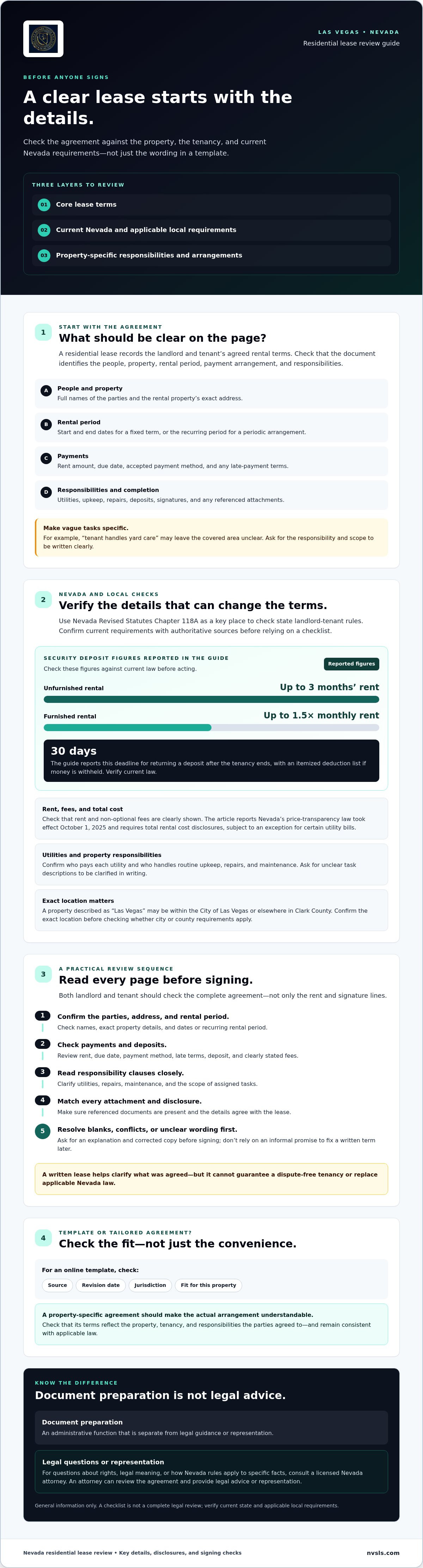
Jurisdiction matters, too. A property described as “Las Vegas” may be within the City of Las Vegas or elsewhere in Clark County. Confirm the property’s exact location before checking whether city or county requirements apply. Keep statewide rules distinct from any local rules, and verify both against current authoritative sources before relying on them.
Rent, deposits, utilities, and property responsibilities
Check that the agreement clearly states the rent amount, due date, accepted payment method, and any late-payment terms. Nevada’s current requirements should be checked for deposit limits and handling. As of September 2026, the supplied research reports a maximum security deposit of three months’ rent for an unfurnished rental and 1.5 times monthly rent for a furnished rental. It also reports a 30-day deadline to return a deposit after the tenancy ends, with an itemized deduction list if money is withheld. Verify these details against current law before acting on them.
Look for clear language about which utilities each party pays and who handles routine upkeep, repairs, and maintenance. If the lease assigns a task without specifying what it covers, ask for the scope to be clarified in writing. Also check whether rent and non-optional fees are shown clearly. The research brief reports that Nevada’s price-transparency law took effect October 1, 2025, and requires total rental cost disclosures, subject to an exception for certain utility bills.
Disclosures and local rules to verify before signing
Compare the lease’s disclosures with current state requirements. The supplied research identifies disclosures concerning public nuisances, how to report nuisances or code violations, the tenant’s right to display the U.S. flag, and whether the property is under foreclosure. Treat these as review prompts, not an exhaustive checklist. Requirements can change, and the details may depend on the tenancy.
- Confirm the current wording and applicability of each disclosure against Nevada law.
- Check whether the property’s exact address places it under additional local rules.
- Review all attachments and make sure referenced documents are included.
For Clark County housing and eviction information, the Civil Law Self-Help Center provides a local resource. For administrative document-preparation or contract-drafting information, you can also review available document services; confirm directly whether residential lease preparation is currently within scope. This is not legal advice. Ask a licensed Nevada attorney to interpret requirements or advise you about your rights.
Generic Lease Template or Property-Specific Agreement: How to Compare
A downloadable form can be a useful starting point, but a professional appearance doesn’t prove it’s current, legally compliant, or suited to your rental. A residential lease agreement Las Vegas landlords or tenants use should match the actual property and arrangement, not just fill in names and rent on a generic form. Compare the document’s source, revision date, jurisdiction, and included pages or addenda. Check legal requirements against Nevada's Residential Landlord and Tenant Act, and seek attorney guidance when you need an interpretation.
Questions to ask before using a downloaded lease
Before filling out a form, confirm that it specifically addresses Nevada and the type of residential rental involved. Then inspect the full document. Are any fields blank? Do different sections give conflicting instructions? Are addenda mentioned but missing or unexplained? An older form may not reflect current requirements, so verify its date and check current sources rather than assuming a familiar-looking template is up to date.
When tailored drafting or legal review may be appropriate
A standard form may not clearly fit an unusual property arrangement, several occupants, or terms the parties disagree about. Tailoring can help record the parties’ actual agreement, but administrative drafting support isn’t legal interpretation or representation. If you have questions about rights, liability, or whether a term is enforceable, consult a licensed Nevada attorney. Attorney review can address your specific facts; a template alone can’t do that.
| Option | What it can offer | What to check |
|---|---|---|
| Generic form | A convenient starting structure for common lease terms. | Source, revision date, Nevada applicability, missing fields, and attachments. |
| Property-specific document | Terms organized around the particular property and agreed arrangement. | Whether all important details are included and the document reflects the parties’ actual agreement. Drafting support, if available, is not legal advice. |
| Attorney-reviewed document | Legal review of the document in light of the parties’ questions and circumstances. | Ask the attorney what the review covers and raise questions about rights, liability, and legal effect directly with them. |
Use the table as a comparison tool, not as a ranking. The right next step depends on what you need: a basic form to review, a document that records agreed property-specific terms, or legal advice about a concern. Don’t sign while a key clause remains unclear or an attachment is missing.
How to Review and Complete a Las Vegas Residential Lease
A careful review gives both sides a chance to catch errors before signing. Use this sequence for a residential lease agreement Las Vegas renters or landlords are preparing. It’s a practical check, not a guarantee of legal compliance, enforceability, or a particular outcome.
A practical pre-signing checklist for renters and landlords
- Confirm the parties and property. Check each landlord’s and tenant’s name, the rental address, and any unit number. Make sure the occupancy details match what everyone agreed to.
- Review the rental period and payment terms. Compare the start and end dates, rent amount, due date, payment method, and other written charges against the agreed arrangement. Ask about any term that’s missing or unclear.
- Read every clause and attachment. Check responsibilities, rules, and addenda. If the lease refers to a separate document, confirm you have it and understand how it relates to the agreement.
- Resolve blanks and conflicts. Don’t sign with important fields left blank or with clauses that appear inconsistent. If the written language doesn’t match what the parties agreed, ask for a correction in the document before signing.
- Put agreed changes in writing. Don’t rely on a verbal promise to change a lease term. Ask for the agreement to be updated so the final document records the change, and confirm the parties acknowledge the revised version.
- Complete signatures and keep copies. Confirm all required parties have signed the same final version. Each party should receive a complete, readable copy, including attachments.
Signing, copies, and recordkeeping
Before you sign, pause on anything you don’t understand. A clause about maintenance, for example, may leave uncertainty if it assigns responsibility without describing the task. Ask for clarification and a written revision rather than assuming both sides interpret the wording the same way.
Store the signed lease and related records securely. Keep the attachments and any written changes with it so you can refer to the same set of terms later. Also verify separately whether notarization is required for your specific document. Don’t assume that a standard residential lease needs to be notarized.
If you’re seeking administrative document-preparation help, first confirm whether residential lease preparation is currently within scope. Ask about residential lease document preparation. This type of support is not legal advice or representation. For questions about your rights, legal obligations, or how a clause applies to your situation, consult a licensed Nevada attorney.
Getting Residential Lease Document Help in Las Vegas
Choose help based on the question you need answered. You can review a straightforward agreement yourself, ask about administrative document preparation if the service is available, or consult an attorney for legal analysis. These options serve different purposes. A document preparer can help with drafting or organizing information within the confirmed scope of their work, but that isn’t a substitute for legal advice.
Choosing the right kind of help for your situation
If the terms are clear and match what both parties agreed to, careful self-review may be a reasonable next step. For help preparing paperwork, first confirm that the provider currently handles residential lease documents. Nevada State Forms & Filing Services does not provide legal advice or legal representation, and residential lease drafting availability must be confirmed before requesting it.
Questions about tenant or landlord rights, responsibility for a disputed issue, or whether a lease term is enforceable call for a licensed Nevada attorney. If you’re already dealing with a tenant-landlord dispute, verify which legal aid organization or government resource serves your situation. The Clark County Civil Law Self-Help Center may be a starting point for housing-related information, but it doesn’t replace individualized legal advice.
What to gather before requesting document preparation
If a provider confirms they can help with your residential lease agreement Las Vegas paperwork, having the basic details ready can make it easier to discuss the requested administrative support. Gather:
- The property’s address and any unit details.
- The landlord’s and tenant’s names, plus agreed occupancy details.
- Proposed rental dates, rent terms, and payment arrangements.
- Agreed responsibilities, such as utilities or upkeep arrangements.
- Any existing draft and referenced addenda or attachments.
Bring existing paperwork as context, not proof that the agreement is current or legally sufficient. If the parties disagree about a term, pause before asking a document preparer to record it as settled. Get legal guidance on the disagreement first.
Nevada State Forms & Filing Services provides document preparation and contract drafting in Las Vegas, Henderson, and North Las Vegas, but the current availability of residential lease drafting should be confirmed directly. To ask whether administrative document preparation is available for your situation, Ask Nevada State Forms & Filing Services about document preparation. For legal interpretation or representation, contact a licensed Nevada attorney.
Take the Next Step With Confidence
A strong residential lease agreement Las Vegas renters and landlords can work from starts with clear, property-specific terms and a careful check against current Nevada requirements. Reviewing the complete document, including attachments and agreed changes, helps you spot questions before signing. For advice about legal rights or how a clause applies to your situation, speak with a licensed Nevada attorney.
If you’re looking for administrative document preparation, Nevada State Forms & Filing Services provides document preparation and contract drafting in Las Vegas, Henderson, and North Las Vegas. Confirm directly whether residential lease preparation is currently available. The business does not provide legal advice or representation.
Ask about document preparation services and clarify what support may be available for your needs. With the right questions and next step, you can move forward with greater confidence.
Frequently Asked Questions
What should a residential lease agreement in Las Vegas include?
It should clearly identify the landlord, tenant, rental property, rental period, rent, payment process, and each party’s agreed responsibilities. Check that utility arrangements, maintenance terms, attachments, and signature spaces are addressed where relevant. A residential lease agreement Las Vegas tenants or landlords use should also be checked against current Nevada requirements. A clear document helps record the arrangement, but it can’t replace applicable law or guarantee there won’t be disagreements.
Is a written lease required to rent a home in Nevada?
Nevada requires a written lease for a tenancy longer than one year, according to the current research provided for this article. For a shorter or periodic rental arrangement, confirm what documentation applies to your circumstances rather than assuming there’s no value in a written record. A written agreement can spell out terms and responsibilities. Check current Nevada Revised Statutes Chapter 118A or ask a licensed Nevada attorney if you’re unsure.
Can I use a free lease agreement template in Las Vegas?
You can use a free template as a starting point, but free access doesn’t confirm the form is current, Nevada-specific, or complete. Check who published it, its revision date, and whether it covers your type of rental. Look for blank fields, conflicting clauses, and missing addenda. Compare the form with current Nevada requirements, and get legal advice from a Nevada attorney if you need help interpreting a term.
What disclosures must a Nevada residential landlord provide?
Disclosures depend on current law and the rental circumstances, so verify them against an authoritative Nevada source before signing. The research for this article identifies disclosures related to public nuisances and reporting them, a tenant’s right to display the U.S. flag, and whether the property is under foreclosure. Treat these as examples, not a complete checklist. Confirm which disclosures apply to the property and tenancy, and consult a Nevada attorney with legal questions.
Does a residential lease in Las Vegas need to be notarized?
Don’t assume a standard residential lease must be notarized. Check the requirements for your specific document and circumstances before arranging notarization. If a landlord or tenant asks for a notarized signature, clarify the reason and verify whether it’s necessary. Notarization doesn’t answer questions about whether a lease term complies with Nevada law or fits your agreement. Ask a licensed Nevada attorney about legal requirements that aren’t clear.
Can a document preparation service give me legal advice about my lease?
No. Document preparation is administrative support, not legal advice or representation. Nevada State Forms & Filing Services does not provide legal advice or legal representation. Confirm directly whether residential lease preparation is currently available before requesting it. If you need someone to interpret a clause, explain your rights, assess liability, or represent you, speak with a licensed Nevada attorney. Keep those roles separate so you know what kind of help you’re receiving.
What should I do if my landlord or tenant will not follow the lease?
Keep copies of the signed lease, relevant messages, notices, and records related to the issue. Review the agreement and communicate in writing, keeping your message factual and specific. Avoid taking action based only on a template or general online information, since the right response can depend on the facts and applicable law. For a dispute, contact a licensed Nevada attorney or verify whether a local legal aid or court self-help resource can guide you.


