

Most entrepreneurs think filing Articles of Organization is the finish line, but in Nevada, it's actually just the warm-up. You've likely heard that the Silver State offers incredible business benefits, yet the path to official status is paved with specific administrative hurdles. If you're wondering how to form an llc in nevada without making a costly mistake, you aren't alone. It's natural to feel anxiety about legal forms or the confusion between state and local requirements. You want the asset protection an LLC provides, but you don't want to get lost in a sea of paperwork.
We know that the filing process can feel like a minefield. You're probably worried about missing a hidden fee or failing to meet a strict annual deadline. This 2026 guide provides a clear, professional roadmap to navigate these requirements and establish your business entity with total confidence. We'll cover everything from your initial name search to ongoing maintenance, ensuring your company remains legally compliant and ready for growth.
Key Takeaways
- Discover why Nevada remains a top choice for business owners, including the significant advantages of having no state corporate or personal income taxes.
- Learn exactly how to form an llc in nevada by navigating naming restrictions and filing your Articles of Organization correctly the first time.
- Understand why an Operating Agreement is your most vital internal document for protecting personal assets and defining business governance.
- Avoid the common "local license trap" by identifying the specific requirements for operating in Las Vegas, Henderson, or unincorporated Clark County.
- Gain a clear timeline for your initial and annual filings to ensure your entity stays in good standing with the Secretary of State.
Why Form an LLC in Nevada? The 2026 Benefits
A Nevada Limited Liability Company (LLC) is more than just a piece of paper from the Secretary of State. It is a legal shield designed to protect your personal life from your professional risks. Its core purpose is to create a separate legal entity that can own property, sign contracts, and take on debt. When you learn how to form an llc in nevada, you are essentially building a fortress around your personal savings and family assets.
Nevada has earned a reputation as a pro-business state for several specific reasons. Beyond the legal protections, the state offers a level of privacy that is hard to find elsewhere. Nevada provides strong protections for the identities of its members and managers. This keeps your private details away from public prying eyes and off the radar of solicitors. It is a practical, no-nonsense environment for growing a company.
Asset Protection and Liability
The primary reason most entrepreneurs choose an LLC is the corporate veil. Think of this as a legal barrier between your business lawsuits and your personal bank account. If your company faces a legal judgment, creditors generally cannot seize your house or personal savings. Separating these worlds is vital for risk management. For a 2026 business owner, limited liability means your personal financial exposure is strictly capped at the amount you have invested in the company.
Nevada's Tax Climate for Small Businesses
Tax benefits in the Silver State are among the best in the country. Nevada does not collect a state corporate income tax or a personal income tax. This means profits flowing to members aren't trimmed by the state. While California or Arizona tax every dollar earned, Nevada lets you keep your revenue. The Commerce Tax exists, but typically only applies to businesses with Nevada gross revenue exceeding $4 million. Understanding these perks makes the process of how to form an llc in nevada a strategic move for your long-term financial health.
Step 1: Naming and Preparing Your Nevada LLC Filing
The first hurdle in learning how to form an llc in nevada is securing your business identity. You will handle most of this through SilverFlume, the state's digital business portal. It is a powerful tool, but it moves fast. You need to be prepared before you click start. Nevada law requires that your business name be distinguishable from every other entity currently on file with the Secretary of State. If your chosen name is too similar to an existing one, your filing will be rejected immediately.
Naming Rules and Restricted Words
Your business name must include a specific designator to show its legal structure. You can use phrases like "Limited-Liability Company" or "Limited Company," or abbreviations like "LLC," "L.L.C.," "LC," or "L.C." Most owners opt for "LLC" because it is clean and widely recognized. You can perform a preliminary search on the Secretary of State website to see if your desired name is available. If you aren't ready to file your Articles of Organization just yet, you can pay a fee to reserve the name for 90 days.
Nevada is particularly strict about its Restricted Word List. Under Nevada Revised Statutes (NRS), certain words require approval from state boards before they can appear in a business name. For example, you cannot use "University," "College," "Accountant," "Bank," or "Engineer" without written permission from the corresponding regulatory body. If you are unsure about name availability or the restricted list, our team can help you with professional document preparation to ensure your filing meets every state requirement.
Selecting a Registered Agent in Nevada
Every Nevada LLC must appoint a Registered Agent. This is not just a formality; it is a legal requirement for maintaining a physical presence in the state. Your agent must have a physical street address in Nevada where they can accept service of process and official government notices during normal business hours. A P.O. Box or a virtual office address will not suffice for this role.
You have two main choices: a commercial registered agent or an individual agent. While you can technically serve as your own agent if you have a physical Nevada address, many owners choose a commercial service for privacy. When you act as your own agent, your home address becomes part of the public record. Using a professional service keeps your private residence off the Secretary of State's public database. This choice is a key part of how to form an llc in nevada while maintaining the privacy the state is famous for.
Step 2: Filing Articles of Organization and Initial Documents
Drafting your Articles of Organization is the moment your business officially exists. Think of this document as the birth certificate for your company. While the SilverFlume portal makes the process look like a simple digital form, the details you enter here create a permanent legal record. If you're learning how to form an llc in nevada, you'll need to decide on your management structure right away to avoid future filing amendments.
The Articles of Organization Breakdown
You must choose between a member-managed or manager-managed structure. Member-managed is the standard choice for small businesses where the owners run the daily operations themselves. Manager-managed is often better if you have passive investors or want a specific individual to handle the heavy lifting while the owners remain behind the scenes. You'll also need to provide your business address, registered agent details, and the signatures of your organizers. A simple typo in the agent's name or a mismatched address can lead to an immediate rejection. Most rejected filings happen because of these small, avoidable clerical errors.
The Initial List and State Business License
Nevada is unique because it requires your "Initial List" of managers or members immediately upon formation. Most states wait a year for this information, but Nevada wants to know who is in charge from day one. Along with this list, you must secure your Nevada State Business License. Both requirements are integrated into the SilverFlume filing process to streamline your setup. As of 2026, the standard fees are $75 for Articles, $150 for the Initial List, and $200 for the State Business License. This means you should prepare for a total state filing cost of $425 to get your entity off the ground.
Standard processing times can fluctuate depending on the Secretary of State's current workload. If you're in a hurry to open your doors, you can pay for expedited service. Options include 24-hour, 2-hour, or even 1-hour turnarounds for an additional fee. Getting these forms right the first time prevents delays and keeps your momentum going. For a deeper look at these costs, see our Nevada Business Formation: 2026 Guide for a full fee breakdown. Mastering how to form an llc in nevada requires precision at this stage to ensure your business starts on a solid legal foundation.
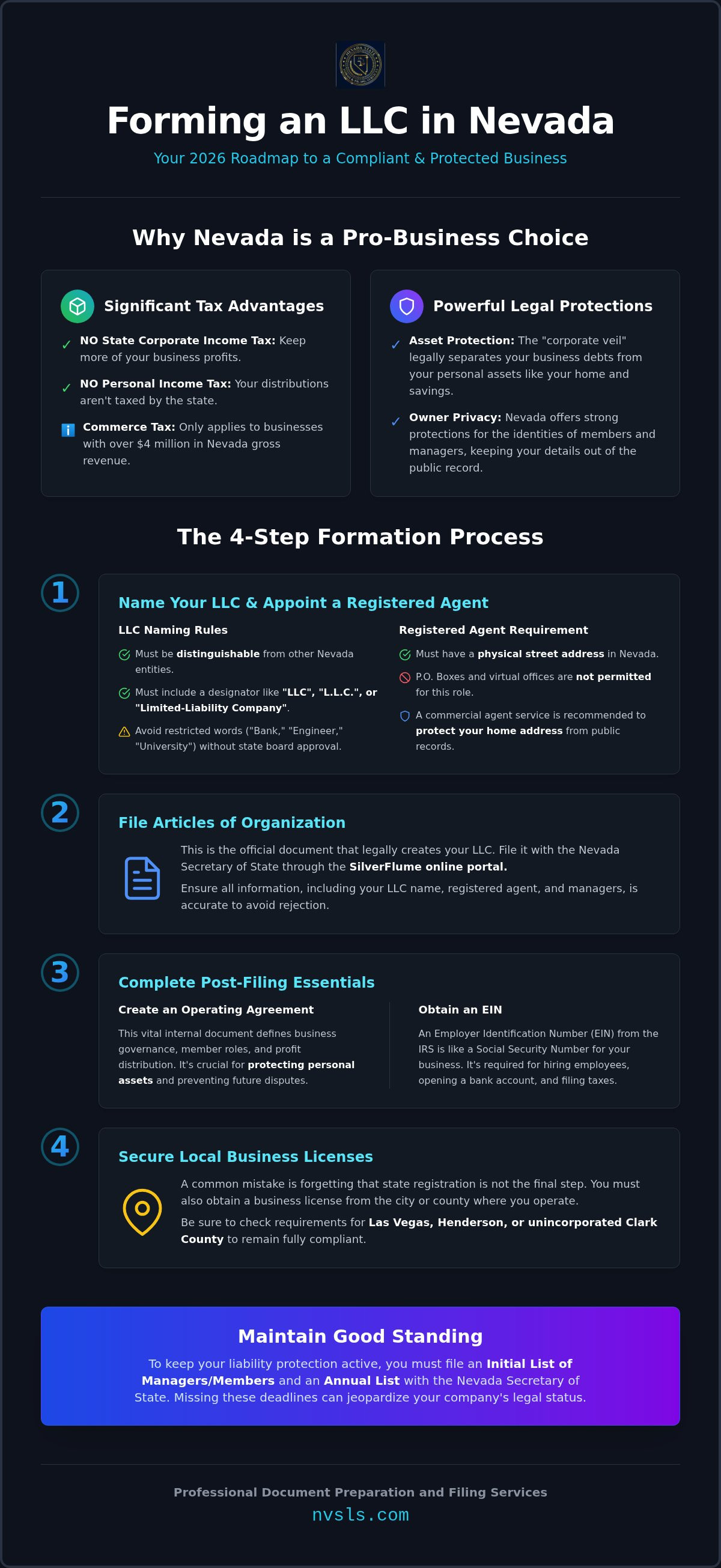
Step 3: Post-Filing Essentials—Operating Agreements and EINs
Once the Secretary of State returns your approved Articles of Organization, you might feel like the hard work is over. You aren't. While the state now recognizes your entity, you still need to define how it functions on a day-to-day basis. This is where the internal work begins. Truly understanding how to form an llc in nevada means looking beyond the state's digital portal and into your own internal record-keeping. You need an instruction manual for your business to ensure long-term protection.
The Nevada Operating Agreement
Under Nevada Revised Statute (NRS) 86.286, an Operating Agreement is not technically required to be filed with the Secretary of State. However, skipping this document is a significant risk. This internal contract defines ownership percentages and how profits are distributed among members. It also sets the rules for what happens if a member wants to leave or if the business needs to close. More importantly, it reinforces your "limited liability" status. In a legal dispute, a robust Operating Agreement proves that your LLC is a legitimate, separate entity rather than just a personal bank account. You should never rely on a generic internet template. Nevada has specific statutes regarding member-managed versus manager-managed entities, and your agreement must reflect these local nuances.
Obtaining Your Federal Tax ID (EIN)
Your next priority is visiting the IRS website to apply for an Employer Identification Number (EIN). This is essentially a social security number for your business. It is a free service, and you will typically receive the number immediately upon completing the online application. You need an EIN even if you are a single-member LLC with no plans to hire employees. This number is the primary link between your LLC and your business bank account. It allows you to pay federal taxes, apply for business credit, and hire staff when you are ready to grow.
You cannot open a business bank account without an EIN and your filed Articles of Organization. Banks are increasingly strict about documentation requirements. Most Nevada financial institutions will also demand to see your Operating Agreement to confirm who has the legal authority to sign for the company. Beyond banking, you must maintain a records book containing your formation documents and any major decisions. Even for one-person companies, keeping simple minutes of annual meetings reinforces your corporate veil. If you need help drafting these vital internal documents, we offer comprehensive business formation services to ensure your entity is legally sound from the inside out. Mastering how to form an llc in nevada requires this attention to detail to protect your personal assets for years to come.
Step 4: Local Licensing in Las Vegas, Henderson, and Clark County
Filing with the Secretary of State is only half the battle. Many new owners fall into the "Local License" trap. They assume their state business license is a green light to open their doors. In reality, Southern Nevada requires a separate municipal license for almost every business. If you are learning how to form an llc in nevada, you must understand that your city or county jurisdiction holds the final say on your operations. The state gives you the right to exist; the city gives you the right to trade.
Your first task is a jurisdictional check. Your physical business address determines which office you need to visit. You might be within the City of Las Vegas, the City of Henderson, or Unincorporated Clark County. These boundaries are often confusing. A Las Vegas mailing address doesn't always mean you are within city limits. Operating without a local municipal license can lead to heavy fines, forced closures, or legal citations from code enforcement officers.
City of Las Vegas and Henderson Requirements
The City of Las Vegas has its own specific application process. You must submit your state documents and pay a separate local fee based on your business type. If you are starting a home-based business in Henderson, prepare for extra scrutiny. Henderson has strict zoning laws for residential businesses to ensure you aren't disrupting your neighbors. For local signing needs, visit our Mobile Notary Las Vegas page to handle your paperwork on-site and ensure every signature is verified.
Clark County Multi-Jurisdictional License
If your business operates across multiple areas, you might qualify for a multi-jurisdictional license. This "one-stop" application covers Unincorporated Clark County and participating cities like Las Vegas and North Las Vegas. It simplifies the process, but you still must meet the specific requirements for each area. You generally have 30 days after starting operations to file these local applications. Missing this window often results in late penalties that can double your initial costs. Operating without a local municipal license puts your entire investment at risk before you even serve your first customer.
You also need to distinguish between a general and a regulated license. Most retail or consulting firms need a general license. If you deal with food, health services, or professional trades, you will need a regulated license. This requires additional inspections from the health department or fire marshal. Professional document preparation ensures you don't miss these local deadlines or jurisdictional nuances. Mastering how to form an llc in nevada means staying compliant at every level of government, not just the state capital.
Launch Your Nevada Business With Confidence
Starting a business in the Silver State is a strategic move for your financial future. You now have a clear roadmap covering everything from tax advantages to the critical jurisdictional checks for local licensing in Clark County. Understanding how to form an llc in nevada is the first step toward achieving true asset protection and professional growth.
Don't let the fear of a paperwork error or a missed deadline hold you back from your goals. We provide professional administrative filing support and local Las Vegas expertise to ensure your documents are precise and filed correctly the first time. You deserve affordable document preparation without the high cost of an attorney.
Let us handle your Nevada LLC document preparation today so you can focus on building your brand. Your new business entity is within reach, and we are here to help you manage the process with ease. You've got the vision; let's get the paperwork done right.
Frequently Asked Questions
How much does it cost to form an LLC in Nevada in 2026?
The total state filing fee for a Nevada LLC in 2026 is $425. This includes $75 for the Articles of Organization, $150 for the Initial List of Managers or Members, and $200 for the State Business License. These fees are paid at the time of formation. Keep in mind that local municipal licenses in cities like Las Vegas or Henderson will require additional separate fees based on your specific business activity.
How long does the Nevada LLC formation process take?
Standard online filings through the SilverFlume portal are typically processed within 1 to 2 business days. If you need your entity active sooner, Nevada offers expedited processing for an additional fee. You can choose 24-hour, 2-hour, or even 1-hour turnaround times. Paper filings submitted by mail take significantly longer, often stretching into several weeks. Most entrepreneurs prefer the speed and efficiency of the digital filing system to start operating quickly.
Do I need an attorney to form an LLC in Nevada?
No, you aren't legally required to hire an attorney to start your business. Many entrepreneurs choose professional document preparation services to manage the administrative filing process without the high cost of legal counsel. While we don't provide legal advice or representation, we specialize in ensuring your state and local paperwork is accurate and filed on time. This provides a cost-effective way to establish a compliant entity while avoiding common clerical mistakes.
What is the difference between an LLC and a Corporation in Nevada?
An LLC offers more management flexibility and fewer administrative formalities than a Corporation. In Nevada, LLCs are popular because they provide robust asset protection without the requirement for annual shareholder meetings or complex bylaws. Corporations have a rigid structure involving directors and officers, which is often better for companies planning to go public. For most small business owners, the LLC is the preferred choice due to its simplicity and tax advantages.
Do I have to live in Nevada to start a Nevada LLC?
You don't need to be a resident to start a business here. Anyone can learn how to form an llc in nevada from anywhere in the world. The only strict residency requirement is that your entity must maintain a Registered Agent with a physical street address in Nevada. This agent serves as your point of contact for legal service of process and official government correspondence, ensuring your business remains in good standing with the state.
What is an Annual List and when is it due for my LLC?
The Annual List is a mandatory filing that identifies your company's current managers or members. It is due by the last day of your anniversary month each year. If you formed your LLC on March 15th, your filing deadline is March 31st every following year. You must also renew your $200 State Business License at the same time. Staying on top of this schedule is the only way to avoid heavy late penalties and maintain compliance.
Can I change my Registered Agent after the LLC is formed?
Yes, you can update your Registered Agent at any time by filing a Statement of Change with the Secretary of State. This is a simple administrative process that requires a small filing fee. Many owners make this change after their first year to move away from using a home address. Switching to a professional commercial agent helps maintain your privacy and ensures that important legal notices are never missed or delivered to your private residence.
What happens if I forget to renew my Nevada State Business License?
Forgetting your renewal leads to immediate financial penalties and puts your entity at risk. The state charges a $100 late fee for the business license and a $75 late fee for the Annual List. If these aren't paid, your LLC status will eventually be revoked. This is why knowing how to form an llc in nevada involves more than just the initial setup; it requires a long-term commitment to tracking these critical annual state requirements.


