

You don't need to spend $5,000 on a retainer just to end a marriage that both of you already agree is over. For many Nevada couples, the biggest hurdle isn't a legal battle; it's the paperwork. If you want to move forward without high legal fees, learning how to file for divorce in Nevada without a lawyer is your most practical path. It's an efficient approach that puts you in control of your future and your finances.
We know the process feels intimidating. You're likely worried about documents being rejected due to a small error or feeling confused by the six-week residency requirement. It's a lot to manage during a major life transition. This guide replaces that stress with a clear plan. We'll show you how to navigate the Nevada court system with total confidence and precision.
We'll break down the exact steps for 2026. You'll learn about the difference between a Joint Petition and a Complaint, current filing fees in Clark County, and how to ensure your paperwork meets every court standard. By the end, you'll have a roadmap to a legally binding decree with minimal cost and zero guesswork.
Key Takeaways
- Understand the strict six-week residency requirement and why Nevada's "no-fault" status simplifies your eligibility.
- Learn exactly how to file for divorce in Nevada without a lawyer by choosing between a Joint Petition for total agreement or a Complaint for solo filings.
- Discover the essential steps for drafting documents and why professional mobile notary services are critical for valid, legally binding signatures.
- Identify the common administrative traps, such as formatting errors and missing signatures, that frequently cause Nevada courts to reject DIY filings.
- Explore how professional document preparation provides the accuracy of an expert guide without the high cost of a traditional law firm.
Understanding Nevada Divorce Eligibility and Residency
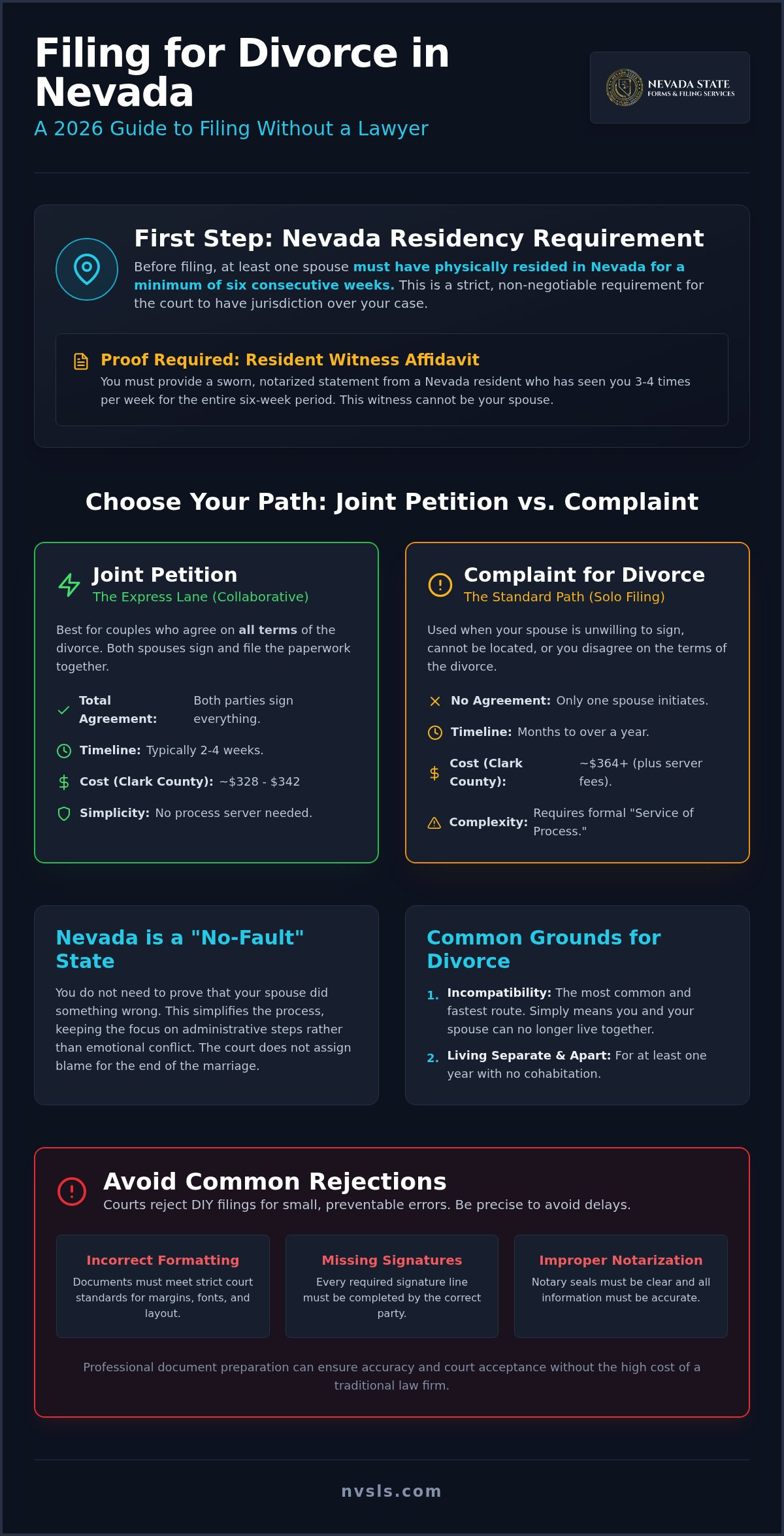
Before you download a single form, you must confirm you're eligible. Nevada has some of the most accessible laws in the country, but the court is strict about jurisdiction. If you're learning how to file for divorce in Nevada without a lawyer, your first task is proving you actually live here. At least one spouse must have resided in the state for a minimum of six weeks before the filing date. This isn't just a suggestion; it's a legal requirement that determines if the court has the power to sign your decree.
You also need to file in the correct venue. While you can file in any county where a spouse resides, many people choose Clark County. The Family Court in Las Vegas is well-equipped to handle administrative filings efficiently. You should also consider if you want a full divorce or legal separation. In Nevada, a decree of separate maintenance handles property and custody but keeps the marriage legally intact. If you want the right to remarry, a full divorce is your only option.
Nevada is a "no-fault" state. This means you don't have to prove your spouse did something wrong to end the marriage. This concept is a standard part of Divorce in the United States, but Nevada makes it particularly straightforward. You aren't airing dirty laundry in public records. You're simply stating the partnership is over. This lack of "fault" keeps the focus on the administrative steps rather than emotional conflict.
The Resident Witness Affidavit
You can't just tell the judge you've been here for six weeks. You need a third party to vouch for you. This is done through a Resident Witness Affidavit. This document is a sworn statement from someone who lives in Nevada and sees you at least 3 to 4 times every week. It's a foundational piece of your filing packet. Choosing the right witness is simple, but specific rules apply:
- The witness must be a current Nevada resident.
- They cannot be your spouse.
- They must have personal knowledge of your physical presence in the state for the full six weeks.
The witness must sign this affidavit in the presence of a notary public. If this signature isn't properly notarized, the court will reject your entire filing. Using a mobile notary service can make this step much easier for your witness, ensuring the document is executed correctly without them needing to travel to a bank or office.
Grounds for Divorce in 2026
In 2026, the most common ground cited in Nevada remains "incompatibility." It's a simple way of saying you can no longer live together as a married couple. There's no need for a trial to prove it. Another legal ground is "living separate and apart" for at least one year without cohabitation. Choosing your grounds is a vital part of how to file for divorce in Nevada without a lawyer because it dictates which specific forms you'll prepare. For most DIY filers, incompatibility is the fastest route to a final decree.
Joint Petition vs. Complaint: Which Path is Right for You?
Choosing your filing method is the most significant decision you'll make when learning how to file for divorce in Nevada without a lawyer. This choice depends entirely on whether your spouse is willing to sign the paperwork with you. In Nevada, you have two primary routes: the Joint Petition and the Complaint. One is a collaborative "express lane," while the other is a standard legal action taken by one person.
The timeline and cost differences are substantial. A Joint Petition is often finalized in as little as two to four weeks in Clark County. A Complaint, however, can take several months or even over a year if the other party contests the terms. Filing fees in 2026 also vary by method. A Joint Petition in Clark County costs approximately $328 for couples without children and $342 for those with children. Filing a Complaint is slightly more expensive, starting at approximately $364.
The Benefits of a Joint Petition
This is known as a "summary proceeding." It's designed for couples who agree on every single detail, from how to split the credit card debt to the specifics of a holiday visitation schedule. By Filing a Joint Petition, you completely bypass the "service of process" requirement. You don't need to hire a process server or wait for a response period.
The forms are simplified and designed for speed. Because both of you sign the documents under oath, the judge can often sign the final decree without requiring anyone to appear in a courtroom. It's the most private and least expensive way to end a marriage. If you want to ensure your agreement is drafted with total precision, using a professional for family law document drafting can prevent common administrative errors that stall these fast-track cases.
When a Complaint is Necessary
Sometimes, cooperation isn't possible. If your spouse refuses to sign the papers or if you cannot locate them, you must file a Complaint for Divorce. This starts a one-sided filing. After you file, you must issue a Summons. This is a formal court notice that must be hand-delivered to your spouse by a neutral third party.
Once served, your spouse has a specific window to file an Answer. If they ignore the Summons, you can eventually ask the court for a "Default." This allows the judge to grant the divorce based on your requested terms because the other party failed to participate. While this path involves more steps and higher costs, it's a reliable way to move forward when your spouse is uncooperative or unavailable.
The 4-Step Process to File for Divorce in Nevada
Filing for divorce is primarily an administrative task. If you and your spouse are in agreement, the process moves through the court system with predictable logic. Understanding how to file for divorce in Nevada without a lawyer requires you to follow a specific sequence of drafting, signing, and filing. Missing a single step can lead to a rejected application, but following this roadmap ensures your case stays on track.
The process begins with document preparation and ends when a judge signs your final decree. You must first ensure you meet the Nevada residency requirements before preparing your packet. Once residency is established, you'll move through four distinct phases: drafting, notarization, filing, and final submission.
Drafting Your Documents Accurately
Your divorce packet is a collection of several high-stakes forms. The most critical include the Joint Petition (or Complaint), the Decree of Divorce, and the Confidential Information Sheet. The Confidential Information Sheet is a mandatory document used by the court to track Social Security numbers and other sensitive data. If you have minor children, your paperwork must also include a detailed parenting plan and child support worksheets that comply with Nevada's statutory formulas.
Precision is your best friend during this stage. Every name must match your marriage certificate exactly, and every asset must be accounted for. The Decree of Divorce is the final order that legally ends the marriage. Because this document becomes the law of your post-divorce life, it must be drafted to clearly reflect your agreements on debt, property, and custody. Any ambiguity here can lead to future legal disputes that are far more expensive than the initial filing.
Executing and Filing Your Paperwork
Once your documents are drafted, they aren't legal until they are signed and notarized. This is where many DIY filers hit a logistical wall. Coordinating schedules between two spouses and a resident witness to meet at a bank or a shipping store is difficult. This is why mobile notary services are a game-changer for Nevada filings. A mobile notary comes to your home or office, ensuring every signature is verified and every seal is placed correctly on the first try. This convenience eliminates the risk of the clerk rejecting your papers due to an improper notarization.
After notarization, you must file your documents with the Clerk of the Court. In Clark County, most filings are now handled through an electronic system called eFileNV. You'll need to pay the filing fees at this time, which we've noted range from approximately $328 to $364 depending on your specific case type. If you cannot afford these fees, you can submit an Application to Proceed in Forma Pauperis to request a fee waiver. After the clerk processes your filing and assigns a case number, you'll submit your final Decree of Divorce to the judge's chambers for a signature. Once signed and filed by the clerk, your divorce is official.
Avoiding Common Paperwork Mistakes and Rejections
Nevada courts operate with zero margin for error. A single missing checkmark or a misspelled middle name can send your entire packet back to the start. When you're learning how to file for divorce in Nevada without a lawyer, you must act as your own quality control officer. Most rejections don't happen because of complex legal disagreements; they happen because of simple administrative oversights that are easily preventable.
The "Administrative Trap" is the most common reason for case delays. This includes missing signatures or improper notarization. Every signature must match the name printed on the form exactly. If your notary's seal is faint, blurry, or if their commission has expired, the clerk will reject the filing immediately. Inconsistency between your initial Petition and the final Decree is another major pitfall. If you list a specific retirement account in your initial filing but omit it from the final order, the judge cannot legally sign your decree. Even a simple typo in a Social Security number can lead to weeks of frustrating correspondence with the court clerk.
Property and Debt Distribution Errors
Nevada is a community property state. The court expects a clear, specific division of all assets and debts acquired during the marriage. Vague language like "we will split the credit cards" is a recipe for a rejected filing. You must list each debt specifically, including the last four digits of the account number and which spouse is responsible for the balance. Real estate requires even more precision. You cannot simply list a street address. You must include the full legal description and the Assessor’s Parcel Number (APN) to ensure the property division is legally sound and enforceable.
Child Support and Custody Pitfalls
If children are involved, the court’s scrutiny increases significantly. Nevada uses specific statutory formulas to calculate child support based on gross monthly income. If your math doesn't align with these state-mandated numbers, your paperwork will be flagged for correction. You must also include mandatory language regarding medical insurance coverage, dental care, and travel arrangements for visitation. Parenting plans must be granular and leave no room for interpretation. "Reasonable visitation" is far too vague for 2026 court standards. You need specific dates, times, and exchange locations to secure judge approval on the first attempt.
To avoid these costly delays and ensure your filing is court-ready, consider using professional Nevada divorce document preparation to handle the technical drafting and formatting for you.
How Professional Document Prep Simplifies Your Divorce
Ending a marriage is emotionally heavy. You shouldn't have to carry the weight of administrative perfection too. While you've learned how to file for divorce in Nevada without a lawyer, knowing the steps and executing them flawlessly are different challenges. Professional document preparation bridges this gap. It provides the precision of an expert without the high costs of a traditional law firm. You move from staring at confusing blank forms to holding a ready-to-file packet in just a few days.
Logistics often stall DIY filings. Finding a notary who understands Nevada family law documents and is available on your schedule is difficult. We solve this through integrated mobile notary services in Las Vegas and Henderson. We come to you. This ensures your signatures are executed correctly the first time. This service prevents the administrative trap of rejected filings due to improper seals or expired commissions. It’s about making a complex system work for you, not against you.
Why Choose Nevada State Forms & Filing Services?
We aren't a national template factory. We specialize in Nevada-specific family law document drafting. Our team has deep local expertise in Clark County filing procedures. We take a no-nonsense approach. We don't offer legal advice, but we do offer a clear path through the administrative maze. Our goal is to be your friendly expert guide. We reduce your anxiety by handling the technical formatting the court demands so you can focus on your future.
Next Steps for Your Uncontested Divorce
Getting started is straightforward. You don't need to spend weeks researching. First, gather your basic information. This includes marriage dates, property lists, and any existing agreements regarding children or debt. Once you have these details, we can begin drafting your specific forms. Accuracy is our priority, and efficiency is our promise.
Follow these steps to move forward:
- Collect your financial and residency information.
- Confirm your spouse is willing to sign for a Joint Petition.
- Identify any specific property or debts that need precise legal descriptions.
- Schedule your document intake with our team.
Ready to finalize your paperwork with confidence? Contact us for professional divorce document preparation in Nevada to ensure your filing is accurate, affordable, and ready for the judge's signature.
Take the Next Step Toward Your New Chapter
Ending a marriage is a significant transition, but the administrative process doesn't have to be a source of constant stress. You now have a clear understanding of how to file for divorce in Nevada without a lawyer. By meeting the six-week residency requirement and choosing the efficient Joint Petition path, you can save thousands in legal fees. The key is precision. Avoiding simple typos and ensuring your property descriptions are accurate will prevent the court from rejecting your filing and delaying your future.
We're here to help you cross the finish line with confidence. Our expert document preparation is tailored specifically to Nevada court requirements, providing an affordable alternative to high attorney fees. We even offer convenient mobile notary services throughout Las Vegas and Henderson to make your execution process seamless. Don't let paperwork stand in the way of your progress. Start your Nevada divorce paperwork with professional help today. You're ready to move forward, and we're ready to help you get it done correctly.
Frequently Asked Questions
Can I file for divorce in Nevada if we were married in another state?
Yes, you can file for divorce in Nevada regardless of where your marriage ceremony took place. Nevada courts only require that at least one spouse meets the state residency requirements. As long as you or your spouse has physically lived in the state for at least six weeks before filing, the court has the jurisdiction to end your marriage.
How long does a DIY divorce take in Nevada in 2026?
An uncontested divorce, filed as a Joint Petition, typically takes between two and four weeks to be finalized in 2026. This timeline depends on the current workload of the judge assigned to your case. If you file a Complaint for Divorce and must serve your spouse, the process can take several months; especially if your spouse contests the terms.
What are the current filing fees for divorce in Clark County?
Current 2026 filing fees in Clark County vary by the type of case you file. A Joint Petition for Divorce costs approximately $328 for couples without children and $342 for those with children. If you choose to file an individual Complaint for Divorce, the filing fee is approximately $364. These fees are paid directly to the Clerk of the Court.
Do I have to go to court if we both agree on the divorce?
No, you generally do not have to appear in front of a judge if you and your spouse agree on all terms. This is a primary advantage for those learning how to file for divorce in Nevada without a lawyer. When you submit a Joint Petition, the judge usually reviews the paperwork in chambers and signs the decree without requiring a hearing.
What is a "Resident Witness" and why do I need one?
A Resident Witness is a third party who signs an affidavit swearing that you have lived in Nevada for at least six weeks. The court requires this to prove it has the legal authority to grant your divorce. This witness must be a Nevada resident and their signature must be notarized to be accepted by the court clerk.
Can I change my name back to my maiden name during the divorce process?
Yes, Nevada law allows you to request the restoration of a former name as part of your divorce decree. You must include this request in your initial petition or complaint. This is the most efficient way to handle a name change. It avoids the extra cost and time of filing a separate petition after your divorce is already final.
What happens if I cannot find my spouse to serve them the papers?
If you cannot locate your spouse after a diligent search, you must ask the court for permission to serve them by publication. This involves running a legal notice in a local newspaper for a specific period. Once the publication period ends, you can move forward with the divorce. This process adds time and extra costs for the newspaper fees.
Is a document preparation service the same as a lawyer?
No, a document preparation service is an administrative partner, not a legal representative. We handle the technical drafting and formatting of your forms to ensure they meet court standards. While we provide a cost-effective path for those who know how to file for divorce in Nevada without a lawyer, we do not provide legal advice or represent you in a courtroom.


